
Catkin facts for kids

A catkin (also known as an ament) is a special type of flower cluster that grows on many trees and shrubs. Instead of having large, colorful petals like roses or sunflowers, a catkin consists of dozens or hundreds of tiny flowers arranged along a central stem. These drooping or upright spikes usually sway in the breeze, releasing clouds of pollen into the air.
Catkins are an essential part of nature's early spring awakening. Long before trees grow their summer leaves, catkins appear to take full advantage of seasonal breezes for wind pollination. They provide critical early-season food for hungry insects, birds, and small mammals.
Contents
What Is a Catkin and How Does It Work?
To understand what a catkin is, it helps to look at how botanists describe flowers. Most garden flowers are single blooms or wide clusters designed to attract pollinators like bees and butterflies. Catkins, however, are long, flexible cylinders packed with minimalist flowers that usually lack showy petals, sepals, or sweet scents.
Anatomy of a Catkin
Each catkin contains a central stem known as an inflorescence axis. Along this axis, many small individual flowers grow tightly grouped together.
- The flowers are typically single-sex (unisexual), meaning an individual flower holds only male parts or only female parts.
- Male catkins produce large amounts of lightweight pollen grains inside tiny organs called stamens.
- Female catkins feature sticky structures called pistils that catch airborne pollen grains.
- Tiny modified leaves called bracts sit beneath each tiny flower, shielding the delicate parts from harsh spring weather.
Wind Pollination and Anemophily
The scientific name for wind pollination is anemophily. Trees with catkins have evolved an efficient system that relies entirely on moving air currents rather than visiting insects.
- Because the tree does not need to attract animals, it does not waste energy making nectar, bright pigments, or sweet perfumes.
- The hanging, dangling shape of many catkins lets them swing freely in light gusts, shaking loose massive amounts of dust-like pollen.
- Female flowers expose feather-like surfaces that act like nets in the air to capture passing pollen grains.
- This wind-based system works best before deciduous trees grow their leaves, because dense foliage would block moving air currents and trap the airborne pollen.
Animal Pollinators and Early Spring Nectar
While most catkins rely on the wind, some species use both wind and insects. Willows (Salix) are famous for producing catkins that secrete nectar and give off sweet scents.
When honey bees, bumblebees, and early-emerging solitary bees wake up from winter hibernation, few plants are blooming. Willow catkins offer a vital survival feast of high-protein pollen and energy-rich nectar during cold months like March and April.
Common Trees with Catkins
Many familiar forest and landscape trees produce catkins. Scientists group these plants into several important families, including the birch family (Betulaceae), the beech and oak family (Fagaceae), the willow family (Salicaceae), and the walnut family (Juglandaceae).
Hazel and Alder

Hazel (Corylus) and alder (Alnus) are among the earliest bloomers in temperate regions across Europe, Asia, and North America.
- Hazel: Hazel trees form long, golden-yellow male catkins that hang down like lambs' tails in late winter. The female flowers on the same twig are not catkins; instead, they look like tiny green buds topped with bright red, thread-like styles.
- Alder: Alder trees produce both male and female catkins. The female catkins harden into woody structures that look like miniature pinecones after pollination, protecting the developing seeds throughout the winter.
Birches and Willows

Birch (Betula) and willow (Salix) trees are widespread across the Northern Hemisphere and display prominent catkins every spring.
- Birch: Silver birches and paper birches produce drooping male catkins in pairs or clusters of three at the ends of twigs. Their female catkins stand upright at first, turning into papery seed cones that break apart in autumn winds.
- Willow: Willows are known for soft, fuzzy buds that open in late winter. Male willow catkins burst into bright yellow flowers coated with pollen, while female willow catkins turn green and develop cottony seeds that float across waterways.
Oaks, Poplars, and Chestnuts
- Oak (Quercus): In mid-to-late spring, oak trees produce delicate, drooping male catkins alongside their expanding young leaves. Female oak flowers sit nestled in leaf joints and eventually mature into acorns.
- Poplar and Aspen (Populus): Poplars produce long, soft catkins before leafing out. Poplar trees carry male and female catkins on separate trees, meaning an entire tree is either male or female.
- Sweet Chestnut (Castanea): Blooming later in summer, sweet chestnuts produce long, creamy-white upright catkins that emit a strong scent to attract beetles and bees alongside wind pollination.
Seasonal Blooming Schedule
The exact time catkins appear depends on local weather, geographic latitude, and temperature patterns.
| Plant Type | Scientific Name | Typical Flowering Window | Pollination Method |
|---|---|---|---|
| Hazel | Corylus avellana | January – March | Wind |
| Alder | Alnus glutinosa | February – March | Wind |
| Pussy Willow | Salix caprea | March – April | Insects & Wind |
| Silver Birch | Betula pendula | March – May | Wind |
| White Oak | Quercus alba | April – May | Wind |
| White Poplar | Populus alba | March – April | Wind |
| Sweet Chestnut | Castanea sativa | June – July | Insects & Wind |
In milder maritime climates like the British Isles and western Europe, hazel catkins can start elongating as early as December or January. In colder continental zones, blooming is delayed until the ground thaws in early spring.
Plant Reproduction and Life Cycle
Catkins play an essential role in the plant reproduction cycle of many forest canopies.
Pollen Dispersal and Fertilization
The life cycle of a catkin-bearing tree follows a clear seasonal pattern:
- Catkin Formation: The tree begins forming catkin buds during the previous summer and autumn, protecting them through winter with tough scales.
- Elongation: As temperatures warm in late winter or early spring, male catkins absorb water, swell, and stretch out, exposing millions of pollen grains.
- Dispersal: Gusts of wind shake the male catkins, releasing fine clouds of pollen.
- Fertilization: Carried by air currents, pollen grains land on the sticky stigmas of receptive female flowers, fertilizing the ovules inside.
- Seed Development: Once fertilized, the male catkins wither, dry up, and drop to the ground. The female structures remain on the tree, developing into seeds, nuts, or winged fruits (samaras).
Monoecious vs. Dioecious Trees
Botanists classify catkin-bearing trees into two main reproductive categories:
- Monoecious Plants: Both male and female flowers grow on the same individual tree. Examples include oaks, birches, hazels, and alders. This ensures every individual tree can produce seeds while cross-pollinating with neighbors.
- Dioecious Plants: Male and female flowers grow on completely separate trees. Examples include willows and poplars. A male willow tree only produces pollen catkins, while a female willow tree produces seed-bearing catkins.
Evolutionary History and Adaptations
For many years, 19th-century and 20th-century botanists believed that all trees bearing catkins belonged to a single evolutionary branch called the Amentiferae (or Hamamelididae). They thought catkins represented a primitive, early stage of flower evolution.
Discovery of Convergent Evolution
Modern scientific research using molecular phylogeny (comparing plant DNA) disproved the old grouping. Botanists discovered that catkins are not a primitive trait shared by one single ancient ancestor.
Instead, catkins arose multiple times independently in different plant lineages through a process called convergent evolution. Unrelated plant families developed matching catkin structures because wind-pollinated cylinders work exceptionally well in temperate and boreal forest ecosystems.
Adaptations for Survival
Trees with catkins developed remarkable physical adaptations:
- Cold Resistance: Many catkins survive freezing early-spring nights without damage thanks to protective hairs and natural plant sugars that act like antifreeze.
- Aerodynamic Pollen: The pollen grains are tiny, light, and dry, allowing them to stay suspended in air currents for kilometers.
- Non-Wetted Surfaces: Catkins shed rain quickly so water droplets do not weigh them down or ruin the dry pollen.
Ecological Importance of Catkins
Catkins are vital components of forest ecosystems, supporting a wide range of wildlife during difficult times of the year.
- Early Food for Pollinators: In February and March, blooming willows and hazels provide queen bumblebees with the nectar and protein they need to establish new colonies.
- Nesting Materials: Songbirds gather the soft down from female willow and poplar catkins to insulate their nests against spring chills.
- Food for Birds and Mammals: Finches, siskins, and grouse feed on tree catkins throughout late winter when other food sources are buried under snow.
- Soil Enrichment: Millions of dropped male catkins decompose rapidly on the forest floor, cycling nitrogen and minerals back into the soil.
Etymology

The word catkin entered the English language as a loanword from the Middle Dutch word katteken, which means "kitten" or "little cat."
- People gave the plant structure this name because the soft, fuzzy appearance of young willow catkins closely resembles the furry tail of a small kitten.
- In German, catkins are similarly called Kätzchen ("little kittens").
- The alternative botanical name, ament, comes directly from the Latin word amentum, meaning a "strap" or "thong," describing the long, hanging strap-like shape of mature catkins.
Summary of Key Facts
- A catkin is a dense, slender spike of reduced flowers lacking bright petals.
- Most catkins are adapted for wind pollination (anemophily) before spring leaves emerge.
- Common catkin-bearing trees include hazel, birch, alder, willow, oak, and poplar.
- Trees can be monoecious (both sexes on one tree) or dioecious (separate male and female trees).
- Catkins evolved independently in multiple plant families through convergent evolution.
- The name "catkin" comes from the Dutch word for kitten, describing the soft, furry look of young flower clusters.
Gallery
-
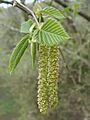
Male catkins of hop-hornbeam (Ostrya carpinifolia)
-
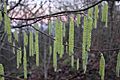
Young male catkins of hazel (Corylus avellana)
-
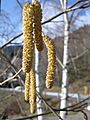
Mature male catkins of hazel (Corylus avellana)


