
Cercopoidea facts for kids
Quick facts for kids Froghopper |
|
|---|---|
 |
|
| Prosapia bicincta | |
Scientific classification  |
|
| Kingdom: | Animalia |
| Phylum: | Arthropoda |
| Class: | Insecta |
| Order: | Hemiptera |
| Suborder: | Auchenorrhyncha |
| Superfamily: | Cercopoidea Leach, 1815 |
| Families | |
|
|

Froghoppers are tiny, fascinating insects found in gardens, meadows, and forests all over the world. They belong to a large scientific group called the superfamily Cercopoidea. While the grown-up insects are famous for their world-record jumping abilities, their young are known for something completely different: making white, bubbly foam nests on plant stems.
Because of these distinct stages of life, these creatures go by two popular names. People call the bouncy adults "froghoppers" because their wide faces look a bit like tiny frogs and they are incredible jumpers. Meanwhile, the wingless young are called spittlebugs because their bubbly homes look like drops of white foam or spit.
Froghoppers are true bugs belonging to the order Hemiptera. They have specialized piercing mouthparts that work like tiny drinking straws to drink plant fluids. They play important roles in outdoor ecosystems, serving as food for birds and spiders, while also showing off some of the most unusual survival tricks in the animal kingdom.
Contents
- What Are Froghoppers and Spittlebugs?
- The Amazing World of Spittlebug Nymphs
- Incredible Jumping Power of Adult Froghoppers
- Diet and the Mystery of Xylem Sap
- Life Cycle and Reproduction
- Anatomy and Appearance
- Classification and Major Families
- Evolutionary History and Fossils
- Ecological Importance and Agriculture
- Fast Facts About Froghoppers
- Related Topics
What Are Froghoppers and Spittlebugs?
Froghoppers are small insects that usually measure between 0.2 and 0.8 inches (5 to 20 millimeters) long. They come in many different patterns, ranging from dull green and bark-like brown to bright red and black.
Even though they look quiet when resting on a leaf, adult froghoppers are the ultimate jumping champions of the insect world. A single froghopper can launch itself higher into the air relative to its body size than almost any other creature on Earth, including a flea.
The Superfamily Cercopoidea
In scientific classification, froghoppers make up the superfamily Cercopoidea. This group contains over 3,000 known species divided into several smaller families.
All froghoppers share a few key features that set them apart from their close cousins, such as leafhoppers, treehoppers, and cicadas. Their strong hind legs have a few sturdy spines and a ring of tiny teeth at the tips, which give them a firm grip before they jump.
Where Do Froghoppers Live?
Froghoppers live on nearly every continent except Antarctica. They thrive in environments where green plants grow, including:
- Grassy meadows and open pastures
- Backyard gardens and city parks
- Roadside ditches and wild fields
- Tropical rainforests and temperate woodlands
Because their survival depends entirely on drinking sap from living plants, they are most active during the spring and summer months when plants are full of circulating fluids.
The Amazing World of Spittlebug Nymphs
The most famous part of a froghopper's life is its youth. Young froghoppers are called nymphs. Unlike the strong, winged adults, nymphs are soft, delicate, and completely wingless. To protect themselves, they construct remarkable bubble fortresses.
What Is the Bubbly Foam?
If you walk through a field in late spring, you will probably spot clumps of white, frothy bubbles clinging to plant stems. In old folklore, people called this substance "cuckoo spit," "frog spit," or "snake spit" because they thought birds or reptiles left it behind.
In reality, the foam is produced entirely by baby spittlebugs. The nymph drinks sap from the plant and passes excess fluid out of its body. It then uses special valves on its belly to pump air into the liquid, whipping it into a stable, long-lasting lather of tiny bubbles.
-
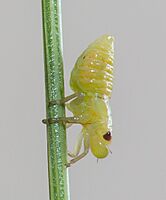
Spittlebug nymph
-
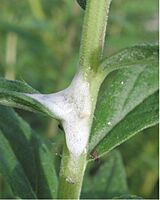
Spittlebug nymph surrounded by foam for protection and moisture
,_East_Lyn_River,_Devon,_UK_-_Diliff.jpg)

Why Do Spittlebugs Make Foam?
The white bubble nest is not just for decoration; it is a life-saving survival shelter. It serves several vital purposes:
- Predator Protection: The thick mass of bubbles hides the soft nymph from hungry birds, ladybugs, and spiders. Most predators avoid sticking their faces into the slimy, bitter foam.
- Moisture Shield: Spittlebug nymphs have very thin skin and dry out quickly in the sun and wind. The wet foam keeps them moist and humid at all times.
- Temperature Control: The foam acts like natural insulation, keeping the nymph cool on hot afternoons and warm during chilly nights.
- Chemical Defense: The bubbles contain bitter plant compounds that taste terrible to any animal trying to eat the nymph.
How Does the Nymph Breathe Inside Foam?
Living completely submerged inside a ball of wet bubbles presents a challenge: how does the insect get oxygen?
Spittlebug nymphs have evolved a clever solution. They have a specialized breathing channel along their abdomen. The nymph reaches the tip of its tail outside the bubble mass, grabs a tiny pocket of fresh air, and pulls it back into its breathing tubes, allowing it to stay safe inside its bubbly fortress without drowning.
Tube Spittlebugs: An Unusual Exception
While almost all spittlebug nymphs live inside foam nests, one unique family called the Machaerotidae does something different. Known as tube spittlebugs, these tropical nymphs build hard, calcium-rich tubes on tree branches.
The tube looks like a tiny snail shell or mineral horn. The nymph lives safely inside this rigid shelter while drinking plant sap, showing that different froghoppers have evolved creative ways to build protective homes.
Incredible Jumping Power of Adult Froghoppers
When the nymph finishes growing, it crawls out of its bubble home, sheds its outer skin for the last time, and emerges as a fully winged adult. That is when its jumping superpower appears.
The World Record Jumpers
Scientists have studied froghopper jumping mechanics using high-speed cameras. The results are astounding:
- A froghopper can jump up to 28 inches (70 centimeters) straight up into the air.
- Relative to body size, this is like a human jumping over a skyscraper taller than the Empire State Building.
- Froghoppers can leap over 100 times their own body length in a single bound.
The Physics Behind the Leap
Froghoppers do not use regular muscle contractions to jump because muscles cannot move fast enough to produce that much power. Instead, they use a biological catapult system:
- Natural Springs: Inside the insect's thorax is a tough, elastic protein pad called resilin. The froghopper slowly tightens its muscles to bend this protein pad, storing huge amounts of mechanical energy like a drawn archer's bow.
- Catch-and-Release Clamps: Tiny internal latches lock the hind legs in place while the energy builds up.
- Instant Release: When the froghopper lets go of the latches, all the stored energy explodes in less than one millisecond, propelling the bug into the sky at incredible speed.
- Extreme G-Forces: During takeoff, the froghopper experiences an acceleration of 4,000 meters per square second. This creates a force of over 400 times Earth's gravity (400 Gs). For comparison, human fighter pilots usually black out at around 9 Gs.
Diet and the Mystery of Xylem Sap
Froghoppers are pure vegetarians, but they have one of the most unusual diets in the natural world.
Phloem vs. Xylem Sap
Plants transport two different kinds of fluids:
- Phloem Sap: This fluid carries rich sugars made during photosynthesis down from the leaves. Most sap-sucking insects, such as aphids, feed on phloem sap because it is packed with energy.
- Xylem Sap: This watery fluid carries minerals upward from the roots to the leaves. It contains very little sugar and is over 99 percent water.
Froghoppers choose to feed on xylem sap. Because xylem sap has almost no nutritional value, a froghopper must drink huge quantities of liquid every day just to get enough food. A single spittlebug nymph can drink up to 300 times its own body weight in xylem fluid within 24 hours.
Symbiotic Bacteria Partners
How can an animal survive on a diet made mostly of watery mineral fluids? Froghoppers rely on tiny partners living inside their bodies.
Special symbiotic bacteria reside within the insect's digestive tract. These friendly microbes take the simple minerals from the xylem fluid and synthesize essential amino acids and vitamins for the froghopper. In exchange, the insect provides the bacteria with a safe home and a constant supply of moisture.
Life Cycle and Reproduction
The life cycle of a froghopper is an example of incomplete metamorphosis, which includes three main stages: egg, nymph, and adult.
The Egg Stage
In late summer or autumn, adult female froghoppers use a sharp egg-laying tube to insert eggs into plant stems, leaf sheaths, or soil cracks. The eggs are tough and well-protected, allowing them to survive freezing winter temperatures beneath the snow.
The Growing Nymph
When spring arrives and fresh plant shoots begin to grow, the tiny nymphs hatch from the eggs. A newborn nymph immediately crawls to a tender green stem, pierces the plant tissue, starts drinking xylem fluid, and builds its first tiny bubble nest.
As the nymph grows, it molts (sheds its hard exoskeleton) four to five times. With each molt, it grows larger, develops tiny wing pads, and adds more bubbles to its foam shelter. This nymph stage lasts between one and two months.
The Adult Stage
Once fully grown, the nymph climbs near the edge of the foam mass, dries off, and sheds its skin one final time to emerge as an adult with fully formed wings.
Adult froghoppers live for several months during the summer. Their main tasks are jumping to fresh feeding grounds, finding mates, and laying eggs for the next generation before the cold weather returns.
Anatomy and Appearance
Froghoppers share several distinctive physical features that help them survive and feed.
Body Structure
Like all insects, the froghopper's body is divided into three main sections:
- Head: Features two large compound eyes, short antenna bristles, and a piercing beak called a rostrum that folds underneath the body when not in use.
- Thorax: The middle section houses powerful jumping mechanisms, two pairs of wings, and six legs.
- Abdomen: The rear section contains digestive organs, breathing tubes, and the egg-laying structures in females.
Clever Defense Mechanisms
Adult froghoppers face threats from birds, lizards, and predatory insects. To stay alive, different species use clever defenses:
- Aposematic Coloration: Some species, like the two-lined spittlebug, display bright red, orange, or yellow markings against dark black bodies. These vivid patterns warn predators that the insect tastes foul.
- Reflex Bleeding: When grabbed by a bird, some froghoppers can push drops of bitter, distasteful body fluid out of their foot joints, encouraging the predator to drop them.
- False Heads: Members of the family Clastopteridae have patterns on the rear tips of their wings that look like eyes and antennae. A confused predator often attacks the tail instead of the head, giving the froghopper a chance to jump away safely.
Classification and Major Families
Scientists organize froghoppers into several major family groups based on their physical traits and evolutionary history.
The Main Families
- Aphrophoridae: Known as common spittlebugs, this family includes many species found in gardens and fields throughout Europe, North America, and Asia.
- Cercopidae: Often called froghoppers, these species are common in warmer climates and are known for their bright red, orange, and black warning colors.
- Clastopteridae: Known as tree spittlebugs, these small, rounded bugs often live on trees and bushes and have wings shaped to look like false heads.
- Ischnorhinidae: A family of colorful Neotropical froghoppers found in Central and South America.
- Machaerotidae: The tube-building spittlebugs of tropical Asia and Africa, whose nymphs live in hard mineral shells instead of foam.
Evolutionary History and Fossils
Froghoppers are an ancient group of insects with a fossil record stretching back over 180 million years to the Early Jurassic period, when dinosaurs walked the Earth.
Ancient Relatives
Paleontologists have uncovered well-preserved fossil froghoppers in rock formations across China, Brazil, and Europe. Two notable extinct families include:
- Procercopidae: Primitive ancestral froghoppers from the Jurassic and Cretaceous periods that possessed early versions of the jumping leg structures seen today.
- Sinoalidae: A diverse group of ancient Mesozoic froghoppers known from fossil beds in Asia, showing broad wings and sturdy bodies.
These ancient fossils show that the specialized mouthparts for drinking plant sap and the powerful legs for jumping developed early in the group's evolutionary history.
Ecological Importance and Agriculture
Froghoppers play balanced roles in outdoor habitats, serving both as interesting wildlife and, in some cases, challenging farm pests.
Role in the Ecosystem
In natural meadows and forests, froghoppers are a standard part of the food web:
- They recycle plant moisture and minerals back into the environment.
- Adults provide nutritious meals for insect-eating birds, frogs, and jumping spiders.
- Their presence supports healthy biodiversity in wild grasslands.
Agricultural Impact
While most spittlebugs cause minimal harm to garden plants, a few species can cause problems in agriculture:
- Pasture Damage: In tropical regions, large swarms of pasture froghoppers drink sap from grasses, turning fields brown and reducing food for grazing livestock.
- Sugar Cane and Crops: Some species feed on crops like sugar cane, corn, and fruit orchards, injecting saliva that can cause leaves to turn yellow.
- Disease Carriers: Like leafhoppers, certain froghoppers can accidentally carry plant microbes from one tree to another while feeding, making them an important focus of study for agricultural scientists.
Farmers use environmentally friendly strategies to manage pest species, including encouraging natural predators like beneficial wasps, planting resistant crop varieties, and keeping pastures properly managed.
Fast Facts About Froghoppers
- Nature's Springboard: A froghopper can launch itself into the air with an initial speed of over 9 miles per hour (14.5 kilometers per hour) in less than a millisecond.
- Bubble Mixers: The foam produced by spittlebugs is so stable that it does not wash away easily in normal rain showers.
- Ancient Jumpers: Froghopper ancestors were hopping around primitive plants long before flowering plants and modern trees existed.
- High Pressure Drinkers: Froghoppers have muscular pumping chambers inside their heads to suck sap out of xylem tubes, which are under negative pressure like a stretched rubber band.
- Colorful Warnings: Bright black-and-red froghoppers taste so bitter that birds quickly learn to avoid catching anything with similar colors.
Related Topics
