
Chestnut-banded plover facts for kids
Quick facts for kids Chestnut-banded plover |
|
|---|---|
 |
|
| Conservation status | |
Scientific classification  |
|
| Kingdom: | Animalia |
| Phylum: | Chordata |
| Class: | Aves |
| Order: | Charadriiformes |
| Family: | Charadriidae |
| Genus: | Anarhynchus |
| Species: |
A. pallidus
|
| Binomial name | |
| Anarhynchus pallidus (Strickland, 1853)
|
|
| Script error: The function "autoWithCaption" does not exist. | |

Script error: No such module "Check for conflicting parameters".
The chestnut-banded plover (Anarhynchus pallidus) is a small, special bird that belongs to the plover family. These birds live in Southern Africa. Even though they are found across a large area, they only live in specific small places within that area.
Contents
What Does It Look Like?
This plover is about 15 cm (6 inches) tall. It has long, dark legs and a black bill. Its face has black stripes near its eyes and bill. The forehead, throat, and belly are white. A pretty chestnut-colored band crosses its chest. Another band of the same color is on its head. Its back and the top of its head are greyish-brown.
How Does It Behave?
The chestnut-banded plover moves around a lot, but scientists don't fully understand all its travels. It's thought to be a "partial migrant." This means some birds move to different places, while others stay put.
Daily Life of a Plover
The number of chestnut-banded plovers in one place can change each year. For example, if there's a drought where they usually breed, fewer birds might be seen. They usually breed when it rains.
These birds are often seen in pairs or small groups. During breeding season, pairs protect their own areas. When it's not breeding season, they can gather in very large groups. Once, 375 birds were seen together in Namibia! They sometimes look for food in groups of up to 60 birds. They might even rest with other types of plovers.
Plovers in Different Countries
South Africa
Plovers living near the coast in South Africa usually stay in one place. They breed during two main times: from March to May and from September to January.
Namibia
In Namibia, some coastal birds fly inland to breed. After breeding, some inland birds join the coastal groups. If there's a drought, the birds stay near the coast.
It's not totally clear when Namibian plovers breed. Some reports suggest it could be between January and June. Other experts say it's from March to October.
African Great Lakes
In Kenya and Tanzania, near the African Great Lakes, these plovers breed between March and October. They travel up and down the Rift Valley. The most birds are seen at Lake Manyara from July to September. Sometimes, birds are seen outside their usual areas, which suggests they might be nomadic, meaning they wander without a fixed home.
Where Does It Live?
This bird mostly lives near salty or alkaline water, like places with lots of salt.
Where Are They Found?
The chestnut-banded plover has two main groups. One group is found in Angola, Botswana, Kenya, Mozambique, Namibia, South Africa, Tanzania, Zambia, and Zimbabwe. The other group, called venustus, lives only in the Rift Valley in Kenya and Tanzania. Scientists have found that these two groups are quite different genetically.
Because this bird lives in fewer than ten places during the non-breeding season, and its habitat is shrinking, it is listed as "Near Threatened" by the IUCN Red List. This means it could become endangered if things don't change.
How Many Plovers Are There?
There are about 17,500 chestnut-banded plovers in the world. During the non-breeding season, places like Walvis Bay and Sandwich Harbour in Namibia, and Lake Natron in Tanzania, can hold 87% of all the plovers in the world!
Breeding Homes
These birds build their nests in salty or alkaline wetlands. This includes inland salt pans and even man-made salt ponds. Near the coast, they live around lagoons and salt marshes. They like areas with no plants and usually stay within 50 meters (about 164 feet) of the water.
Their nest is a simple, round scrape in the ground. It's about 5 cm (2 inches) wide and 1 cm (0.4 inches) deep. They make it in dry mud, stony ground, or soil with lots of lime.
Non-Breeding Homes
When it's not breeding season, the chestnut-banded plover spends more time in its coastal homes. They can be found up to 1 km (0.6 miles) away from the water during this time.
What Do They Eat?
Scientists don't know exactly what the chestnut-banded plover eats. But they believe it eats insect larvae and small crustaceans, which are tiny water animals like shrimp.
What Threats Do They Face?
Two important places for these birds are facing problems because of human activities.
Walvis Bay
Walvis Bay in Namibia is a top spot for these plovers. However, it faces pollution from Namibia's largest port. This pollution includes fish oils and other waste from ships. The area is also getting filled with silt from a salt works nearby.
Lake Natron
Lake Natron in Tanzania is a tough place to live because of its climate. But it might get even less water in the future. This would greatly shrink the plover's habitat.
A project to water crops using the Ewaso-Ng'iro River and a factory that takes soda from the lake threaten to use up much of the water that flows into the lake.
How Are They Protected?
The three most important places for the chestnut-banded plover are protected by the Ramsar Convention. This means they are recognized as important wetlands. They are also named Important Bird Areas. Sandwich Harbour is also a National Park, and Lake Natron is a game controlled area, which helps protect the wildlife there.
Images for kids
-
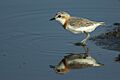
A chestnut-banded plover standing near water.
