
Conus muriculatus facts for kids
Quick facts for kids Conus muriculatus |
|
|---|---|
 |
|
| Apertural view of Conus muriculatus | |
| Conservation status | |
Scientific classification  |
|
| Kingdom: | Animalia |
| Phylum: | Mollusca |
| Class: | Gastropoda |
| Subclass: | Caenogastropoda |
| Order: | Neogastropoda |
| Superfamily: | Conoidea |
| Family: | Conidae |
| Genus: | Conus |
| Species: |
C. muriculatus
|
| Binomial name | |
| Conus muriculatus G. B. Sowerby I, 1833
|
|
| Script error: The function "autoWithCaption" does not exist. | |
| Synonyms | |
|
|

Script error: No such module "Check for conflicting parameters".
Conus muriculatus, also known as the muricate cone, is a type of sea snail. It's a marine gastropod mollusk that belongs to the Conidae family, which are often called cone snails.
Like all cone snails, these snails are predatory (they hunt other animals for food) and venomous (they can inject venom). Because of their venom, it's very important to be careful and avoid touching them if you ever see one alive. They can "sting" humans, so it's best not to handle them at all.
Contents
What Does the Muricate Cone Snail Look Like?
The shell of an adult muricate cone snail can be anywhere from 15 mm to 50 mm long. That's about the size of a small button to a golf ball.
Shell Shape and Texture
This snail has a strong shell with straight sides. It has a short, cone-shaped spire at the top. The "shoulder" of the shell is sharply angled and has small bumps, called tubercles. The main part of the shell, called the body whorl, has strong grooves near its bottom. It is also covered all over with lines of tiny granules, which feel like small bumps.
Shell Color and Pattern
The shell is usually white. It might have a slight violet tint near the bottom. You can also see two wide, irregular bands of light chestnut or yellowish-brown color. These bands might not be very clear.
Where Do Muricate Cone Snails Live?
You can find Conus muriculatus in many parts of the world's oceans.
Indian and Pacific Ocean Homes
These snails live in the Indian Ocean near Madagascar and the Mascarene Basin. They also live all the way to Western Australia. In the Pacific Ocean, they are found from Japan down to New Caledonia, Fiji, the Solomon Islands, Tonga, Vanuatu, and French Polynesia. They are also found off the coast of Australia, specifically in New South Wales and Queensland.
Gallery
-
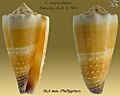
Conus muriculatus Sowerby, G.B. I, 1833
-
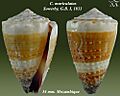
Conus muriculatus Sowerby, G.B. I, 1833


