
Dentistry facts for kids

A dentist treats a patient with the help of a dental assistant.
|
|
| Occupation | |
|---|---|
| Names |
|
| Profession | |
|
Activity sectors
|
Health care, anatomy, physiology, pathology, medicine, pharmacology, surgery |
| Description | |
| Competencies |
|
|
Education required
|
Dental degree |
|
Fields of
employment |
|
|
Related jobs
|
|

Dentistry is a special part of medicine that focuses on your teeth, gums, and mouth. It involves studying, finding problems, preventing, and treating diseases or conditions in your mouth. Most often, dentists focus on your dentition (how your teeth grow and are arranged) and the lining of your mouth. Dentistry can also include other parts of your face and jaw, like the joint that connects your jaw to your skull. The person who practices dentistry is called a dentist.
The history of dentistry is very old, almost as old as human civilization itself! The earliest signs of dental care date back thousands of years. Dentistry was one of the first areas in medicine to become its own special field. It now has its own degrees and many different specializations.
A team of dental professionals usually performs dental treatments. This team often includes a dentist and other helpers like dental assistants, dental hygienists, and dental technicians. Most dentists work in private offices, dental hospitals, or other healthcare places.
Modern dentistry uses scientific research to guide decisions. This means dentists use the best available information to help you. They use this knowledge to prevent and treat common mouth problems like tooth decay and gum disease. They also understand how your mouth health can affect your overall body health.
Contents
What Does the Word "Dentistry" Mean?
The word "dentistry" comes from "dentist." This word comes from the French word "dentiste," which means "tooth doctor." It's related to the French and Latin words for "tooth." The scientific study of teeth is called odontology. This word comes from a Greek word meaning "tooth." Odontology is all about the structure, growth, and problems of teeth.
Common Dental Treatments
Dentistry mainly deals with problems in your mouth. The World Health Organization says that mouth diseases are a big health problem worldwide. They affect many people, especially those who have fewer resources.
Most dental treatments aim to prevent or fix the two most common mouth diseases: dental caries (which are cavities or tooth decay) and periodontal disease (which is gum disease). Common treatments include fixing teeth (like with fillings), removing teeth, deep cleaning of gums, and root canal treatments. Some dentists also do cosmetic dentistry to improve how your smile looks.
Dentists are trained to do many different treatments. They can place fillings, crowns, and bridges. They can also create dentures (false teeth) and perform root canal therapy. Dentists also treat gum problems and remove teeth. They perform exams, take X-rays, and figure out what's wrong. Dentists can also prescribe medicines like antibiotics to fight infections or sedatives to help patients relax. Sometimes, general dentists need extra training for certain procedures like sedation or dental implants.
Dentists also teach you how to prevent mouth diseases. They encourage good hygiene (like brushing and flossing) and regular checkups. These checkups allow for professional cleaning and evaluation. Infections or swelling in your mouth can affect your overall health. Sometimes, problems in your mouth can even show signs of other health conditions in your body. Many studies show that gum disease can be linked to other health issues. This idea, that your mouth health affects your whole body, is called "oral-systemic health."
Becoming a Dentist


To become a dentist, you need a lot of education and training! The world's first dental school was started by John M. Harris in Bainbridge, Ohio, in 1828. This helped make dentistry a recognized health profession. The first dental college, Baltimore College of Dental Surgery, opened in Baltimore, Maryland, in 1840.
In many countries, dentists study for five to eight years after high school. After getting their dental degree, many dentists choose to do an internship or residency. This helps them focus on specific areas of dental care. In North America (the US and Canada), dental degrees are often called Doctor of Dental Surgery (DDS) or Doctor of Dental Medicine (DMD). In the UK and other countries, degrees like Bachelor of Dental Surgery (BDS) are common.
In the United States, almost all dentists complete a bachelor's degree first. Then, they go to dental school for four years to earn their DDS or DMD degree. After that, some dentists choose to specialize even further. There are many different specialties in dentistry, like working with children or doing surgery.
Dentists also need to keep learning throughout their careers. This is called continuing education. It helps them stay updated with the newest treatments and safety standards. This way, they can always provide the best care for their patients.
Different Kinds of Dentists

Some dentists get extra training to become specialists in certain areas. Here are some examples of dental specialties:
- Anesthesiology – helping patients feel comfortable and manage pain during dental procedures.
- Cosmetic dentistry – improving the look of your mouth, teeth, and smile.
- Dental public health – studying how oral health affects large groups of people and communities.
- Endodontics – treating problems inside the tooth, like root canal therapy.
- Forensic odontology – using dental evidence to help solve legal cases.
- Geriatric dentistry – providing dental care for older adults.
- Oral and maxillofacial pathology – studying and diagnosing diseases of the mouth and jaw.
- Oral and maxillofacial radiology – using X-rays and other images to diagnose mouth and jaw diseases.
- Oral and maxillofacial surgery – performing surgery on the jaws, mouth, and face, including extractions and implants.
- Oral implantology – replacing missing teeth with dental implants.
- Oral medicine – diagnosing and treating diseases of the mouth lining.
- Orthodontics – straightening teeth and guiding jaw growth, often with braces.
- Pediatric dentistry – dentistry specifically for children.
- Periodontology – treating diseases of the gums and the bone around teeth.
- Prosthodontics – creating dentures, bridges, and other artificial parts to restore teeth and smiles.
- Special needs dentistry – providing dental care for people with special developmental or acquired needs.
- Sports dentistry – preventing and treating dental injuries related to sports.
- Veterinary dentistry – providing dental care for animals.
A Look Back at Dental History


Long ago, before farming, people had fewer cavities. But when farming began about 10,000 years ago, tooth decay became more common. The oldest known dentistry dates back over 13,000 years! Early evidence shows flint tools used to clean infected teeth. In ancient Slovenia, beeswax was used to fill a tooth fracture 6,500 years ago. The Indus Valley (around 7000 BC) also shows signs of early dentistry, possibly using bow drills.
Ancient texts, like those from Sumeria, believed a "tooth worm" caused cavities. This idea was found in many cultures, even up to the 14th century! Ancient Egyptians, Greeks, and Romans also wrote about dental problems and treatments. They used tools for extractions and even tried early forms of prosthetics (artificial teeth). The Etruscans in Italy (around 700 BC) used gold bands to fasten human or animal teeth together.
During the Islamic Golden Age, famous doctors like Avicenna and Al-Zahrawi wrote about dentistry. Al-Zahrawi even invented many surgical tools that look like modern ones. For a long time, barbers or general doctors often performed dental procedures. In the Middle Ages, the "dental pelican" was used for extractions, later replaced by the "dental key," and then by modern forceps.
The first book just about dentistry was published in 1530. In the UK, dentistry became a fully regulated profession in 1921, meaning only qualified people could practice.
Modern Dentistry Begins
.jpg)

Modern dentistry really started to develop between 1650 and 1800. A French surgeon named Pierre Fauchard is known as the "father of modern dentistry." Even with simple tools, he was very skilled. He often adapted tools from watchmakers and jewelers for dental use. Fauchard introduced dental fillings for cavities. He also believed that acids from sugar caused tooth decay.

Fauchard was also a pioneer in dental prosthesis. He found ways to replace lost teeth using carved ivory or bone. He even introduced dental braces to straighten teeth, using gold wires and silk threads. His book, "The Surgeon Dentist," published in 1728, was very important. It explained basic mouth anatomy, how teeth work, and different ways to fix and restore teeth. This book helped separate dentistry from general surgery.
After Fauchard, dentistry grew quickly. British surgeon John Hunter wrote important books on teeth in the 1770s. He even explored the idea of tooth transplants. He realized that a successful transplant needed a fresh tooth that matched the recipient's size. These ideas are still used today for organ transplants.
By the 19th century, dentistry changed from a trade to a respected profession. Governments began to regulate it to ensure quality care.
Keeping Dentists Safe at Work

Dentists and their teams use many tools and materials every day. They follow strict safety rules to protect themselves and their patients. Some dental tools, like those used for cleaning, can be loud. Dentists might use ear protection to prevent hearing problems over time.
They also work with various cleaning products and dental materials. To stay safe, dental professionals use special ventilation systems in their clinics. They also wear personal protective equipment (PPE) like gloves, masks, and eye protection. This helps prevent skin irritation or breathing problems from the materials they use. Following these safety steps is a key part of working in a dental office.
Using Science in Dentistry
Modern dentistry strongly emphasizes using high-quality scientific evidence. This is called Evidence-based dentistry. It means dentists use the latest research to make decisions about your care. This approach helps dentists stay updated on the best procedures. It ensures patients receive the most effective treatments. This is part of a larger movement in all of medicine to use evidence-based practices. It's especially important in dentistry because it deals with many mouth and body diseases.
How Technology Helps Dentists
Just like other areas of medicine, dentistry is changing with new technology. Digital tools are making patient treatment more effective and accurate.
Dentists now use technologies like computer-aided design and manufacturing (CAD/CAM) systems. These can work with 3D printing to create crowns or other dental parts. Artificial intelligence (AI) and electronic health records are also becoming more common. These digital tools help dentists provide better care. Larger dental centers and younger dentists often adopt these new technologies faster.
Cool facts about dentistry
- The earliest evidence of dentistry goes back to ancient civilizations. For example, the ancient Egyptians, around 5000 years ago, had doctors who specialized in teeth. They even tried to fill cavities with things like linen and resin!
- The ancient Romans were also quite advanced. They used gold crowns and even developed early forms of dental bridges to replace missing teeth. They also used toothpicks made of bronze and bone.
- In the Middle Ages, barbers often performed dental procedures, like pulling teeth, because they had sharp tools! It wasn't until the 17th and 18th centuries that dentistry started to become a separate, recognized profession.
- Before modern toothbrushes, people used "chewing sticks" – twigs with frayed ends – to clean their teeth.
- Early toothpastes were very different from what we use today! The Egyptians used a paste made of ox hooves, eggshells, pumice, and myrrh. The Romans added things like charcoal and bark.
- The first collapsible tube for toothpaste, similar to what we use now, was invented in 1892.
- Saliva helps wash away food particles and bacteria from your teeth. It's like a tiny, constant shower for your mouth.
- Your mouth produces about 1 to 2 liters of saliva every single day! That's enough to fill a medium-sized soda bottle!
- The first bristle toothbrush was invented in China in the 15th century (around the late 1400s). It used bristles from hogs' necks attached to a bone or bamboo handle.
- Your teeth are the hardest substance in your entire body! Even harder than your bones. This is because of something called enamel, which is the shiny, outer layer of your teeth. It's like a tough shield protecting the softer parts inside.
Images for kids
-
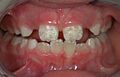
Irreversible enamel defects caused by an untreated celiac disease. They may be the only clue to its diagnosis, even in absence of gastrointestinal symptoms, but are often confused with fluorosis, tetracycline discoloration, acid reflux or other causes. The National Institutes of Health include a dental exam in the diagnostic protocol of celiac disease.
-
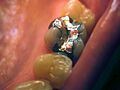
Pre-capsulated dental amalgam used for restorative procedures, containing approximately 50% elemental mercury.


See also
 In Spanish: Odontología para niños
- Dental aerosol
- Dental instrument
- Dental public health
- Domestic healthcare:
- Dentistry in ancient Rome
- Dentistry in Canada
- Dentistry in the Philippines
- Dentistry in Israel
- Dentistry in the United Kingdom
- Dentistry in the United States
- Eco-friendly dentistry
- Geriatric dentistry
- List of dental organizations
- Occupational hazards in dentistry
- Pediatric dentistry
- Sustainable dentistry
- Veterinary dentistry
