
Dracula (1931 English-language film) facts for kids
Quick facts for kids Dracula (1931 English-language film) |
|
|---|---|
.jpg)
Theatrical release poster
|
|
| Directed by | |
| Produced by |
|
| Screenplay by | Garrett Fort |
| Starring |
|
| Cinematography | Karl Freund |
| Editing by |
|
| Studio | Universal Pictures |
| Distributed by | Universal Pictures |
| Release date(s) | February 12, 1931 (New York) February 14, 1931 (United States) |
| Running time | 74 minutes |
| Country | United States |
| Language |
|
| Budget | $341,191 |
Dracula is a famous American vampire film from 1931. It was directed by Tod Browning and stars Bela Lugosi as the mysterious Count Dracula. The movie is based on a popular stage play and an older novel by Bram Stoker. In the film, Count Dracula, a powerful vampire, moves from his home in Transylvania to England. There, he makes people weak by taking their energy, including a young woman named Mina.
Universal Pictures made and released Dracula. It was the first time the famous story was made into a "talkie" film, meaning it had sound. Many actors wanted to play Dracula, but Bela Lugosi, who had played the role on stage, got the part. The movie was filmed in California. Interestingly, the same sets were used at night to make a Spanish version of the film at the same time!
When Dracula came out, it was a huge hit. It led to many sequels and other movies. Bela Lugosi's portrayal of Dracula became super famous. It helped create the image of vampires we often see today. In 2000, the U.S. Library of Congress chose the film for its National Film Registry. This means it's considered very important for culture and history. As a film from 1931, Dracula is scheduled to become available for public use on January 1, 2027.
Contents
The Story of Dracula's Journey
Renfield's Strange Trip to Transylvania
The film begins with Renfield, a lawyer, traveling to Count Dracula's castle in Transylvania. Local villagers are scared of vampires and warn Renfield not to go. But Renfield ignores them. He is driven to the castle by Dracula's coach, with Dracula secretly as the driver. On the way, Renfield sees that the driver has vanished, and a bat is guiding the horses!
Renfield enters the castle. Count Dracula welcomes him. Renfield doesn't know that Dracula is a vampire. They talk about Dracula wanting to rent Carfax Abbey in England. Dracula then uses his powers to make Renfield open a window. Renfield faints as a bat appears, and Dracula's three wives come closer. Dracula stops them and then overpowers Renfield.
Dracula Arrives in England
Later, on a ship called the Vesta, Renfield is now under Dracula's control. He acts very strangely. Dracula hides in a coffin and makes the ship's crew weak. When the ship reaches England, Renfield is the only one found alive. He is sent to Dr. Seward's hospital next to Carfax Abbey.
In London, Dracula meets Dr. Seward at a theater. Seward introduces his daughter Mina, her fiancé John Harker, and their friend Lucy Weston. Lucy is very interested in Dracula. That night, Dracula enters Lucy's room and makes her weak while she sleeps. She passes away the next day.
Van Helsing Investigates the Mystery
Renfield becomes obsessed with eating insects. Professor Van Helsing, a wise doctor, examines Renfield's blood. He realizes that vampires might be involved. Renfield begs Dr. Seward to send him away, saying his cries might bother Mina. When Dracula calls Renfield with a wolf's howl, Van Helsing shows Renfield a plant called wolfsbane. Van Helsing says it protects against vampires.
Dracula visits Mina in her bedroom and makes her weak. The next evening, Van Helsing and Harker notice that Dracula has no reflection in a mirror. When Van Helsing points this out, Dracula smashes the mirror and leaves. Van Helsing understands that Dracula is the vampire causing all the trouble.
Mina goes to the garden where Dracula makes her weak again. Harker wants to take Mina to London for safety. But he is convinced to leave her with Van Helsing. Van Helsing tells Nurse Briggs to watch Mina and keep the wolfsbane around her neck.
The Final Confrontation
Renfield escapes and overhears the men discussing vampires. Before he is taken back, Renfield explains how Dracula promised him many rats to get into the hospital. Dracula then enters the parlor and talks with Van Helsing. He says Mina now belongs to him. Van Helsing promises to find Dracula's hiding place and stop him. Dracula tries to hypnotize Van Helsing, but Van Helsing is too strong. When Dracula lunges, Van Helsing shows him a crucifix, forcing Dracula to retreat.
Harker visits Mina, who talks about loving "nights and fogs." A bat flies above them and squeaks to Mina. She then tries to make Harker weak, but Van Helsing and Seward save him. Mina confesses what Dracula has done and says their love is over.
Dracula hypnotizes Nurse Briggs to remove the wolfsbane from Mina's neck and open the windows. Van Helsing and Harker see Renfield going to Carfax Abbey. They find Dracula with Mina there. When Harker shouts, Dracula thinks Renfield betrayed him. He pushes Renfield down a staircase, causing his death. Van Helsing and Harker chase Dracula. They know he must sleep in his coffin during the day. Van Helsing quickly makes a wooden stake from the coffin lid. Harker searches for Mina. Van Helsing defeats Dracula, and Mina returns to normal.
Meet the Cast
- Bela Lugosi as Count Dracula
- Helen Chandler as Mina Seward
- David Manners as John Harker
- Dwight Frye as Renfield
- Edward Van Sloan as Van Helsing
- Herbert Bunston as Dr. Seward
- Frances Dade as Lucy Weston
- Joan Standing as Nurse Briggs (in an error on the opening credits, she is misidentified as "Maid")
- Charles K. Gerrard as Martin
Some people appeared in the film without being named in the credits. These include director Tod Browning as the voice of the harbormaster. Carla Laemmle, a cousin of producer Carl Laemmle Jr., appears at the start in the coach with Renfield. Geraldine Dvorak, Cornelia Thaw, and Dorothy Tree played Dracula's brides.
Behind the Scenes: How Dracula Was Made
The Story's Journey to the Big Screen

Before this film, Bram Stoker's novel was made into a movie called Nosferatu in 1922. But the filmmakers didn't have permission. Stoker's widow took them to court for using the story without permission. She won, and the court ordered that all copies of Nosferatu be destroyed.
Universal Pictures then bought the full rights to the Dracula novel and plays for $40,000. This meant they were the only ones who could make movies about Dracula. They hired a famous writer, Louis Bromfield, to write the script. He had some interesting ideas, like Dracula changing from an old man to a younger one. He also suggested Dracula kissing Mina, but these ideas were changed. They were either too costly, rewritten, or thought to be too risky for audiences. Another writer, Garrett Fort, took over the script.
Choosing the Actors for Dracula
Many actors were considered for the role of Dracula. First, Conrad Veidt was thought of, but he went back to Germany. Then, Lon Chaney, a famous horror actor, was considered. But he was busy with another film and sadly passed away soon after. Finding the right Dracula was hard.
Bela Lugosi had played Dracula on Broadway and was very good at it. Even though the studio wasn't sure at first, Lugosi worked hard to get the part. He even agreed to a lower salary of $500 a week for seven weeks, which was $3,500 in total. This helped him win the role.
David Manners was chosen to play John Harker. Edward Van Sloan, who played Van Helsing on stage with Lugosi, also played the role in the movie. He didn't think much of the film later, but it became one of his most famous parts.
Director Tod Browning chose Helen Chandler to play Mina. She was paid $750 a week, making her the highest-paid actor in the cast. She was known to sometimes laugh at Lugosi's acting during filming.
Filming the Classic Horror Story


Filming for Dracula began on September 29, 1930. The budget was about $355,050, and it was planned to take 36 days. Tod Browning filmed the castle and Borgo Pass scenes in the first week. Many say the filming was a bit disorganized. Cinematographer Karl Freund often took charge, almost like an uncredited director.
David Manners remembered Lugosi being very serious on set. He would pose in front of a mirror, shouting, "I am Dracula!" Manners said Lugosi was polite but always kept his distance from other actors. He thought Lugosi wasn't just acting but truly embodying the strange character.
The movie includes some interesting cultural details. At the beginning, the villagers pray in Hungarian. This is because many Hungarians lived near Borgo Pass in Transylvania. At the time the film was made, Transylvania was part of Kingdom of Romania.
Some scenes of the ship struggling in a storm were taken from an older silent film called The Storm Breaker. These older clips were sped up when shown with the new sound film. Jack Foley created the sound effects for the movie. The film was finished for $341,191.20, which was even less than the planned budget.
Bela Lugosi worried that playing Dracula would make him only known for that role. He even turned down offers to play Dracula on stage again. He said he hoped to "never hear of Dracula again" after the movie.
Special Effects and Directing Style
The film's special effects were simple, using fog, lighting, and large bats. Dracula's changes from bat to human always happened off-camera. The movie also used long silences and close-ups to create drama. It even used text cards, like silent films, to tell parts of the story. Director Tod Browning was famous for silent films. He found sound films a bit challenging. He directed only a few more films after Dracula.
The Music of Dracula
Original Soundtrack and Classical Pieces
No new music was written just for the film when it first came out. The music you hear at the start, during the opening credits, is from Tchaikovsky's famous ballet, Swan Lake. This same music was also used in another Universal horror film, The Mummy (1932). In the theater scene, you can hear parts of music by Wagner and Schubert.
A New Score for a Classic Film
In 1998, a composer named Philip Glass was asked to write new music for Dracula. The Kronos Quartet, a string group, performed this new music.
Philip Glass said he wanted the music to sound like the 19th century. He felt a string quartet would be perfect for this. He also wanted to avoid typical scary movie sounds. He hoped the new music would add more emotion to the film.
This version of the film with Glass's new music was released in 1999. On DVD, you can choose to watch the movie with or without this new score. Philip Glass and the Kronos Quartet have even performed the music live during showings of the film.
Dracula's Release and Reception
A Big Hit for Universal Pictures
Releasing Dracula was a big risk for a major Hollywood studio. People weren't sure if audiences were ready for a serious, full-length scary movie. But Dracula turned out to be a huge success at the box office.
When the film first showed in New York City on February 12, 1931, newspapers reported that some audience members were very scared. This publicity, cleverly planned by the studio, made even more people curious to see the film. In just two days, it sold 50,000 tickets in New York. It ended up making a profit of $700,000, which was the most for any Universal film in 1931.
Changes and Different Versions
Film Censorship Over Time

The film was first released at 85 minutes long. When it was re-released in 1936, new rules about what could be shown in movies were in place. Because of these rules, two scenes were changed:
- The sounds of Dracula's defeat at the end of the film were shortened. Renfield's sounds of struggle when he was defeated were also cut. These sounds were later put back into the film for its LaserDisc and DVD releases.
- The biggest change was removing an ending speech. This speech, given by Edward Van Sloan (who played Van Helsing), was meant to reassure the audience. It was taken out because people worried it might make viewers believe in supernatural things. In April 2026, this missing ending was restored using old film footage and new audio created with special computer programs.
Other Versions of the Film
In the early days of sound films, studios often made versions of their movies in different languages. While Tod Browning filmed the English Dracula during the day, George Melford used the same sets at night to make a Spanish-language version. This version starred Carlos Villarías as Count Dracula. For a long time, people thought this Spanish film was lost. But a good copy was found in Cuba in the early 1990s. It is now kept in the U.S. National Film Registry.
A silent version of the film was also released. In 1931, not all movie theaters had sound equipment. So, many studios made silent versions with text cards to explain the story.
Dracula's Lasting Impact
What People Think of the Film Now
In 1999, film critic Roger Ebert gave Dracula a perfect score, praising Bela Lugosi's acting and the camera work. He noted how much the film influenced later movies. Angie Errigo of Empire also gave it high marks, calling Lugosi's Dracula the one "against which all others are measured." John Oliver of the British Film Institute said the film created the "popular on-screen image of the vampire."
On the website Rotten Tomatoes, the film has a very high approval rating of 96%. Most critics agree that Bela Lugosi's portrayal of Dracula set the standard for all vampire roles that followed.
Sequels and Influence on Other Films

After Dracula became a success, Universal Pictures made many other famous horror films. These included Frankenstein (1931), The Mummy (1932), and The Wolf Man (1941).
Dracula had several sequels. Dracula's Daughter (1936) continued the story right after the first film. Then came Son of Dracula (1943). Count Dracula also appeared in other Universal monster movies like House of Frankenstein (1944) and the comedy Abbott and Costello Meet Frankenstein (1948).
Bela Lugosi only played Dracula in one more Universal film, the Abbott and Costello comedy. Other actors, like John Carradine, took on the role in later movies. Lugosi played other vampire characters in different films, which made many people think he played Dracula more often than he did.
Director Chris McKay referenced Dracula in his 2023 film Renfield. This movie is like a "quasi-sequel" to the original 1931 film. It features Nicolas Cage as Count Dracula and Nicholas Hoult as Renfield.
In 2000, Dracula was chosen for the U.S. National Film Registry because it is "culturally, historically, or aesthetically significant." It was also ranked 79th on Bravo's list of The 100 Scariest Movie Moments.
Playing Dracula made Bela Lugosi very famous, but it also meant he was often only offered similar roles. This is called typecasting.
The film is also recognized by the American Film Institute in these lists:
- 2001: AFI's 100 Years...100 Thrills – #85
- 2003: AFI's 100 Years...100 Heroes & Villains:
- Count Dracula – #33 Villain
- 2005: AFI's 100 Years...100 Movie Quotes:
- Count Dracula: "Listen to them. Children of the night. What music they make." – #83
How Lugosi Influenced Other Draculas
Actors who played Dracula after Lugosi had different thoughts about his performance.
Christopher Lee, who played Dracula in many Hammer films, felt Lugosi's Dracula was "too nice" at the beginning and lacked menace. He also thought Lugosi's movements were stiff. Lee believed Lugosi was a wonderful actor but not the right nationality for Dracula, even though Lugosi's hometown was in a region considered Transylvania at the time of the novel.
Gary Oldman, who played Dracula in Francis Ford Coppola's 1992 film, loved Lugosi's portrayal. He said Lugosi "was really on to something: the way he moved, the way he sounded." Oldman even based his Dracula voice on Lugosi's.
Movie Posters and Their Value
The film's poster campaign was managed by Karoly Grosz, who also designed one of the posters himself. Original posters from 1931 are very rare and valuable to collectors. In 2009, actor Nicolas Cage sold his collection of old film posters. One "Style F" poster from Dracula sold for $310,700. In 2017, a very rare "Style A" poster sold for $525,000, setting a new world record for the most expensive film poster.
- Original 1931 posters
-
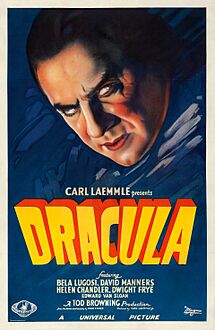
Style A one-sheet – most valuable film poster in the world in 2017
-
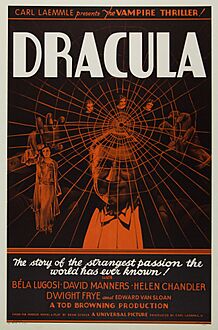
Style B one-sheet
-
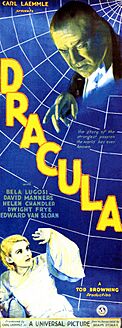
"Insert" poster by Karoly Grosz
-
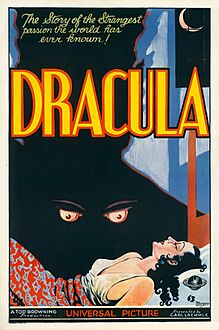
Style C one-sheet — scan of the copy owned by Kirk Hammett as of 2017
-
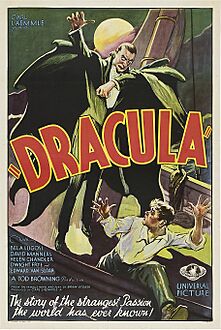
Style F one-sheet — scan of the copy sold by Nicolas Cage in 2009
.jpg)
.jpg)
.jpg)
.jpg)
.jpeg)
Over the years, when the film was shown again in theaters, new posters were designed to promote it.
- Theatrical reissue posters
-
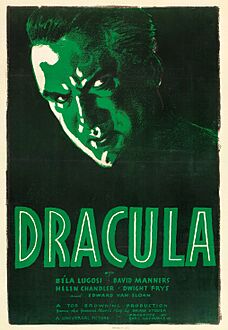
1938 one-sheet by Universal
-
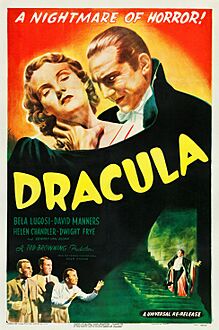
1947 one-sheet by Universal
-
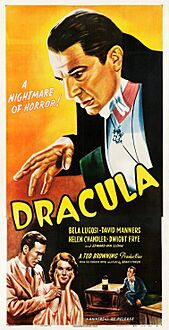
1947 three-sheet by Universal
-
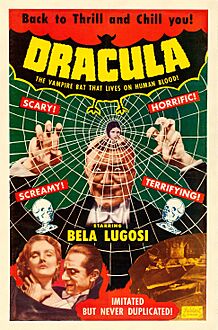
1951 one-sheet by Realart
-
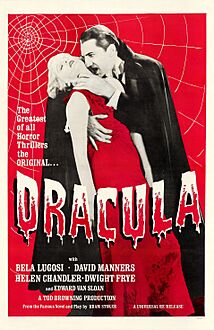
1960s one-sheet by Universal
.jpg)
.jpg)
.jpg)
.jpg)
.jpg)
Dracula's Iconic Look and Phrases
This film, along with the 1920s stage play, helped create many of the famous images we have of Dracula today. These images are quite different from how Dracula is described in Bram Stoker's novel. In the book and in the silent film Nosferatu (1922), Dracula looks scary and unpleasant. But Bela Lugosi's Dracula is handsome and charming.
The play and this film also introduced the well-known scenes of Dracula entering bedrooms through windows. They also showed him wrapping his cape around his victims and turning into a bat more often. In Stoker's novel, he could also turn into a wolf, mist, or dust.
The classic line, "I never drink ... wine," was first said in this film. It wasn't in Stoker's novel or the original play. When the play was brought back to Broadway in 1977, that line was added to the script.
In the novel, Dracula's home in England is simply called Carfax. The film changed it to Carfax Abbey.
Watching Dracula at Home
Over the years, Dracula has been released in many formats for people to watch at home. In the 1980s, it came out on Betamax, VHS, and CED. In the 1990s, it was part of the "Universal Monsters Classic Collection" on VHS and LaserDisc.
In 1999, Universal released Dracula on VHS and DVD. Later, in 2004, a special "Legacy Collection" DVD set included both the English and Spanish versions of Dracula, along with other films.
In 2012, Dracula was released on Blu-ray as part of a collection of classic Universal monster films. Since then, it has been released many times on Blu-ray and even on 4K Ultra HD Blu-ray in 2021. This means fans can enjoy this classic film with the best possible picture quality.
See also
- Bela Lugosi filmography
- Dracula in popular culture
- Dracula (1979), based on the same Deane/Balderston play
- Gothic film – Notable films
- Universal Classic Monsters
