
Death penalty facts for kids

The death penalty, also known as capital punishment, is when a government or state officially puts someone to death. This usually happens because the person has committed a very serious crime. A crime that can lead to the death penalty is called a capital crime or a capital offense.
In recent centuries, governments have used the death penalty less often. It is a topic that many people disagree about. It causes a lot of discussion and debate around the world.
Contents
What is the Death Penalty?
The death penalty is the most severe punishment a person can receive from the law. It means the government takes away a person's life as a punishment. This is different from being put in prison.
Why is it Used?
Governments use the death penalty for very serious actions that break the law. These are often crimes like murder or terrorism. Some countries, especially those with authoritarian or totalitarian governments, might also use it for less serious crimes. They might even use it if someone says bad things about the government.
Where is the Death Penalty Used?
About one-third of the countries in the world still have laws that allow the death penalty.
Many nations have changed their legal codes over the last several decades:
- In the Americas, countries like Canada, Mexico, and most South American nations do not use the death penalty. In the United States, individual states make their own criminal laws; some states use it, while 23 states and Washington, D.C. have banned it.
- In Europe, almost every country has abolished it entirely. The only country in Europe that still keeps the law is Belarus.
- In Africa, many nations have not carried out an execution in many years, and several have officially changed their laws to end it.
- In Asia, nations such as China, Japan, India, and Singapore continue to keep the policy in their legal systems.
Debates About Capital Punishment
There are many ongoing discussions among lawyers, leaders, and citizens regarding this legal practice.
Arguments Supporting the Policy
People who support the death penalty often focus on justice and public safety:
- Retributive justice: Some believe that the most severe offenses deserve an equally severe legal response.
- Crime prevention: Supporters argue that tough punishments discourage other people from committing terrible acts.
- Community protection: Some suggest that removing dangerous individuals permanently ensures they can never harm others again.
Arguments Opposing the Policy
People who want to abolish the death penalty focus on human rights and legal fairness:
- Human rights: Groups like the United Nations General Assembly argue that governments should never have the power to end a person's life.
- The risk of mistakes: Courts sometimes make errors. If an innocent person is wrongly convicted, ending their life is a mistake that cannot be undone.
- Rehabilitation: Many people believe that justice systems should focus on helping individuals learn, change, and make amends for their actions.
- Unequal treatment: Critics point out that poorer defendants often cannot afford expert legal defense, leading to unfair outcomes.
Because of these deep moral questions, governments around the world continue to debate how best to balance justice, fairness, and human dignity.
Images for kids
-
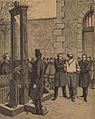
Anarchist Auguste Vaillant about to be guillotined in France in 1894
-
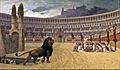
The Christian Martyrs' Last Prayer, by Jean-Léon Gérôme (1883). Roman Circus Maximus.
-
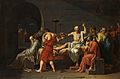
The Death of Socrates (1787), in the Metropolitan Museum of Art in New York City.
-
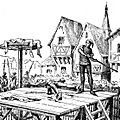
The breaking wheel was used during the Middle Ages and was still in use into the 19th century.
-
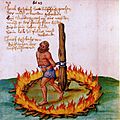
The burning of Jakob Rohrbach, a leader of the peasants during the German Peasants' War.
-
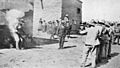
Mexican execution by firing squad, 1916
-
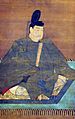
Emperor Shomu banned the death penalty in Japan in 724.
-

Peter Leopold II abolished the death penalty throughout Tuscany in 1786, making it the first nation in modern history to do so.
-
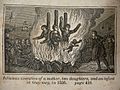
Mother Catherine Cauchés (center) and her two daughters Guillemine Gilbert (left) and Perotine Massey (right) with her infant son burning for heresy
-
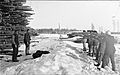
The Red Guard prisoners are being executed by the Whites in Varkaus, North Savonia, during the 1918 Finnish Civil War.


See also
 In Spanish: Pena de muerte para niños
