
Golestan Palace facts for kids
The Golestan Palace (Persian: کاخ گلستان, romanized: Kākh-e Golestān) is a magnificent royal complex in Tehran, Iran. It was once the official home for the Qajar kings. This palace is one of the oldest and most important historical places in Iran's capital city. It is so special that UNESCO has named it a World Heritage Site. The Golestan Palace is made up of many beautiful royal buildings. These buildings were once protected by strong walls around Tehran's old citadel. Most of these royal buildings were built in the 1800s. Inside, you can see amazing collections of Iranian and European art and gifts from the 1700s to the 1900s.
| UNESCO World Heritage Site | |
|---|---|
.jpg)   .jpg) |
|
| Location | Tehran, Iran |
| Criteria | Cultural: ii, iii, iv |
| Inscription | 2013 (37th Session) |
| Area | 5.3 ha |
| Buffer zone | 26.2 ha |
Contents
- History of the Royal Palace
- Exploring the Palace Sites
- The Marble Throne (Takht-e Marmar)
- Karim Khani Nook (Khalvat-e Karim Khani)
- The Pond House (Howz Khaneh)
- Brilliant Hall (Talar-e Brelian)
- Containers' Hall (Talar-e Zoruf)
- Ivory Hall (Talar-e Adj)
- Mirror Hall (Talar-e Aineh)
- Salam Hall (Talar-e Salam)
- Diamond Hall (Talar-e Almas)
- The Windcatcher Mansion (Emarat-e Badgir)
- Edifice of the Sun (Shams-ol-Emareh)
- Museum of Gifts
- Abyaz Palace
- Photographic Archive
- Restoring the Golestan Palace
- The Palace Today
- Gallery
- See also
History of the Royal Palace
The story of Tehran's royal citadel began a very long time ago. Records show that in 1404, a traveler from Spain stayed in a house in this area. Over time, this area grew into a royal complex. The first palace was built during the time of King Suleiman I of the Safavid dynasty. Later, King Tahmasp I built a strong citadel. Abbas the Great added a large garden and more buildings, making it a royal residence.
The palace was later improved by Karim Khan of the Zand dynasty. Then, Agha Mohammad Khan Qajar chose Tehran as his capital city. The citadel became the main seat for the Qajar kings, who ruled from 1794 to 1925. The Golestan Palace became their official home. The palace you see today was largely rebuilt in 1865 by Haji Ab ol Hasan Mimar Navai.
During the Pahlavi era (1925–1979), the Golestan Palace was used for important official events. The Pahlavi kings built their own new palaces elsewhere. However, two very important ceremonies happened here: the coronations of Reza Shah in 1926 and Mohammad Reza Shah with Queen Farah in 1967. Sadly, between 1925 and 1945, many parts of the palace complex were taken down by order of Reza Shah. He wanted Tehran to become a modern city and felt the old Qajar palaces were in the way. New commercial buildings were built where the old palaces once stood.
In March 2026, news reports from Iran mentioned that the palace was damaged.
Exploring the Palace Sites
The Golestan Palace complex has 17 different structures. These include palaces, museums, and grand halls. Almost all of these were built during the 131 years that the Qajar dynasty ruled Iran. These palaces were used for many special events, like coronations and big celebrations. The complex also holds three important archives: a collection of old photographs, a library of handwritten books, and an archive of historical documents.
The Marble Throne (Takht-e Marmar)
This beautiful terrace is called the Marble Throne. It was built between 1747 and 1751. It features a grand throne made entirely of marble.

Karim Khani Nook (Khalvat-e Karim Khani)
This part of the palace dates back to 1759. It was once a private area for Karim Khan of the Zand dynasty. The Karim Khani Nook looks a bit like the Marble Throne, as it is also a terrace. Inside, there is a smaller marble throne. This area is not as grand as the main Marble Throne, and it has fewer decorations. Long ago, a small pond with a fountain was here. Water from an underground stream flowed into the pond, helping to water the palace gardens. Naser al-Din Shah Qajar especially loved this quiet corner of the Golestan Palace.

The Pond House (Howz Khaneh)
During the Qajar era, the Pond House was a cool place to relax in the summer. Today, it displays paintings by European artists that were given as gifts to the Qajar court.

Brilliant Hall (Talar-e Brelian)
King Naser ed Din Shah ordered the building of the Brilliant Hall. It gets its name from the amazing and sparkling Iranian mirror-work, called Ayeneh-kari, that covers its walls.

Containers' Hall (Talar-e Zoruf)
This building replaced an older building called Narenjestan. It is located north of the Ivory Hall.
Ivory Hall (Talar-e Adj)
The Ivory Hall is a very large room that was used as a dining room. It was decorated with many gifts that European kings and queens gave to Naser ed Din Shah.
Mirror Hall (Talar-e Aineh)
The Mirror Hall is a smaller, but very beautiful, hall. It was designed by Haj Abd ol Hossein Memar Bashi.

Salam Hall (Talar-e Salam)
The Salam Hall, which means "Reception" Hall, was first planned to be a museum. It is a grand space for welcoming important guests.

Diamond Hall (Talar-e Almas)
You can find the Diamond Hall in the southern part of the Golestan Palace. It is right next to the unique Windcatcher Mansion.
The Windcatcher Mansion (Emarat-e Badgir)
This special mansion was constructed during the time of Fath-Ali Shah Qajar. It has tall structures called windcatchers that helped cool the building in the hot climate. King Naser ed-Din Shah later made big changes and improvements to the mansion.


Edifice of the Sun (Shams-ol-Emareh)
The Edifice of the Sun was designed by Moayer ol Mamalek. Its construction started in 1865 and took two years to finish. A clock, given as a gift by Queen Victoria to Naser al-Din Shah, sits at the top of this building. It was repaired in 2012.

Museum of Gifts
This museum is located right below the Salam Hall. It holds many valuable gifts that were given to the royal family.
.png)
Abyaz Palace
The Abyaz Palace was finished in 1883. It was built to show off gifts from the Ottoman Empire. King Naser al-Din Shah Qajar himself oversaw its construction and even designed parts of it. The building has a unique style, combining different architectural ideas. It used to have fancy decorations like French-style living room furniture, velvet curtains, and gold statues. Its white outer walls gave it the name "Abyaz," which means "White."
.JPG)
Photographic Archive
The Golestan complex has a very old collection of photographs. These pictures mostly show how photography developed in Europe in the 1800s. King Naser ed-Din Shah ordered this collection to be created. It is said that photography was so popular at the palace that even the king's wives and servants took pictures and had fun posing for the camera.

Restoring the Golestan Palace
Between 2007 and 2021, many projects took place to restore the Golestan Palace. Workers carefully fixed parts that were weak, cleaned old materials, and brought back the palace's original beauty. They made sure to use methods that would not harm the old structure.
- Marble Throne Veranda (Takht-e Marmar): Experts cleaned and strengthened the stone parts. They treated the wooden roof to stop decay. They also fixed salt damage at the base of the throne.
- Shams-ol-Emareh: Cracks in the walls were repaired using special mortars. Rusted iron beams were replaced with strong stainless steel to make the building safer. Damaged mirror mosaics were fixed by skilled artists using old techniques.
- Tile Restoration: Original Qajar tiles were gently cleaned and treated to stop them from flaking or breaking.
- Hall of Mirrors (Talar-e Ayeneh): Restoration here focused on making the mirror-work stable. They used special materials to fix the plaster behind the mirrors and to secure the mosaic pieces.
- HVAC and Drainage Systems: New, hidden systems were put in place to control humidity and water. This helps protect the delicate materials without changing how the palace looks.
How Restoration Was Done
The restoration projects followed important rules to protect the palace:
- Minimal Changes: Workers only did what was absolutely necessary to save the building and its materials. They avoided replacing things unless they had to.
- Reversible Methods: The materials and methods used can be undone later without hurting the original parts of the palace.
- Matching Materials: They used traditional materials like lime and stucco that were similar to the original ones.
- Clear Differences: Any new parts, like structural supports, were made so you can tell them apart from the original parts. This helps keep the palace's history clear.
Challenges for the Future
Even with all the work, some challenges remain:
- City Pollution: The palace is in a busy city, so pollution can still damage its materials.
- Weather Changes: Changes in humidity and temperature can cause problems like salt stains and mold.
- Public Involvement: It's important to teach more people about the palace so they can appreciate it and help support its ongoing care.
The Palace Today
On October 11, 2005, Iran's Cultural Heritage Organization asked UNESCO to add the Golestan Palace to its World Heritage List. On June 23, 2013, it officially became a World Heritage Site during a meeting in Cambodia.
Today, the Cultural Heritage Organization of Iran manages and cares for the Golestan Palace. It is a wonderful place for everyone to visit and learn about Iran's rich history.
Gallery
-
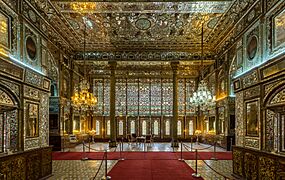
The Windcatcher Mansion
-
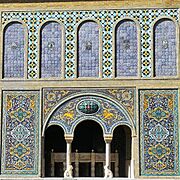
Karim Khani Nook
-
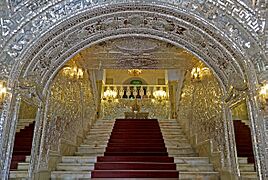
Stairs leading up to the Salam Hall
-
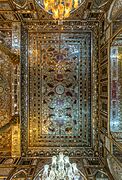
The ceiling of the Windcatcher Mansion
-
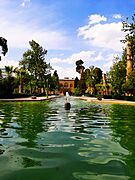
A pool
-
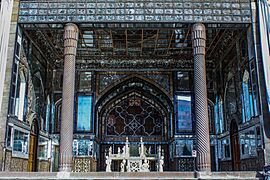
The Marble Throne
-
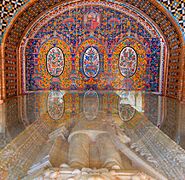
Tombstone of Naser al-Din Shah Qajar
-
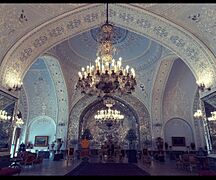
The ceiling of Salam Hall
-
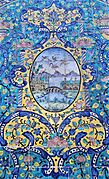
Tilings 1
-
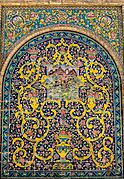
Tilings 2
-
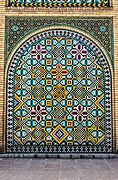
Tilings 3
-
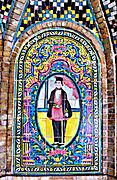
Tilings 4
-
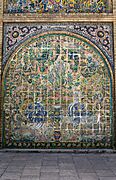
Tilings 5
-
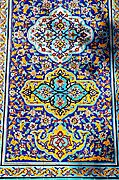
Tilings 6
-
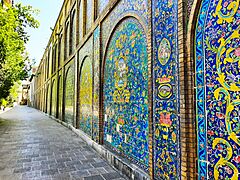
Tilings on the walls
-
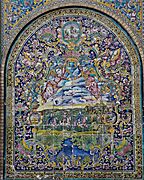
Tilings 7
-
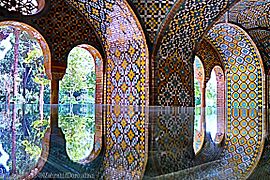
Tilings on the Karim Khani Nook
-
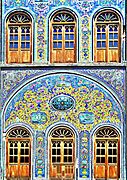
Tilings on the palace
-
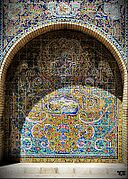
Tilings 8
-
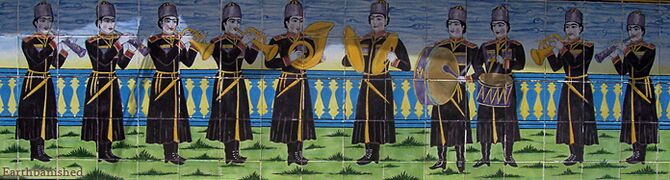
Tilings on the Shams-ol-Emareh palace
-
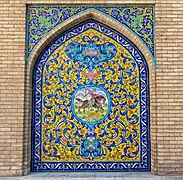
Tilings 9
-
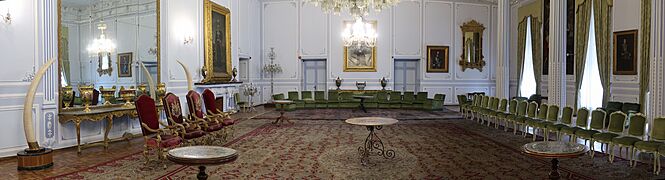
The Ivory Hall (Talar-e Adj)
-
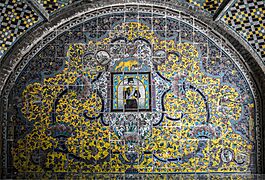
Tilings in the Karim Khani Nook
-
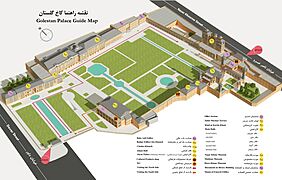
The map of Golestan Palace
-
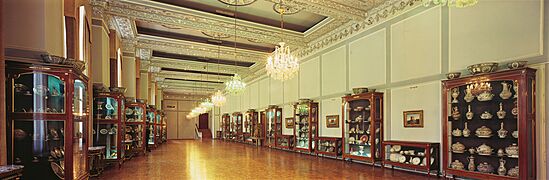
Containers' Hall (Talar-e Zoruf)
-
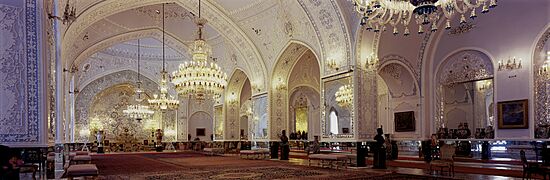
The Salam Hall
-
Mirror Hall, Golestan Palace (2022).jpg
The Mirror Hall (Talar-e Aineh)
-
The Golestan Palace 006.jpg
Museum Hall
-
FS-FSA A.15 01.jpg
Naser al-Din Shah on the steps of the Sun Throne at the Mirror Hall
-
کتیبه سنگی عمارت برلیان دوره مظفرالدین شاه قاجار 1218 ق.jpg
Stone inscription of the Brilliant Hall from the reign of Mozaffar ad-Din Shah Qajar
-
نقشه قصر گلستان اثر تروفیموف 1931 م.jpg
The map of Golestan palace, 1931
-
تاج آقامحمد خان.jpg
The crown of Agha Mohammad Khan Qajar
-
کاشی سرسرا.jpg
The tilings of the Museum Mansion


See also
- Ferdows Garden
- Baharestan
- Morvarid Palace
