
HMS Cambridge (1815) facts for kids
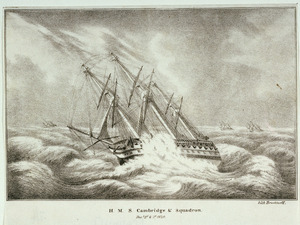
HMS Cambridge is shown after taking part in the Syrian operations of 1840 against Mehmet Ali, battered by the severe storm that raged in this area.
|
|
Quick facts for kids History |
|
|---|---|
 United Kingdom United Kingdom |
|
| Name | HMS Cambridge |
| Ordered | 16 July 1810 |
| Builder | Deptford Dockyard |
| Laid down | December 1811 |
| Launched | 23 June 1815 |
| Fate | Broken up, 1869 |
| General characteristics | |
| Class and type | 80-gun third rate ship of the line |
| Tons burthen | 2139 bm |
| Length | 187 ft 2.25 in (57.0548 m) (gundeck) |
| Beam | 50 ft 11.5 in (15.532 m) |
| Depth of hold | 21 ft 7 in (6.58 m) |
| Propulsion | Sails |
| Sail plan | Full-rigged ship |
| Armament |
|
HMS Cambridge was a powerful 80-gun ship of the line in the Royal Navy. She was launched on June 23, 1815, at Deptford Dockyard in England. This ship was designed based on a Danish ship called Christian VII, which the British had captured in 1807.
Contents
Early Years: A Quiet Start
When HMS Cambridge was first built, the big Napoleonic Wars were ending. This meant she didn't see much fighting right away.
Voyage to the Americas (1824)
In 1824, HMS Cambridge set sail on an important journey to the Americas. She left Portsmouth, England, on January 5, carrying many passengers. These included new British officials, called Consuls, who were going to countries like Peru, Chile, Argentina, and Uruguay.
The ship first stopped at Santa Cruz in Tenerife. Then, she sailed across the Atlantic Ocean, reaching Rio de Janeiro in Brazil. After a quick stop for repairs, she continued her journey.
Exploring South America
HMS Cambridge sailed to Montevideo, where some officials left the ship. Others traveled further by land or on different ships. One official, Thomas Rowcroft, even rode his horse all the way across the continent and over the Andes mountains!
The ship then sailed around the famous Cape Horn, which is at the very tip of South America. She traveled up the west coast, dropping off officials in Valparaíso, Chile. Finally, she reached Callao Harbour in Peru, where Thomas Rowcroft disembarked for his new job in Lima. Sadly, Rowcroft died later that year after an accidental shooting.
Mediterranean Service (1830-1843)
After her long journey to the Americas, HMS Cambridge was taken out of service for a while. But in 1830, she was brought back into action under Captain Edward Barnard. For the next 13 years, until 1843, she led a group of naval ships in the Mediterranean Sea.
Operations in Syria (1840)
During her time in the Mediterranean, HMS Cambridge took part in important operations. In 1840, she was involved in a campaign along the coast of Syria. This was part of a combined effort by the Ottoman Empire and Britain against a powerful Egyptian leader named Mehmet Ali.
Her duties included bombarding the city of Beirut on September 10. She also helped to blockade Alexandria, preventing ships from entering or leaving the port. These actions were key parts of the military efforts in the region.
Final Years: Gunnery Training Ship
After her service in the Mediterranean, HMS Cambridge was once again taken out of active duty. She stayed in Devonport until 1856.
Becoming a Gunnery Ship
On August 9, 1856, HMS Cambridge was given a new and important role: she became the 'gunnery ship at Plymouth'. This meant she was used to train sailors in how to use naval guns. She had several different captains during this time.
She served in this training role until 1869. That year, she was finally taken apart, or 'scrapped', as ships often are at the end of their lives. Another ship, HMS Windsor Castle, was then renamed HMS Cambridge and took over her job as the gunnery training ship.
