
Parliament of India facts for kids
Quick facts for kids Parliament of IndiaBhāratīya Sansad |
|
|---|---|
 |
|
| Type | |
| Type | |
| Houses | Rajya Sabha (Council of States) Lok Sabha (House of the People) |
| History | |
| Founded | 26 January 1950 |
| Preceded by | Constituent Assembly of India |
| Leadership | |
|
Droupadi Murmu
Since 25 July 2022 |
|
|
C.P. Radhakrishnan
Since 12 September 2025 |
|
|
Om Birla
Since 19 June 2019 |
|
| Structure | |
| Seats | 788 245 Members of Rajya Sabha 543 Members of Lok Sabha |
 By party By party By alliance By alliance |
|
|
Rajya Sabha political groups
|
|
 By party By party By alliance By alliance |
|
|
Lok Sabha political groups
|
|
| Elections | |
| Single transferable vote | |
| First-past-the-post | |
|
Rajya Sabha last election
|
2025 |
|
Lok Sabha last election
|
19 April – 1 June 2024 |
|
Rajya Sabha next election
|
2026 |
|
Lok Sabha next election
|
By May 2029 |
| Meeting place | |
 |
|
| Sansad Bhavan 118, Rafi Marg, New Delhi Delhi, India – 110001 | |
| Constitution | |
| Constitution of India | |
The Parliament of India (known in Hindi as the Bhāratīya Sansad) is the supreme lawmaking group for the Republic of India. It is a bicameral legislature, which means it is made up of two separate lawmaking houses. These two houses are the Rajya Sabha (the Council of States) and the Lok Sabha (the House of the People).
The President of India acts as the head of the legislature. The President has the official power to call the houses to meet, end a session, or dissolve the Lok Sabha. However, the President uses these powers by following the advice of the Prime Minister of India and the Council of Ministers. The Prime Minister and the ministers are chosen from the Parliament and answer directly to it, forming the Government of India.
People chosen to sit in either house are called Members of Parliament (MPs). Citizens of India vote directly for members of the Lok Sabha during national elections. Members of the Rajya Sabha are elected indirectly by state lawmakers. The Parliament works inside a grand building called Sansad Bhavan in New Delhi. With nearly one billion eligible voters participating in its democracy, the Indian Parliament represents the largest democratic voting population in the entire world.
Contents
- History and Origins of Indian Democracy
- The Parliament Buildings
- Structure and Houses of Parliament
- Core Powers and Responsibilities
- How a Bill Becomes an Act
- Parliamentary Sessions and Daily Work
- Parliamentary Committees
- Parliamentary Privileges and Code of Conduct
- Important Historical Milestones
- Gallery
- See also
History and Origins of Indian Democracy
India has a rich tradition of councils and assemblies dating back thousands of years to ancient village gatherings. However, the modern system of parliamentary government grew during the nineteenth and twentieth centuries.
The British Colonial Period
During the period of British rule, the main lawmaking group was the Imperial Legislative Council. It was created in 1861 by a law called the Indian Councils Act 1861.
At first, this council had very little power and only included British officials. Over several decades, Indian leaders fought peacefully for greater representation and self-rule. As new laws were passed, more Indian representatives were allowed to join the council and debate policies.
The Imperial Legislative Council was dissolved in August 1947 when India achieved its independence.
The Constituent Assembly of India
After gaining independence on 15 August 1947, the country needed a permanent set of rules to govern itself. The leaders created the Constituent Assembly of India, which was a group of respected thinkers, lawyers, and freedom fighters.
Led by great leaders like Dr. B. R. Ambedkar, Jawaharlal Nehru, and Sardar Vallabhbhai Patel, the assembly spent nearly three years writing the Constitution of India. The assembly met in the Central Hall of the old Parliament House to debate every single rule.
On 26 January 1950, the Constitution came into effect, turning India into a sovereign democratic republic. The Constituent Assembly then transformed into the provisional Parliament until the first national general elections took place in 1951 and 1952.
The Parliament Buildings
The Parliament of India has carried out its work in two historic buildings located in the heart of the national capital, New Delhi.
Old Parliament Building: Samvidhan Sadan
The Old Parliament House, officially renamed Samvidhan Sadan (Constitution House), is a famous circular landmark.
.png)
- British architects Edwin Lutyens and Herbert Baker designed the circular structure.
- Construction began in 1921 and was completed in 1927.
- The opening ceremony took place on 18 January 1927, led by the Viceroy, Lord Irwin.
- The building is circular, measuring 560 feet (171 meters) in diameter, and covers around six acres.
- A large Central Hall sits at the center, surrounded by chambers and curved colonnades with 144 granite pillars.
The Constitution of India was debated, written, and adopted inside this historic Central Hall. Over time, modern technology and a growing staff made the building crowded, leading to the construction of a new home for lawmakers.
New Parliament Building: Sansad Bhavan
On 28 May 2023, Prime Minister Narendra Modi officially opened the New Parliament House.
- The building has a modern triangular design that makes the best use of space across 65,000 square meters.
- The Lok Sabha chamber seats up to 888 members and is decorated with designs inspired by the peacock, India's national bird.
- The Rajya Sabha chamber seats up to 384 members and uses a theme based on the lotus, India's national flower.
- For special joint meetings of both houses, the Lok Sabha hall can seat up to 1,272 members.
- The building features advanced communication technology, digital voting systems, and energy-saving green architecture.
The very first official lawmaking session inside the new building began on 19 September 2023.
Structure and Houses of Parliament
The Parliament of India is composed of three main elements: the President of India, the Lok Sabha, and the Rajya Sabha.
The President of India
Under Article 79 of the Indian Constitution, the President of India is an official part of Parliament.
- The President does not sit in daily parliamentary debates but performs essential constitutional duties.
- The President officially summons both houses to meet and can dissolve the Lok Sabha for new elections.
- Every bill passed by the Lok Sabha and Rajya Sabha must receive the President's formal approval (assent) to become a law.
- The President is chosen by an electoral college made up of elected members from both houses of Parliament and state legislative assemblies.
- The President serves a term of five years.
The Lok Sabha (House of the People)
The Lok Sabha is the lower house of Parliament and represents the citizens of India directly.

Membership and Elections
- The Lok Sabha has 543 elected members.
- The country is divided into 543 geographic areas called parliamentary constituencies.
- Each constituency elects one representative using the first-past-the-post voting system, where the candidate with the most votes wins.
- Every Indian citizen aged 18 or older has the right to vote, regardless of background, gender, or wealth.
Qualifications to Become an MP in the Lok Sabha
To stand for election to the Lok Sabha, a candidate must meet several requirements:
- Must be a citizen of India.
- Must be at least 25 years old.
- Must be registered as a voter in an Indian parliamentary constituency.
- Must be mentally sound and not hold a paid government job that creates a conflict of interest.
- Must meet all standard legal criteria set by national election laws.
Terms and Reserved Seats
The Lok Sabha is elected for a normal term of five years. However, it can be dissolved earlier if the government loses its majority support.
To ensure fair representation for historically disadvantaged communities, the Constitution reserves specific seats:
- 84 seats are reserved for members of Scheduled Castes (SC).
- 47 seats are reserved for members of Scheduled Tribes (ST).
The Rajya Sabha (Council of States)
The Rajya Sabha is the upper house of Parliament and represents India's states and union territories.

Membership and Continuous Operation
- The Rajya Sabha has a total strength of up to 250 members (currently operating with 245 members).
- 233 members are chosen by the elected lawmakers of state legislative assemblies using proportional representation.
- 12 members are nominated by the President for their outstanding contributions to literature, science, art, and social service.
- Unlike the Lok Sabha, the Rajya Sabha is a permanent body and is never completely dissolved.
- Members serve six-year terms, with one-third of the members retiring every two years, ensuring continuity in government.
Qualifications for Rajya Sabha
To become a member of the Rajya Sabha, an individual must:
- Be a citizen of India.
- Be at least 30 years of age.
- Possess all necessary legal qualifications established by Parliament.
Core Powers and Responsibilities
The Parliament of India carries out essential duties that keep the democratic government functioning fairly and smoothly.
Making and Changing Laws
The primary job of Parliament is to debate, draft, and pass laws for the entire nation.
- Union List Matters: Parliament has exclusive power to pass laws on national topics like defense, foreign policy, railways, banking, and space exploration.
- Concurrent List Matters: Parliament shares power with state assemblies over topics such as education, forests, and trade, but national laws take precedence during disagreements.
- Residuary Powers: Any new topic not mentioned in the Constitution falls under the authority of Parliament.
- Amending the Constitution: Parliament can update or modify articles of the Constitution using special voting majorities to adapt to modern needs.
Financial Control and National Budget
Parliament serves as the guardian of the nation's public funds.
- The government cannot collect any taxes or spend money without the explicit approval of Parliament.
- Every year, the government presents the Central Budget showing expected earnings and planned spending on schools, roads, healthcare, and security.
- Parliament debates budget proposals and votes to approve funds for different government ministries.
- Specialized parliamentary committees examine spending reports to make sure public funds are used honestly and efficiently.
Executive Accountability and Oversight
Parliament keeps a close watch over the Prime Minister and government ministers.
- Ministers must answer questions from lawmakers during daily sessions.
- The government stays in power only as long as it has the support of a majority in the Lok Sabha.
- If lawmakers feel the government is not leading well, the Lok Sabha can hold a vote of no confidence; if the vote passes, the government must resign.
- Parliamentary committees review the ongoing work of ministries and investigate policy problems.
Judicial and Electoral Duties
- Parliament participates in electing the President and Vice President of India.
- Parliament has the sole authority to remove high-ranking officials, such as judges of the Supreme Court or the President, through a formal constitutional removal process (impeachment) if severe wrongdoing occurs.
How a Bill Becomes an Act
The lawmaking process in India follows structured steps to make sure every new rule is thoroughly examined.
Step 1: Introduction of a Bill
A proposed new law begins as a document called a Bill.
- An Ordinary Bill can be introduced in either the Lok Sabha or the Rajya Sabha by a minister or an ordinary lawmaker.
- A Money Bill, which deals with taxes or government spending, can only be introduced in the Lok Sabha.
Step 2: Three Readings in the First House
Inside the house where the bill begins, it goes through three stages:
- First Reading: The bill is introduced, and its general purpose is explained to lawmakers.
- Second Reading: Lawmakers examine the bill line by line. Members may debate clauses, propose changes (amendments), or send the bill to a committee for expert review.
- Third Reading: The house holds a final debate and votes on whether to accept or reject the complete bill.
Step 3: Action by the Second House
Once passed by the first house, the bill goes to the other house.
- The second house repeats the three-reading process.
- It can pass the bill without changes, suggest amendments, or reject it.
- If both houses disagree on an Ordinary Bill, the President can call a joint sitting where members of both houses meet and vote together.
- For a Money Bill, the Rajya Sabha can only make suggestions within 14 days; if it takes no action, the bill is considered passed.
Step 4: Presidential Assent
After being approved by both houses, the bill is sent to the President of India.
- Once the President signs the bill, it becomes an official Act of Parliament and part of national law.
Parliamentary Sessions and Daily Work
Parliament meets throughout the year in organized working periods known as sessions. The Constitution requires that Parliament meet at least twice a year, with no more than six months between sessions.
The Three Annual Sessions
- Budget Session (February to May): The longest and most important session of the year. Lawmakers review, debate, and approve the national budget and financial plans.
- Monsoon Session (July to August): Takes place during India's rainy season. Focuses on introducing new bills and debating pressing national issues.
- Winter Session (November to December): The final session of the calendar year. Lawmakers review government progress, debate social topics, and pass pending legislation.
- Special Sessions: The government can request extra sessions at any time to handle urgent national matters.
The Daily Schedule
A typical day in Parliament follows a clear schedule:
- Question Hour: The first hour of every sitting where members ask ministers direct questions about public issues, requiring written or spoken answers.
- Zero Hour: A unique Indian parliamentary tradition starting around noon where members can raise urgent matters of public importance without advance notice.
- Legislative Business: The afternoon is dedicated to debating bills, discussing policies, and voting on laws.
Parliamentary Committees
Because Parliament has hundreds of members and limited meeting time, much of the detailed work is done by smaller groups called Parliamentary Committees.
Standing Committees
Standing committees are permanent groups formed each year with members from different political parties.
- Departmentally Related Committees: Review the budgets, programs, and bills related to specific ministries like defense, science, agriculture, and education.
- Financial Committees: Examine government spending reports to prevent waste. Key examples include the Public Accounts Committee and the Estimates Committee.
Ad Hoc Committees
Ad hoc committees are temporary teams appointed to investigate a specific problem or review a particular complex bill. Once they finish their study and hand in their written report, the committee is dissolved.
Parliamentary Privileges and Code of Conduct
To protect democracy, lawmakers receive special protections while also following ethical rules of behavior.
Key Protections for Lawmakers
- Freedom of Speech in the Chamber: Members can speak, debate, and question policies openly during sessions without fear of outside lawsuits.
- Protection from Civil Arrest: Lawmakers cannot be detained in civil cases during parliamentary sessions, ensuring they can attend important votes.
- Internal Rule-Making: The Lok Sabha Speaker and Rajya Sabha Chairman have total authority to run daily meetings and maintain order.
Code of Ethical Conduct
Lawmakers must follow strict standards of personal honesty:
- Members must publicly declare their income and financial assets to avoid conflicts of interest.
- Members must treat colleagues with respect and avoid offensive language during debates.
- Words deemed inappropriate by the Speaker are removed (expunged) from official debate records.
- Lawmakers must attend debates regularly and listen to the concerns of the citizens they represent.
Important Historical Milestones
- 1947: The Constituent Assembly begins shaping the governance of free India.
- 1950: The Constitution of India takes effect on 26 January, establishing the Parliament of India.
- 1951–1952: India organizes its first national general election, setting a global standard for large-scale democracy.
- 1977: The first major change in parliamentary governing coalitions occurs through peaceful democratic elections.
- 2023: Parliament moves its official meeting place into the modern New Parliament Building on 19 September.
Gallery
-
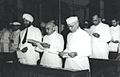
Jawaharlal Nehru and members taking a pledge during the historic independence session in August 1947.
-
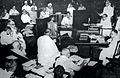
The Constituent Assembly of India meeting to finalize the Constitution.
-
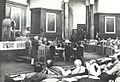
Jawaharlal Nehru speaking to the assembly in 1946.
-
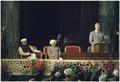
Prime Minister Morarji Desai listening to United States President Jimmy Carter address Parliament.
-
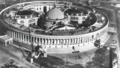
The original Parliament House during its final stages of construction in 1926.


See also
 In Spanish: Parlamento de la India para niños
- Election Commission of India
- Indian Parliamentary Group
- List of constituencies of the Lok Sabha
- List of legislatures by country
- Member of Parliament, Rajya Sabha
- Member of Parliament, Lok Sabha
- PRS Legislative Research
- Politics of India
