
Jardin des Plantes facts for kids

The exterior of the Grande Galerie de l'Évolution ('Gallery of Evolution'). Drawing plans by architect Louis-Jules André, 1889, when it still was named Galerie de Zoologie ('Gallery of Zoology').
|
|
| Lua error in Module:Location_map at line 420: attempt to index field 'wikibase' (a nil value). | |
| Established | 1635 |
|---|---|
| Location | Paris, France |
| Type | botanical garden |
| Visitors | 1,586,450 |
| Muséum national d'histoire naturelle network | |
|
|
The Jardin des Plantes (which means 'Garden of Plants' in French) is the most important botanical garden in France. It is often called the Jardin des Plantes de Paris to show it's the one in Paris. This amazing garden was first created in the 1600s to grow medicinal plants, which are plants used for medicine.
Today, the Jardin des Plantes is home to the National Museum of Natural History. It covers a huge area of 28 hectares (that's about 70 acres!) in the 5th part of Paris, right by the Seine river. The whole garden, with its buildings, libraries, greenhouses, and even a small zoo, is a special historical landmark. It's a place where you can explore nature, history, and science all at once!
Contents
Exploring the Jardin des Plantes
The Jardin des Plantes is a huge area with many exciting things to see. It has four main buildings, which are like special museums called 'galleries' by the French Museum of Natural History.
Discovering the Galleries
- The Gallery of Evolution (Grande Galerie de l'Évolution) opened in 1889. It was updated in 1994 to show how living things have changed and developed over millions of years. It's a fascinating journey through the history of life on Earth!
- The Gallery of Mineralogy and Geology (Galerie de Minéralogie et de Géologie) opened in 1837. Here, you can see amazing rocks, sparkling minerals, and ancient fossils.
- The Gallery of Paleontology and Comparative Anatomy (Galerie de Paléontologie et d'Anatomie Comparée) opened in 1898. This gallery is full of skeletons! You can compare the bones of different animals and see huge fossils of creatures from long ago.
- The Gallery of Botany (Galerie de Botanique) opened in 1935. It has laboratories where scientists study plants. It also holds the world's largest collection of dried plant samples, called a Herbarium, with almost 8 million specimens! There's also a small exhibition about plants.

Gardens and a Zoo
Beyond the galleries, the botanical garden itself is home to over 10,000 different kinds of plants. You can explore:
- Warm tropical greenhouses filled with exotic plants.
- A beautiful rose garden.
- A cozy winter garden.
- And an Alpine garden with plants from high mountains.
There's also a small zoo called the Ménagerie du Jardin des Plantes. It was started in 1795 with animals from the royal zoo at the Palace of Versailles, which closed during the French Revolution.
A Journey Through Time: The Garden's History
The Royal Garden of Medicinal Plants

The Jardin des Plantes began in 1635. King Louis XIII officially created it as the Royal Garden of Medicinal Plants. It was managed by the King's doctor, Guy de la Brosse. Teachers, called "demonstrators," taught students about plants, chemistry, and geology. They used the garden's collections to show how things worked.
Later, in 1673, King Louis XIV's doctor, Guy-Crescent Fagon, became the garden's director. A new amphitheater was built for medical studies and learning about the human body. Famous people like Claude Perrault, who also designed parts of the Louvre Palace, taught there.
In the 1700s, the garden grew. Greenhouses were made bigger to hold plants from scientific trips around the world. Scientists studied these new plants for their medical or cooking uses. For example, Antoine de Jussieu studied coffee plants from Java. His work helped start coffee farms in French colonies.
Buffon's Era of Growth (1739–1788)
-
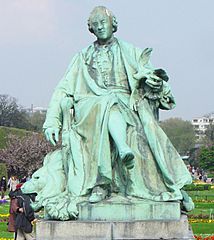
A statue of Georges-Louis Leclerc, Comte de Buffon in the garden.
-
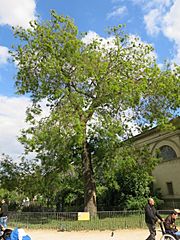
The Sophora Jussieu tree, planted by Buffon in 1747.


One of the most famous directors of the garden was Georges-Louis Leclerc, Comte de Buffon. He led the garden from 1739 until he passed away in 1788. Buffon lived right in the garden. He made the garden twice as big, stretching it all the way to the Seine river.
Buffon also brought many important scientists to work at the garden. One of them was Jean Baptiste Lamarck, who had early ideas about how living things change over time. Buffon sent explorers and botanists all over the world. They collected plants and animals for the garden and museum. These specimens were carefully studied and sorted.
This research led to discussions about how life on Earth changed over time. Scientists like Buffon believed that species slowly developed. Because the scientists had support from the King, they could continue their important studies.
The French Revolution and the 19th Century
-
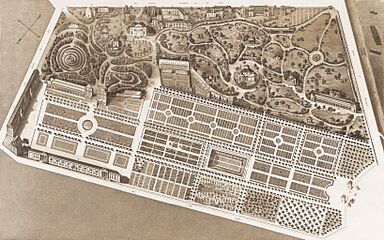
The Jardin des Plantes and Menagerie in 1842.
-
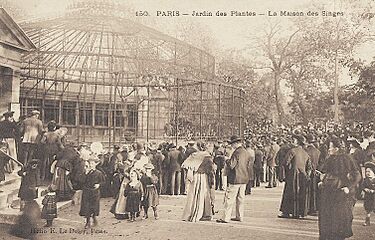
A crowd outside the Palace of the Apes around 1900.
-
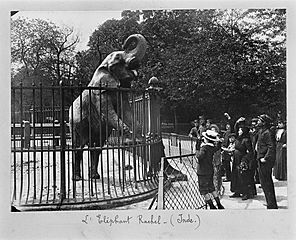
Rachel the elephant around 1905.


In 1793, during the French Revolution, the government changed the royal institutions. They combined the Royal Garden of Plants and the Cabinet of Natural Sciences. This created the Museum of Natural History. The museum also received many collections from noble families.
The museum and gardens also benefited from Napoleon's trip to Egypt in 1798. Many scholars, including botanists and astronomers, went with him. Their drawings and findings are now part of the Natural History Museum's collections.
The Menagerie is Born
A big addition to the garden in the late 1700s was the Ménagerie du Jardin des Plantes, a zoo. It was suggested in 1792 to save animals from the royal zoo at the Palace of Versailles. These animals had been left alone during the Revolution.
In 1795, the government bought a large estate next to the gardens. They moved the animals into big cages there. The menagerie had a tough start, but with more funding, it became a home for animals brought back from scientific trips. This included a famous giraffe given to King Charles X of France in 1827.
Discoveries and New Buildings (Late 1800s – 1900s)
Throughout the 19th and early 20th centuries, the garden and museums focused on research. Scientists made important discoveries here. Chemist Eugene Chevreul studied fatty acids and dyes. Physiologist Claude Bernard researched how the liver works.
In 1896, physicist Henri Becquerel discovered radioactivity in a museum laboratory. He found that uranium salts could affect photographic plates, even in the dark. He won the Nobel Prize in 1903 for this amazing discovery.
The Gallery of Paleontology and Comparative Anatomy opened in 1898. It displayed thousands of animal skeletons. The zoo also grew, with a huge Bird House built in 1888.
The main building, the Gallery of Zoology, was designed by Jules André. It opened in 1888 and had a grand iron structure. It was closed for a long time but reopened in 1994 as the Grand Gallery of Evolution. A massive underground storage area, the Zoothêque, was built beneath the Esplanade Milne-Edwards. It holds millions of specimens for researchers.
National Museum of Natural History
The National Museum of Natural History is sometimes called "the Louvre of the Natural Sciences." It has five main buildings along the formal garden: the Gallery of Evolution, Mineralogy and Geology, Botany, Paleontology and Comparative Anatomy, and the Laboratory of Entomology.
The Grand Gallery of Evolution
-
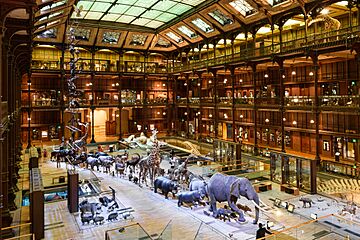
The courtyard of the Grand Gallery of Evolution.
-
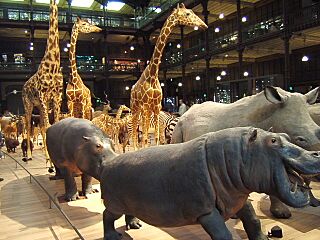
A parade of species inside the Grand Gallery of Evolution.
-
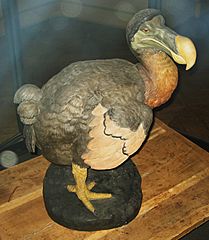
A model of a dodo in the section about endangered species.


The Grand Gallery of Evolution was designed by Jules André. It opened during the Paris World's Fair in 1889. The main front of the building, facing the garden, has medallions honoring ten famous scientists.
Inside, the building has a modern iron structure, similar to other grand buildings in Paris. It's a huge hall, 55 meters long and 15 meters high, with a glass roof. After a big restoration from 1991 to 1995, it now shows how species have evolved. It also highlights animals that have disappeared or are in danger.
Gallery of Mineralogy and Geology
-
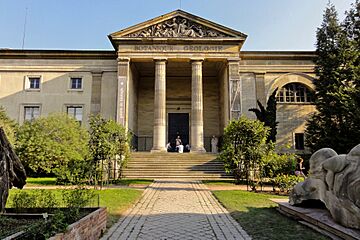
Inside the Gallery of Mineralogy and Geology.

In front of this gallery stands a Sophora Japonica tree, planted in 1747. The gallery itself was built between 1833 and 1837. It holds about 600,000 stones, gems, and fossils. One special exhibit is a petrified tree trunk from a bald cypress, found in France.
Gallery of Botany
-
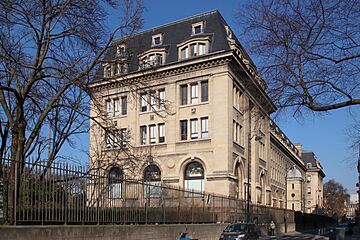
The Gallery of Botany building.
-
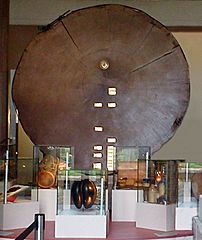
A slice of a giant Sequoia tree, 2200 years old.
-
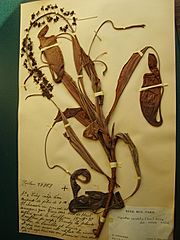
A preserved specimen of Nepenthes mirabilis from the National Herbarium.


The oldest tree in Paris, a "Robinier Faux Acacia" from America, stands in front of the Gallery of Botany. It was brought to France in 1601. The gallery was built from 1930 to 1935. It houses the National Herbarium, with 7.5 million plant specimens. The ground floor is used for temporary exhibitions.
Gallery of Paleontology and Comparative Anatomy
-
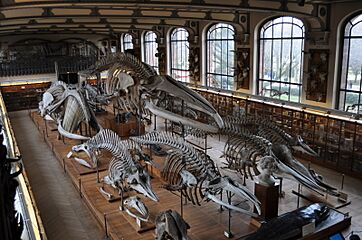
Inside the Gallery of Paleontology and Comparative Anatomy.
-
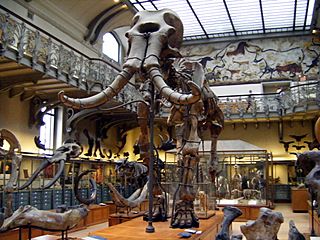
A southern mammoth skeleton in the gallery.
-
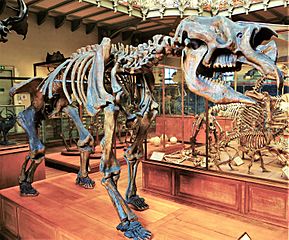
A skeleton of a Diprotodon.


This gallery is next to the Iris garden, which has 260 types of irises. The building was constructed between 1894 and 1897. It has beautiful iron stairways and details. Inside, you can see a huge collection of fossilized skeletons, including dinosaurs and other large animals.
Exploring the Gardens
The Formal Garden
-
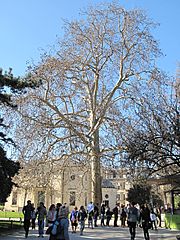
An Oriental plane tree planted by Buffon in 1785.
-
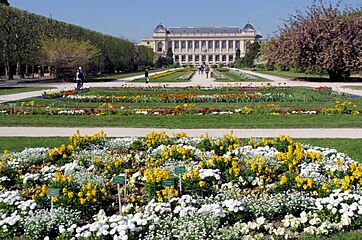
The beautiful formal gardens.
-
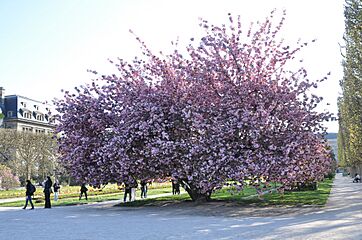
A Prunus serrulata 'Kanzan', or Japanese cherry tree.
.jpg)


The garden covers about 24 hectares (60 acres). It is surrounded by streets named after famous French scientists. The main entrance is on the east, along the Seine river.
This part of the garden is designed in a classic French style. It has a long path, 500 meters (about 547 yards) long, lined with neatly trimmed plane trees. Its rectangular flowerbeds hold over a thousand plants.
At one end of the formal garden is a statue of the botanist Jean-Baptiste Lamarck. At the other end, facing the Grand Gallery, is a statue of Georges-Louis Leclerc, Comte de Buffon.
Amazing Greenhouses
-
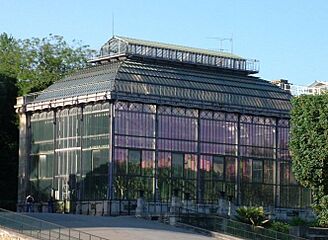
The "Serre Mexicaine" greenhouse, built from 1834 to 1836.
-
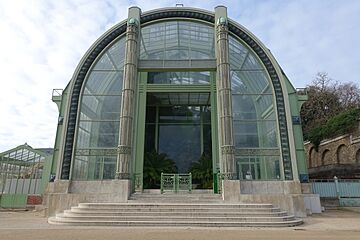
The Art Deco entrance of the "Jardin d'hiver" greenhouse.
-
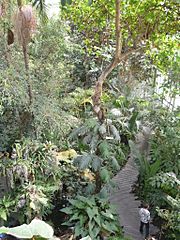
A path inside the "Jardin d'hiver" greenhouse.
-
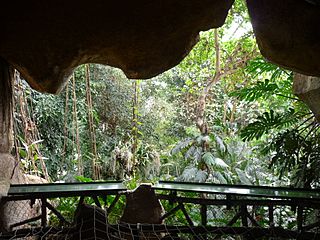
The interior of the "Jardin d'hiver" greenhouse.


Four large greenhouses stand in front of the Gallery of Evolution. They replaced older greenhouses from the 1700s. These were built to house plants brought from tropical places by explorers.
The Mexican greenhouse holds succulents, while the Australian greenhouse has plants from Australia. They were built between 1834 and 1836. Their iron and glass design was very new for Paris at the time.
A larger greenhouse, the "Jardin d'hiver" (Winter Garden), was finished in 1937. It has an Art Deco entrance. Its heating system keeps the inside at 22 degrees Celsius (72°F) all year. This creates a perfect home for bananas, palms, and other tropical plants. It even has a fifteen-meter-high waterfall!
The Alpine Garden
-
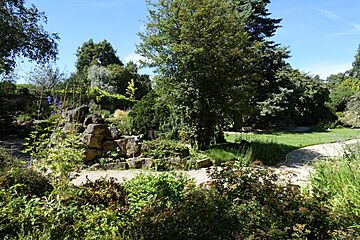
A view of the Alpine Garden.
-
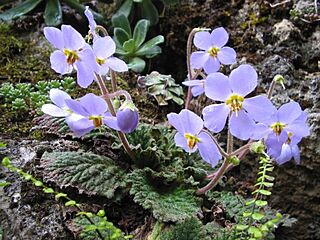
A Ramonda myconi flower from the Pyrenees.
-
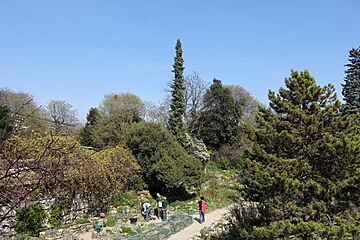
Another part of the Alpine Garden.
.jpg)

.jpg)
The Alpine Garden was created in 1931. It is higher than other parts of the garden. It has different microclimates, which are like tiny weather zones. This allows it to grow plants from places like Corsica, the Caucasus, North America, and the Himalayas.
The oldest plant here is a pistachio tree, planted around 1700. Another ancient tree is the metasequoia, or dawn redwood, a very old type of conifer.
The School of Botany Garden
-
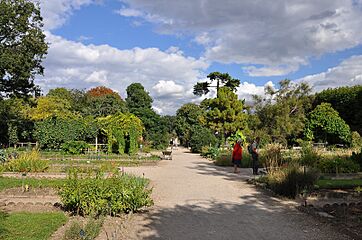
The School of Botany garden.
-
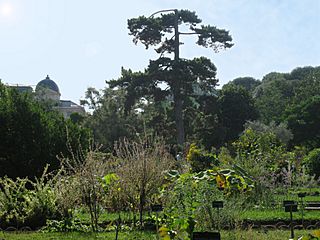
The black pine of Laricio, planted in 1774.
-
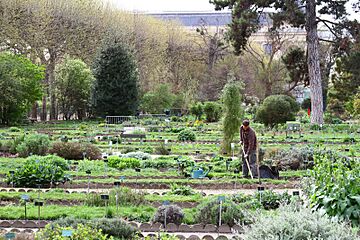
Another view of the School of Botany garden.


This large section focuses on plants used for medicine or for economic purposes. It was first created in the 1700s. Today, it has over 3,800 different plant specimens, organized by their type.
One special tree here is the "Pinus nigra" or black pine. This variety, called Laricio, comes from Corsica. It was planted in the garden by Bernard de Jussieu in the 1770s.
The Small Labyrinth
-
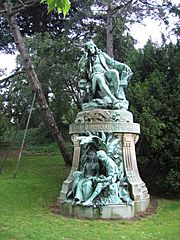
A monument to garden director Bernardin de Saint-Pierre.
-
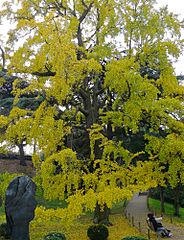
The Ginkgo biloba tree in the small labyrinth.
-
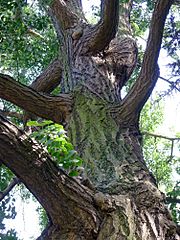
A close-up of the Ginkgo biloba tree.


This small garden is located behind the Winter Garden greenhouse. It features a large oriental plane tree, planted by Buffon in 1785. There's also a Ginkgo biloba tree, planted in 1811. This tree is considered a "living fossil" because its type has existed for millions of years.
In the center of the garden is a monument to Bernardin de Saint-Pierre. He was the last director of the garden appointed by the King before the French Revolution. He also created the menagerie.
The Grand Labyrinth and Gloriette
-
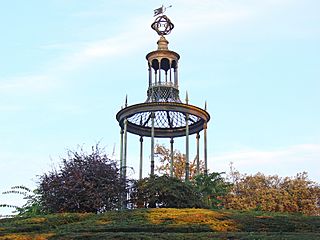
The Gloriette of Buffon at the top of the labyrinth.
-
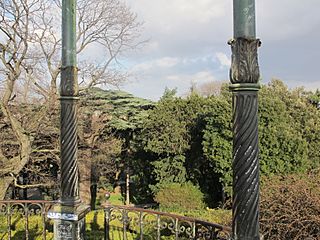
The view from the Gloriette, showing its iron columns.
.jpg)

The Grand Labyrinth has a winding path that leads to the top of the Butte Copeaux, a hill overlooking the garden. It was first created under Louis XIII. At the start of the path is a Cedar of Lebanon, planted in 1734.
At the top of the hill is a beautiful viewing platform called the Gloriette de Buffon. It was made of cast iron, bronze, and copper in 1786–87. It is considered the oldest metal structure in Paris. The Gloriette has eight iron columns and a roof shaped like a Chinese hat.
Nearby, you can find the Lion Fountain, built in 1834. It is decorated with two bronze lions made in 1863.
The Menagerie: A Historic Zoo
-
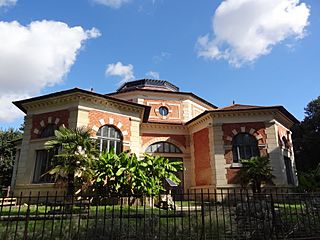
The Rotonda building, built from 1804 to 1812.
-
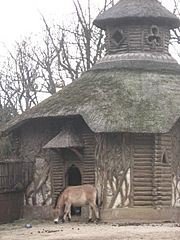
A shelter for horses, like those of Przewalski.


The Menagerie is the second-oldest public zoo in the world that is still open today. It was founded in 1752. It covers about 5.5 hectares (13.6 acres). Besides showing and studying animals, its important job is to help protect endangered species. It works with other zoos to save animals and, hopefully, reintroduce them into nature.
The menagerie has many fenced areas with paths between them. Each area has unique shelters for the animals, from rustic to Art Deco styles. The largest building is the Rotonda, built between 1804 and 1812. It used to house large animals like elephants. In 1934, most of the big animals moved to the new zoo in the Bois de Vincennes.
-
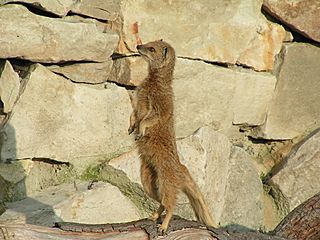
A mongoose at the Jardin des Plantes.
-
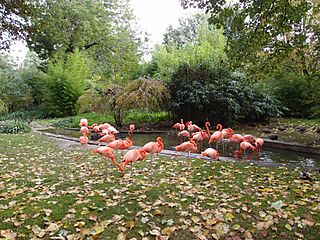
Flamingos enjoying their habitat.
-
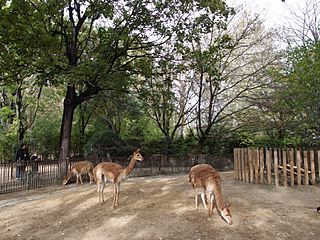
Vicunas grazing in the Menagerie.


Other important buildings include the Grand Volerie, a large birdhouse built in 1888. The Palace of Reptiles was built between 1870 and 1874. The Vivarium, built in 1926, is a modern building with an Art Deco entrance. The Art Deco Ape House from 1934 also housed apes before they moved to Vincennes.
Collection of Fossil Plants
-
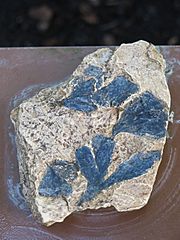
A fossil of Ginkgo digitata from Yorkshire, 170 million years old.
-
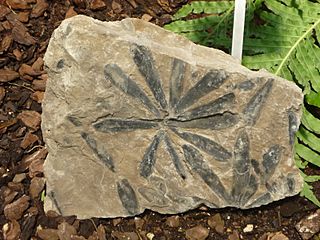
Fossil leaves of Cordaites lungatus.
-
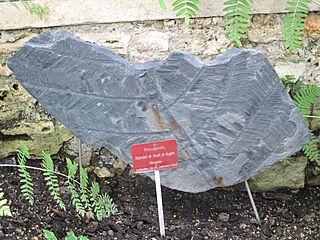
Imprints of the extinct fern Pecopteris from France, 300 million years old.
-
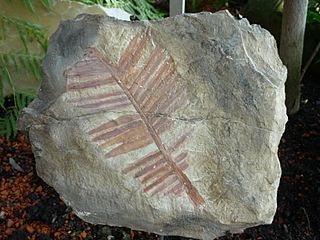
Fossil leaves of Zamites feneonis.
_-_Fossil.jpg)

.jpg)

The garden has a large collection of fossil plants from all over the world. Some of these ancient plant remains are displayed in the garden's greenhouses.
Other Historic Buildings in the Gardens
-
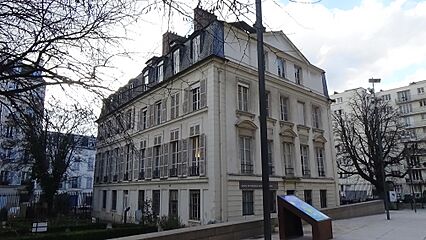
The Maison Buffon, where Georges-Louis Leclerc, Comte de Buffon lived.
-
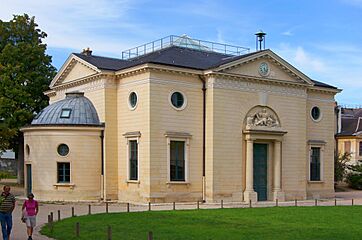
The Amphitheater, built in the 18th century.
-
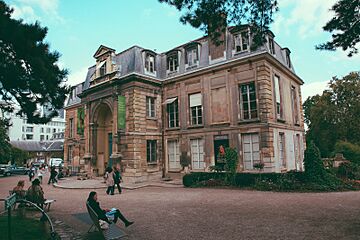
The Hôtel de Magny, the garden's administration building.


- The Maison de Buffon was the home of Georges-Louis Leclerc, Comte de Buffon. He was the director and main creator of the gardens from 1739 until his death in 1788. This house is not open to the public.
- The Cuvier House was the home of scientist Georges Cuvier until 1832. Cuvier helped start the study of paleontology. He was the first to identify a mastodon skeleton as a prehistoric animal. A plaque on the house marks where Henri Becquerel discovered radioactivity in 1896. This house is also not open to the public.
- The Cuvier Fountain is across the street from the garden. It honors George Cuvier with his statue surrounded by various animals. It was built in 1840.
- The Amphitheater was built in 1787–88. It was a place for lectures on natural science and discoveries from the gardens. The building was restored in 2002–2003.
- The Pavilion of New Converts is a historical building that once provided shelter for people. It was the home and laboratory of chemist Eugene Chevreul for 28 years. He lived to be 103 and died there in 1899. Chevreul developed the use of color wheels to define colors.
- The Hôtel de Magny is the administration building for the gardens. It was built around 1700 as a residence. The house and its land were bought by Buffon in 1787 to make the gardens larger. It is not open to the public.
Gardens and Sites Connected to the Jardin des Plantes
-
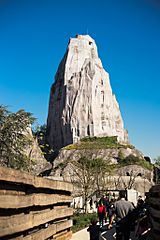
The artificial mountain in the Paris Zoological Park.
-
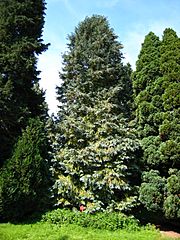
A Chamaecyparis lawsoniana tree in the Arboretum de Chèvreloup.
-
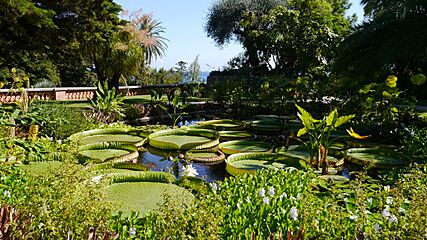
A view of the Jardin botanique exotique de Menton.
-
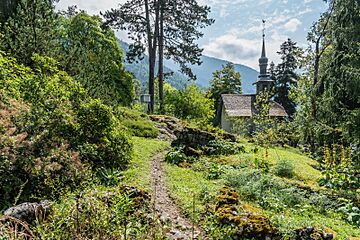
The Alpine Garden of Jaysinia in Haut-Savoie.
.jpg)


- The Paris Zoological Park was created in 1934. It is in the Bois de Vincennes. This park provides more space for larger animals like giraffes and elephants. It has a large artificial rock, 65 meters (213 feet) high. It also includes a huge greenhouse that simulates a tropical rainforest.
- The Parc des Clères in Normandy specializes in birds and certain four-legged animals, including kangaroos.
- The Arboretum de Chèvreloup, near Versailles, was founded in 1927. It covers 222 hectares (548 acres) and grows species from seeds collected worldwide.
- The Jardin botanique exotique de Menton is near Menton. It specializes in tropical and Mediterranean plants.
- The Animal Park of la Haute Touche focuses on helping endangered species reproduce in a large natural setting.
- The Alpine Garden of Jaysinia at Samoëns specializes in high-altitude plants from around the world.
See also
 In Spanish: Jardín de plantas de París para niños
- List of botanical gardens in France
- Friends of the Natural History Museum Paris
