
Jolly Roger facts for kids
.png)

.jpg)
The Jolly Roger is the famous flag flown by pirate ships long ago. Pirates used this flag to show who they were, especially before or during an attack. This happened mostly in the early 1700s, which was a busy time for pirates. Most of these flags showed a human skull, often with other symbols, on a black background. People sometimes called it the "Death's Head flag" or simply the "black flag."
The flag we think of as the Jolly Roger today, with a skull and crossbones on a black background, became popular in the 1710s. Famous pirate captains like Samuel Bellamy, Edward England, and John Taylor used it. By the 1720s, it was the most common pirate flag, though other designs also existed.
Contents
Where Did the Name "Jolly Roger" Come From?

The name Jolly Roger for pirate flags has been around since at least 1724. That's when Charles Johnson published his book, A General History of the Pyrates. The name doesn't seem to be connected to anyone named Roger.
Johnson wrote that two pirates, Bartholomew Roberts in 1721 and Francis Spriggs in 1723, both called their flags "Jolly Roger." However, their flags looked very different. This suggests that "Jolly Roger" was a general term for any black pirate flag, not just one specific design. Neither Spriggs's nor Roberts's flags had the skull and crossbones we often imagine.
In 1724, a man named Richard Hawkins was captured by pirates. He said the pirates had a black flag with a skeleton holding a spear and stabbing a heart. They also called this flag "Jolly Roger." This description matches flags used by several pirates from that era.
An old newspaper from 1723 mentioned pirates calling their flag "Old Roger." This was a nickname for death. The newspaper described a black flag with a picture of Death holding an hourglass and a dart, striking a heart with three drops of blood. The pirates said they would "live and die under it."
Some people used to think the name came from "Joli Rouge," which means "Pretty Red" in French. This was supposedly for red flags used by French privateers. Others thought it came from an Indian pirate named "Ali Rajah." But historians don't have any old records to support these ideas.
A Look Back: The History of Pirate Flags
The skull-and-crossbones symbol on flags first appeared in the 1600s. It might have started with the Barbary pirates. They sometimes used a black flag, which could be linked to the black flags used by some Muslim groups. However, some early reports mention these pirates using a skull symbol on a green flag.
There are stories of English privateer Francis Drake flying a black flag in 1585, but it's hard to know if this is true. Records show Peter Easton used a plain black flag in 1612. Other pirates like Captain Martel (1716), Charles Vane, and Richard Worley (1718), and Howell Davis (1719) also used plain black flags.
One of the earliest records of the skull-and-crossbones on a flag (a red one) by pirates is from 1687. This flag was used on land, not on a ship.


In the 1600s and 1700s, British privateers (who were like legal pirates working for the government) had to fly a special flag. This flag helped people tell them apart from the Royal Navy. Before this, privateers like Sir Henry Morgan used the Red Ensign flag.
One of the first times a black flag with a skull, crossbones, and hourglass was used was by pirate captain Emanuel Wynn around 1700. This information comes from reports by Captain John Cranby of HMS Poole.
After a big war ended in 1714, many privateers became pirates. They still used red and black flags, but they started adding their own designs. For example, Edward England flew three different flags on his ship. One was the black Jolly Roger, another was a red version of it, and a third was the Red Ensign. Red flags sometimes had yellow stripes or symbols of death. Pirates also used colorful streamers and ribbons.
Historians believe that by 1730, the skull-and-crossbones design became very common. This was around the same time the name Jolly Roger became widely used.
How Pirates Used Their Flags
Pirates didn't always fly the Jolly Roger. The flag was a way to tell other ships who they were. This gave the target ship a chance to surrender without a fight. For example, in 1720, when Bartholomew Roberts sailed into a harbor in Newfoundland with black flags flying, the crews of all 22 ships there quickly left their vessels in fear.
Black and Red: Pirate Signals

(Mercy offered)

(No mercy)
During the later years of piracy, the Jolly Roger was part of a flag system. This system used a "black flag" (the Jolly Roger) and a "red flag," often called a bloody flag.
 The "black flag" meant that if the target ship surrendered its goods, the pirates would show mercy. This meant the crew would be safe after giving up.
 The "red flag" meant that no mercy would be shown. The pirates would take the ship's goods by force, and no lives would be spared during the attack.
When a pirate ship approached another vessel, it usually flew a false flag (a flag that wasn't its own) or no flag at all. They waited until they were close enough to attack. Pirate ships, like other vessels, carried many different flags for various reasons.
Once the target ship was close, the pirates would raise the black flag. Often, they would also fire a warning shot. This told the target ship that pirates were attacking and encouraged them to surrender without a fight. If a ship surrendered, it meant they would cooperate with the pirates. Sometimes, the pirates would even leave some of the cargo alone as a reward. To show they were surrendering, the victim ship would lower its own flag.
If the enemy didn't lower their flag after warning shots, the pirates would raise the red flag. This signaled that they would take the cargo by force and show no mercy. If the pirates had several ships, the red flag could also be a signal for all their ships to attack. Pirate captain Jean Thomas Dulaien would wait for the enemy to fire three or more cannon shots after seeing the red flag before ordering a full attack with no mercy.
The red flag was not just for pirates; other navies also used it. The idea of using both black and red flags was mentioned by Richard Hawkins in the mid-1700s. However, not all pirates used this exact tactic. For example, Charles Vane would take down his St. George's Flag and raise a black flag with a skull, meaning he would neither give nor take mercy.
Why These Flags Were Important
It was very important for a ship to know if its attacker was a pirate or a government ship. Government ships usually had rules that said if a crew resisted but then surrendered, they couldn't be harmed.
Pirates, however, were more dangerous. An angry pirate might harm a crew even after they surrendered. Because of this, merchant ships might have been more willing to fight government ships than pirates. To get ships to surrender without a costly fight, pirates needed to make it clear they were pirates.
Flying a Jolly Roger was a sure way to show you were a pirate. Just having or using a Jolly Roger was proof that someone was a pirate, not a legal privateer. Only a pirate would dare fly the Jolly Roger, as they were already facing serious punishment if caught.
What Did Jolly Rogers Look Like?
Before 1700, pirates often used plain black flags along with red ones. Symbols started appearing on flags in the 1700s.
Different Jolly Roger designs might have been like personal calling cards for pirate crews. This could make enemies surrender more easily if they recognized a pirate's reputation. However, old records don't mention this directly. Often, flag details were hard to see from far away. So, the designs might have been more for the crew's own identity. Most pirates used similar designs, perhaps to share in the reputation of others. This led to the skull and crossbones becoming the most common symbol.
Pirates sometimes also flew national flags to show where they were from or who they supported.
Common Symbols on Pirate Flags


Here are some common symbols found on Jolly Roger flags:
- Skull and crossbones: The skull, often called "death's head," showed death and danger. It reminded people of the pirates' tough and deadly reputation. The crossbones, usually behind or below the skull, looked like an "X." They symbolized crossed swords or bones.
- Human skeleton: This was a common way to show the idea of death.
- Hourglass: This symbol meant that the time for the attacked ship was running out.
- Bundle of arrows: This was an older symbol, but on pirate flags, it likely meant tools of death.
- Sword: A clear symbol of fighting and death.
- Sword arm: An arm holding a sword, also meaning death and battle. This was a common symbol on naval flags, not just pirate ones.
- Pistol: Another symbol of weapons and death.
- Cannon: Representing powerful weapons and destruction.
- Powder horn or signal horn: These could also symbolize tools of death or signals for attack.
Modern Uses of the Jolly Roger
The Jolly Roger isn't just a symbol from the past. It's still used today, especially by submarines.
Submarines and the Jolly Roger

Around 1900, when submarines were new, a British admiral named Sir Arthur Knyvet Wilson didn't like them. He called them "underhanded" and said enemy submarine crews captured during wartime should be punished like pirates.
In September 1914, the British submarine HMS E9 successfully sank a German ship. Remembering the admiral's words, the submarine's commander, Max Horton, had his crew make a Jolly Roger. They flew it as the submarine returned to port. After each successful mission, Horton's submarine would fly another Jolly Roger. Eventually, he had a large flag made where symbols were sewn on to show all of E9's achievements. A few other submarines also started this tradition.
The practice became popular again during World War II. In October 1940, after HMS Osiris sank an Italian destroyer, the submarine was given a Jolly Roger to celebrate its success. After this, leaders of submarine groups started giving these flags to successful submarines. While not all British submarines used the flag, those who did would fly it on the day they returned from a successful mission. It would be raised as the boat entered port and stay up until sunset.

The symbols on the flag told the submarine's story. The crew was responsible for keeping their flag updated. The Royal Navy Submarine Museum has many of these flags and recognizes 20 different symbols. For example, a bar meant a ship was torpedoed (red for warships, white for merchant ships, black with a "U" for U-boats). A dagger meant a secret mission, like dropping off or picking up people from enemy land. Stars meant the deck gun was used. A sea mine symbol showed minelaying missions. A lighthouse or torch meant the submarine helped guide an invasion force. A lifebuoy meant they rescued people. Some symbols were unique, like a can-opener on HMS Proteus's flag, after an Italian ship tried to ram it and got damaged. HMS United added a stork and baby when its commander became a father during a patrol.
Flying the Jolly Roger continues today. HMS Conqueror flew a flag with a cruiser silhouette after sinking the Argentine cruiser ARA General Belgrano during the Falklands War. Submarines that fire Tomahawk cruise missiles often fly Jolly Rogers with tomahawk axes on them.
Other Groups Using the Flag

The Jolly Roger is not only used by British submarines. During World War II, Allied submariners working with the Royal Navy also adopted the practice. Polish submarines ORP Sokół and ORP Dzik received Jolly Rogers and updated them throughout the war. Some British surface ships also used Jolly Rogers to mark their U-boat victories. The Australian submarine HMAS Onslow flew the Jolly Roger in 1980 after successfully "sinking" seven enemy ships during a training exercise.
During the Vietnam War, U.S. Seabee Battalions needed to build an airfield quickly at Quảng Trị. This involved moving many graves. The detachments working on this called themselves the Ghost Battalion and chose the Jolly Roger as their symbol.
Also during the Vietnam War, U.S. Marine Corps Radar Technicians at Monkey Mountain flew a Jolly Roger from their radar. It has since become a symbol for Aviation Radar Technicians.
The Kuperjanov Infantry Battalion in the Estonian Land Forces uses the Jolly Roger as its badge.
Three different U.S. Naval Aviation squadrons have used the name and symbol of the Jolly Roger: VF-17/VF-5B/VF-61, VF-84, and VF-103 (now VFA-103). Even though they are different squadrons, they all share the Jolly Roger name and traditions.
At least twice in 2017, the USS Jimmy Carter, an American attack submarine, returned to its home port flying a Jolly Roger. This flag traditionally indicates a successful mission.
The three American destroyers named USS Kidd have all flown the Jolly Roger. They were named after US Navy Rear Admiral Isaac C. Kidd, not the pirate William Kidd.
The Jolly Roger is also often seen on patches worn by private security contractors.
The Jolly Roger as a Symbol of Protest
The Jolly Roger has also been used as a symbol of protest. Soviet-Swiss chess master Viktor Korchnoi offered to play under the Jolly Roger when he was not allowed to use the Swiss flag during the World Chess Championship 1978. The Jolly Roger was also used in anti-government protests in Hungary in 2011.
Straw Hat Pirates' Jolly Roger
The Straw Hat Pirates' Jolly Roger, from the story One Piece, was used during protests in Indonesia in 2025. Truck drivers first flew this flag to protest government rules. They also refused to fly Indonesian flags as part of their demonstration.
In response, the Indonesian government called the flag a threat to national unity. They said waving the flag was a serious act against the government. Various government groups tried to ban this flag.
The Straw Hat Pirates' Jolly Roger was also used as a sign of protest in Nepal in 2025.
More About Pirate Flags
- Flag of Blackbeard
- Bloody flag
- Crossed Swords Jolly Roger – a design often seen in stories
- Old Roger (Jolly Roger) – an older historical design
Related Topics
- Anarchist flag
- Maritime flag
- Ossuary
- Skull emoji
- Totenkopf
- VF-61, VF-84 and VF-103, US Navy fighter squadrons nicknamed "Jolly Rogers"
Images for kids
-
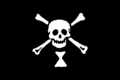
Interpretation of Emanuel Wynn's pirate flag, described as "a sable ensigne with Cross bones, a Death's head, and an hour glase".
-
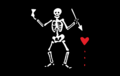
Interpretation of the "Old Roger" design, as described for several pirates, such as Edward Low, Charles Harris, and Francis Spriggs.
-

Interpretation of a death's head flag used by various pirates such as Edward "Blackbeard" Teach, Stede Bonnet, Charles Vane, Thomas Anstis, Captain Kennedy, Christopher Condent, and Howell Davis.
-
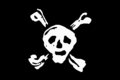
Interpretation of Stede Bonnet's flag, also a description of Blackbeard's flag.
-
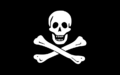
Interpretation of Edward England, John Taylor and Samuel Bellamy's Jolly Roger.
-
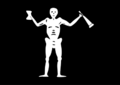
Another flag used by Samuel Bellamy.
-
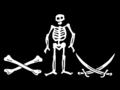
Another of Levasseur's pirate flags.
-
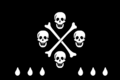
Another of Levasseur's pirate flags.
-
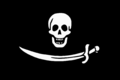
Interpretation of Bartholomew Roberts' Jolly Roger.
-
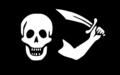
Interpretation of Bartholomew Roberts' Jolly Roger.
-

Interpretation of Edward Low's second flag.
-
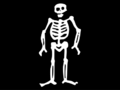
Interpretation of a flag used by various pirates such as John Cole, George Lowther, Richard Worley, and James Skyrme.
-
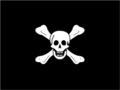
Richard Worley's death's head flag.
-

Another Howell Davis flag.
-
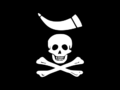
Interpretation of a flag Commodore Roggewein described in 1721.
-

Captain Napin's flag.
-
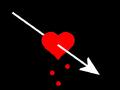
Thomas Nichols' flag.
-
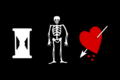
The flag of John Phillips.
-
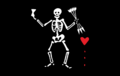
Flag associated with William Moody.
-
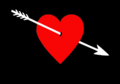
Another flag associated with William Moody.
-
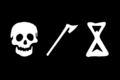
Interpretation of a pirate flag described by William Falconer.
-
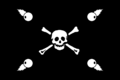
Interpretation of the Jolly Roger flag depicted on an 1811 painting of a 1796 battle.
-

Another of Jeremiah Cocklyn's flags.
-

Another of Jeremiah Cocklyn's flags.
-
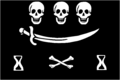
Another flag design by Dulaein.
-
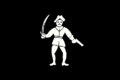
Pirate flag of Philip Lyne.
-
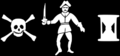
Pirate flag of Captain Kennedy.
-

Alongside the black flag, Dulaien also flew a red pennant.
-

Interpretation of Bartholomew Sharp's pirate flag.
-

A plain red flag used by John Coxon.
-
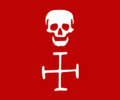
Interpretation of an unknown pirate flag from the Florida Straits.
-
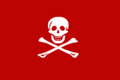
Interpretation of a French filibusters flag from 1688.
-

Bloody flag used by the 17th century Dutch navy.
-

A Spanish Guarde Costa flag encountered in 1731.
-

Flag of the privateers in the service of the League of the Free Peoples.
-

Flag with a Berbian head used by Algerian privateers.
-

A plain blue flag used by Claes Gerritszoon Compaen and Laurens de Graaf.
-
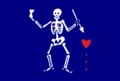
According to one source, Charles Harris used a blue version of the Old Roger flag.
-

A green Barbary corsairs flag with a skull on it.
-

A plain green flag used by Peter Harris.
-
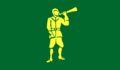
Described by George Roberts after his capture by Edward Low.
-
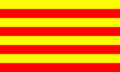
A pirate flag used by Richard Sawkins.
-
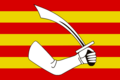
A flag used by Edmund Cooke.
-
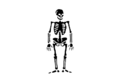
Interpretation of the pirate flag of Olivier "La Buse" Levasseur.
-
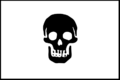
Another flag of Olivier Levesseur.
-

Flag of buccaneer Edward Davis.
-

The pirate flag of John Rackham.
-

Flag of the privateers in the service of the League of the Free Peoples.
-
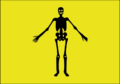
Described by privateer George Shelvocke.
-

The Prinsenvlag used by Dutch pirates.
-

The Flag of England used by John Quelch.
-

Jeremiah Cocklyn's pirate flag.
-

Thomas Anstis' pirate flag.
-
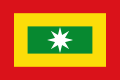
The flag of the United Provinces of New Granada, later used by Jean Lafitte.
-

Flag of the Maltese corsairs.
-
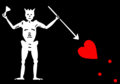
This flag may be incorrectly attributed to Blackbeard.
-
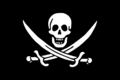
The Crossed Swords Jolly Roger, popularly attributed to John Rackham, is a modern invention.
-
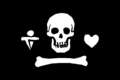
Traditional depiction of Stede Bonnet's flag.
-

Popular version of Henry Every's Jolly Roger.
-

The 1724 book A General History of the Pyrates credited Every with flying a black flag with two crossed bones.
-
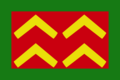
According to a ballad, Every's "shield" was red with four gold chevrons.
-
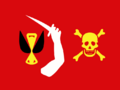
Supposedly a flag of Christopher Moody’s, this was a generic "sea rover" design.
-
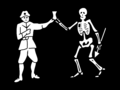
Said to be Roberts' first flag.
-
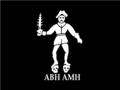
Said to be Roberts' new flag.
-
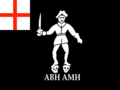
Said to be an early rendition of Roberts' second flag.
-
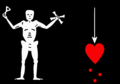
One of Roberts' flags described in Johnson's General History.
-
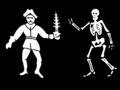
One of Roberts' flags described in Johnson's General History.
-

Tew's personal standard is often depicted as a black flag with a white arm holding a short sword.
-
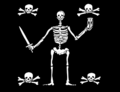
Anne Bonny and Mary Read's Jolly Roger depicted on a book cover from 1725.


.svg)


_3.svg)
_5.svg)
.svg)
.svg)


.png)


.svg)


.svg)
_of_pirate_Philip_Lyne.svg)


.svg)

.svg)


_Levasseur_Pirate_Flag.svg)
.svg)


.svg)

.svg)


.svg)
.svg)


