
List of Adenanthos species facts for kids
Welcome to the amazing world of Adenanthos plants! These unique shrubs are mostly found in Western Australia, and they're often called "woollybushes" or "jugflowers" because of their soft, hairy leaves or their interesting flower shapes. This list will help you discover some of the different kinds of Adenanthos species, subspecies, and even some natural hybrids (mixtures of two different plants).
Contents
- What Makes Adenanthos Special?
- Discovering Different Adenanthos Species
- Adenanthos acanthophyllus (Prickly Woollybush)
- Adenanthos barbiger (Hairy Glandflower)
- Adenanthos cuneatus (Coastal Jugflower)
- Adenanthos cygnorum (Common Woollybush)
- Adenanthos detmoldii (Scott River Jugflower)
- Adenanthos dobagii (Fitzgerald Woollybush)
- Adenanthos macropodianus (Kangaroo Island Gland Flower)
- Adenanthos meisneri (Prostrate Woollybush)
- Adenanthos obovatus (Basket Flower)
- Adenanthos pungens (Spiky Adenanthos)
- Adenanthos sericeus (Coastal Woollybush)
- Adenanthos velutinus (Velvet Woollybush)
- Images for kids
What Makes Adenanthos Special?
Adenanthos plants are known for their beautiful flowers and interesting leaves. They come in different sizes, from small shrubs that spread along the ground to taller ones that can grow like small trees.
How Do They Grow?
Some Adenanthos plants have a special underground woody stem called a lignotuber. This helps them survive bushfires. If the plant above ground burns, new shoots can grow from this hidden stem. Other plants don't have this lignotuber.
What Do Their Leaves Look Like?
The leaves of Adenanthos can be quite varied:
- Holly-like: Like the spiky leaves of a holly plant.
- Entire or lobed: Leaves that are smooth-edged (entire) or have gentle curves (lobed).
- Laciniate: Leaves that are deeply cut into many fine, narrow segments, almost like a comb or a feather. This often gives them a soft, woolly look.
What About Their Flowers?
Adenanthos flowers come in many colors, including shades of red, pink, cream, yellow, and orange. They are often shaped like small tubes or jugs, which is why some are called "jugflowers."
Discovering Different Adenanthos Species
Let's explore some of the fascinating Adenanthos species and their unique features.
Adenanthos acanthophyllus (Prickly Woollybush)
This is a tall shrub that can regrow from its lignotuber after a fire. It has holly-like leaves and flowers that range from dark red to pale pink-red. You can find it near Shark Bay in Western Australia, growing in sandy soils that used to be part of the ocean. It lives in scrub or heathland areas.
Adenanthos barbiger (Hairy Glandflower)
This small shrub also has a lignotuber. Its leaves can be smooth or lobed, and its flowers are a bright scarlet red. It grows in lateritic gravel (a type of rocky soil) in open forests, from Toodyay to Manjimup and Augusta in Western Australia.
Adenanthos cuneatus (Coastal Jugflower)
The Coastal Jugflower is a medium-sized shrub, sometimes growing low to the ground. It has deeply cut, laciniate leaves and beautiful crimson (deep red) flowers. It likes sandy soils and is found along the coast from Walpole to Twilight Cove.

Adenanthos cygnorum (Common Woollybush)
This plant can be a tall shrub or even grow flat along the ground. It has soft, laciniate leaves and flowers that can be light pink, cream, or green. It's found over a wide area, from Kalbarri to Arthur River, growing in lateritic soils or sand.
Adenanthos cygnorum subsp. cygnorum
This is the most common type of Common Woollybush. It grows as a tall shrub and sometimes even like a small tree. It has the same laciniate leaves and light-colored flowers. It thrives in open forests, scrub, or heathland.

Adenanthos detmoldii (Scott River Jugflower)
This tall shrub does not have a lignotuber. Its leaves are either smooth or lobed, and its flowers are a striking mix of yellow and orange/brown. It prefers peaty and waterlogged soils, found in scrub or heathland near the Scott River and Whicher Range. This species is considered a Priority 4 plant in Western Australia, meaning it needs monitoring.

Adenanthos dobagii (Fitzgerald Woollybush)
A small shrub without a lignotuber, the Fitzgerald Woollybush has laciniate leaves and pale cream or pink flowers. It grows in thin, rocky soils (skeletal soils) in the Fitzgerald River National Park. This plant is listed as Endangered under the EPBC Act and is considered Rare in Western Australia, meaning it's very important to protect it.
Adenanthos macropodianus (Kangaroo Island Gland Flower)
This medium-sized shrub doesn't have a lignotuber. It has laciniate leaves and red-pink flowers. As its name suggests, it's found on Kangaroo Island in South Australia, growing in lateritic soils or sand in open forests, scrub, or heathland.

Adenanthos meisneri (Prostrate Woollybush)
This medium shrub often grows low to the ground and has a lignotuber. Its leaves are laciniate, and its flowers are red-purple or purple. It grows in sandy soils from the Swan River area down to Point D'Entrecasteaux, found in open forests, scrub, or heathland.

Adenanthos obovatus (Basket Flower)
The Basket Flower is a small shrub with a lignotuber. Its leaves are smooth or lobed, and its flowers are a vibrant scarlet. It grows in various soils, including rocky, sandy, and peaty, often in waterlogged areas. You can find it from Gingin to Augusta and Green Range, and also near Narrogin, in open forests, scrub, or heathland.

Adenanthos pungens (Spiky Adenanthos)
This plant can be a medium shrub or grow low to the ground, and it doesn't have a lignotuber. It has laciniate leaves and pale or dark pink flowers. It grows in rocky or lateritic sandy soils in scrub or heathland near Tambellup and Hamella Hill.
Adenanthos pungens subsp. effusus (Sprawling Spiky Adenanthos)
This subspecies grows low to the ground and has pale pink flowers. It is found near Tambellup and is listed as Endangered under the EPBC Act and Rare in Western Australia.
Adenanthos pungens subsp. pungens
This subspecies grows as a medium shrub with dark pink flowers. It is found near Hamella Hill and is listed as Vulnerable under the EPBC Act and Rare in Western Australia.
Adenanthos sericeus (Coastal Woollybush)
The Coastal Woollybush is a tall shrub, sometimes even a small tree, without a lignotuber. It has laciniate leaves and scarlet flowers. It grows in rocky soils and marine sands along the coast, from King George Sound to Warriup, Cape Le Grand, and Cape Arid.
Adenanthos sericeus subsp. sericeus
This subspecies is a tall shrub with scarlet flowers, found at Cape Le Grand and Cape Arid.

Adenanthos velutinus (Velvet Woollybush)
This tall shrub does not have a lignotuber. It has laciniate leaves and red-purple or purple flowers. It grows in rocky soils near Cranbrook and is listed as Endangered under the EPBC Act and Rare in Western Australia.
Images for kids
-
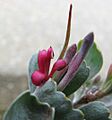
The crimson flowers of the Coastal Jugflower (Adenanthos cuneatus).
-
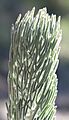
The soft, woolly leaves of Adenanthos cygnorum.
-
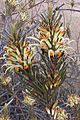
The unique yellow and orange flowers of Adenanthos detmoldii.
-
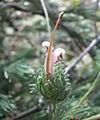
A close-up of the Kangaroo Island Gland Flower (Adenanthos macropodianus).
-
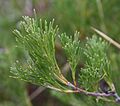
The distinctive foliage of Adenanthos meisneri.
-
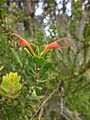
The bright scarlet flowers of the Basket Flower (Adenanthos obovatus).
-
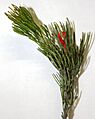
A sprig of Coastal Woollybush (Adenanthos sericeus) with a flower.
