
Loyalist (American Revolution) facts for kids


Loyalists were colonists in British America who chose to remain loyal to the British king during the American Revolution. They were also known as Tories, Royalists, or King's Men. The term "Loyalist" became common around 1774, as tensions grew before the war. Those who supported the revolution called themselves Patriots or Whigs. They saw Loyalists as people who were against American freedom.
Many Loyalists believed that thousands of people would join the British army to fight for the King. The British government hoped this would happen, especially during their campaigns in the southern colonies in 1780 and 1781. However, Britain could only protect Loyalists in areas where their army had control. This meant fewer Loyalists joined the military than expected. British soldiers sometimes even suspected Loyalists, unsure who they could truly trust.
Patriots watched suspected Loyalists closely and did not allow them to organize against the revolution. Many Loyalists who spoke out or fought were forced to leave their homes. A major safe place for them was New York City. William Franklin, the governor of New Jersey and son of the famous Patriot leader Benjamin Franklin, became a Loyalist leader after being released from a Patriot prison in 1778. He worked to create Loyalist military groups to fight in the war.
When the British lost the war, about 65,000 to 70,000 Loyalists (around 15% of all Loyalists) left the United States. They moved to other parts of the British Empire, especially to the Kingdom of Great Britain or to British North America (which is now Canada). There, they became known as United Empire Loyalists. Most received land in Canada or money from the British government to make up for their losses. Loyalists from the southern colonies often moved to East or West Florida or to British islands in the Caribbean. Loyalists who stayed in the United States usually kept their property and became American citizens. Many who left eventually returned to the US after the war, once laws against them were removed. Historians believe that between 15% and 20% of the white population in the colonies in 1775 were Loyalists.
Contents
Why People Chose to Be Loyalists
The American War of Independence was not just a fight between countries; it was also like a civil war that divided families. A famous example is Founding Father Benjamin Franklin and his son, William Franklin, who was the last royal governor of New Jersey. Many colonists felt they were both American and British, and they believed they should remain loyal to their home country. Most Americans hoped for a peaceful solution, but the Patriots took control in most places by 1775–76, forcing people to choose sides.
Historians have found several reasons why people remained loyal to the King and Britain:
- They were often older and had established lives, so they didn't want big, sudden changes.
- They believed that rebelling against the King, who was the rightful ruler, was morally wrong. They saw themselves as British people living in the colonies.
- They felt upset when Patriots used violence, like destroying property or giving people harsh public punishments.
- Some had strong business or family connections with Britain, and being part of the British Empire was important for their trade.
- They thought that more freedom or self-rule would come eventually, but they wanted it to happen peacefully, not through a revolution.
- They worried that a revolution would lead to chaos, corruption, and mob rule.
- Some were "pessimists" who didn't share the Patriots' strong belief in a bright future for an independent America.
Other reasons for loyalism included:
- They believed in the power of the British Parliament and the need for a stable legal system.
- Some felt weak or threatened within American society and looked to the British King and Parliament for protection.
- Black Loyalists were promised freedom from slavery by the British if they joined their side.
Both the British and the American Patriots offered freedom and land to enslaved people who would fight for them. These enslaved people who joined the British became known as Black Loyalists. Many of them later settled in Nova Scotia and Sierra Leone. During the war, British governors like Lord Dunmore offered freedom and land to enslaved people who escaped and served the British.
Who Were the Loyalists?
Historians estimate that about 15% to 20% of white adult men in the colonies were Loyalists. Roughly half of the colonists tried to stay out of the conflict, including pacifists (people who oppose war) and recent immigrants. The Patriots received active support from about 40% to 45% of the white population.

Loyalists were found in all colonies, but many lived in the middle colonies. For example, many tenant farmers in New York and many Dutch people in New York and New Jersey supported the King. Many Germans and Quakers in Pennsylvania tried to stay neutral, but if forced to choose, they often stuck with the familiar British connection. Highland Scots in the Carolinas, many Anglican church members, and a large number of the Iroquois Native American tribes also remained loyal.

After the British army captured New York City and Long Island in 1776, this area became the main British base in North America until 1783. Many Loyalists, including those who had fled from other states, gathered there.
Loyalists often tended to be older and wealthier, but there were also many Loyalists who were not rich. Many active members of the Church of England became Loyalists. Recent immigrants from Britain, especially from Scotland, also had a high number of Loyalists. In areas controlled by Patriots, Loyalists faced difficulties. Their property could be taken away, and those who openly supported the King were sometimes threatened with public shaming or physical attacks. This treatment warned other Loyalists not to openly support the British.
Black Loyalists and Their Fight for Freedom

As the crisis grew in 1775, the British Royal Governor of Virginia, Lord Dunmore, made a promise. He said that enslaved people and indentured servants who could fight and join his Loyalist regiment would gain their freedom. Many enslaved people in the South joined the Loyalists, hoping to escape slavery. About 12,000 African Americans served with the British between 1775 and 1783. This also led the Patriots to offer freedom to enslaved people who would serve in the Continental Army, and thousands of Black Patriots fought for the American side.
Women During the Revolution
While men were fighting, women played a crucial role at home, protecting their land and property. When the war ended, many Loyalist men left America, leaving their wives and daughters to look after their homes. Loyalist families often had their property taken away. However, married women had some protection under a law called "feme covert," which meant their legal rights were linked to their husbands. This made it tricky for committees to take away a woman's land just because of her husband's actions. In many cases, women didn't choose if they were called a Loyalist or a Patriot; it depended on their husband's political side. Still, some women showed their loyalty to the King by continuing to buy British goods and by resisting the Patriots. Grace Growden Galloway, for example, wrote in her diary about her family's struggles when their property was seized by Patriots.
Patriots allowed women to be more involved in politics than Loyalists did. Writers like Catharine Macaulay and Mercy Otis Warren were politically active. They were friends for 20 years, even though Macaulay wrote from a British Loyalist view and Warren supported the American Revolution.
Loyalty in Canada and Nova Scotia

In the months before the war, American Patriot agents tried to convince people in Quebec (which was then called "Canada") to join the revolution. However, many people in Quebec stayed neutral. Most of Quebec's French Canadians were happy with the British government's Quebec Act of 1774, which allowed them religious and language freedom. They generally didn't support a revolution led by Protestants from New England, who were their business rivals. Most English-speaking settlers had arrived after Britain took control of Canada in 1759–60, so they were unlikely to want to separate from Britain. Older British colonies like Newfoundland and Nova Scotia also remained loyal and sent soldiers to support the King.
In late 1775, the American Continental Army tried to invade Quebec to get its residents to join the revolution. But they were stopped by the British military, difficult weather, and a lack of support from local people. The American forces were driven out of Quebec in 1776.
In Nova Scotia, many settlers were originally from New England and generally supported the idea of revolution. However, their support faded as American privateers (armed ships) attacked Nova Scotia communities throughout the war. The Nova Scotia government also punished people for supporting the Patriot cause. Britain built strong forces at the naval base in Halifax, which helped keep the region loyal.
Loyalists in Battle
Loyalists often did not organize politically on their own. They usually remained quiet unless British army units were nearby. However, the British believed that many Loyalists were ready to fight and planned much of their war strategy around forming Loyalist regiments. About 19,000 Loyalists joined the British forces as soldiers or militia members at different times during the war.
In the early days of the Revolutionary War, Patriots took control of most areas where there were few British troops. They seized weapons and gunpowder. Loyalists who spoke out recruited others, often with help from royal governors. In South Carolina, more Loyalists joined up than Patriots at first. However, Patriot militias soon arrested or drove out most Loyalist leaders in the backcountry. Loyalists from South Carolina later fought for the British in battles like the Battle of Camden.
By July 4, 1776, Patriots controlled almost all the territory in the Thirteen Colonies and had removed all British officials. Anyone who openly declared loyalty to the King had to flee or stay silent. Some who remained later helped invading British armies or joined Loyalist regiments. The British were forced out of Boston in March 1776. They then attacked New York in August, capturing New York City and the surrounding area, which they held until 1783. British forces also took control of other cities, including Philadelphia (1777), Savannah, Georgia (1778–83), and Charleston, South Carolina (1780–82). However, most colonists lived outside these cities, meaning the American Congress still represented the majority of the population.
Black Loyalists helped the British in battles in Virginia, fighting for their freedom. In Canada, the American invasion of Montreal in November 1775 was successful, but they were stopped at Quebec City a month later. Quebec then became a base for raids by Loyalists and Native Americans against American frontier communities. In 1777, 1,500 Loyalist militia fought in the Saratoga campaign in New York, surrendering with the British General Burgoyne.
Life After the Revolution
Leaving America
.jpg)
After the war, many Loyalists left the newly formed United States. Historians estimate that around 60,000 people, including about 50,000 white Loyalists, moved to other British territories. They went to places like New Brunswick, Nova Scotia, Quebec, and Prince Edward Island in British North America (Canada). Others went to Florida, the Caribbean islands like Jamaica and the Bahamas, or directly to Britain.
Many Loyalists chose to leave because they faced continued hostility in the United States or because their loyalty to the King was very strong. Those who had deeper roots, family ties, and property in America were more likely to stay. However, a small number of those who left eventually returned to the United States.
The Loyalists who moved to Canada had a big impact on its history. In 1789, Governor Lord Dorchester declared that families who had remained loyal to the British Empire should be honored. As a result, many Loyalist descendants in Canada used the letters "U.E." after their names, standing for "Unity of the Empire." The Loyalists' strong ties to Britain and their dislike of the United States helped keep Canada independent and distinct in North America. New provinces like Upper Canada (now Ontario) and New Brunswick were created as safe places for these United Empire Loyalists.
Some wealthy Loyalists who went to Britain received pensions to help them rebuild their lives. Many Southern Loyalists took their enslaved people with them to the West Indies. Some Loyalists also brought enslaved people to Canada, where slavery was legal at the time. However, a law passed in 1793 in Upper Canada, called the Act Against Slavery, tried to limit slavery by stopping the sale of enslaved people to the United States and freeing enslaved people who escaped from the US into Canada.
Thousands of Iroquois and other Native Americans who had supported the British were forced to leave New York and other states. They resettled in Canada, with one large group, led by Joseph Brant, settling at Six Nations of the Grand River.
For the Black Loyalists, the British kept their promise of freedom. In New York City, General Guy Carleton created a document called the Book of Negroes, listing the names of African Americans who had helped the British and granting them freedom. About 4,000 Black Loyalists went to Nova Scotia and New Brunswick, where they were promised land. They founded new communities, with over 2,500 settling in Birchtown, Nova Scotia, which became the largest free Black community in North America. However, they faced long waits for land and prejudice from white Loyalists, leading to events like the Shelburne riots in 1784. Because of these difficulties, about 1,200 Black Loyalists left Nova Scotia in 1791 to settle in the new colony of Sierra Leone in West Africa, where they named the capital Freetown.
Staying in America
The great majority of Loyalists, about 80% to 85%, never left the United States. They stayed and became citizens of the new country. Many states eventually removed their anti-Loyalist laws by 1787. Some former Loyalists even became important leaders in the new nation, such as Samuel Seabury, who became the first Bishop of the Episcopal Church.
In states like South Carolina, which had seen a lot of internal conflict, a policy of reconciliation was adopted. Many Loyalists who had fought for the British were pardoned if they switched sides and joined the Patriots. Others had to pay a fine. Most Loyalists who appealed to the government were forgiven. In Connecticut, moderate leaders even welcomed Loyalists back, believing their skills and money would help the state's economy.
Changes After Loyalists Left
The departure of many royal officials, wealthy merchants, and landowners who were Loyalists changed the social structure of the colonies. It created opportunities for new Patriot leaders and merchants to rise. For example, in New York, the absence of powerful families like the De Lanceys opened the way for others to gain influence. In Boston, a Patriot noted in 1779 that "fellows who would have cleaned my shoes five years ago, have amassed fortunes and are riding in chariots." This showed how new people, often with a spirit of equality, replaced the old elite.
The Patriots' alliance with Catholic France for military and financial help also led to a big decrease in anti-Catholic feelings. For the Patriots, the King became the main enemy, replacing the Pope. By the 1780s, Catholics were given legal tolerance in all New England states, which had previously been very hostile towards them.
Loyalists in Art and Stories


-
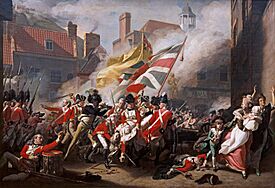
John Copley's The Death of Major Pierson
-
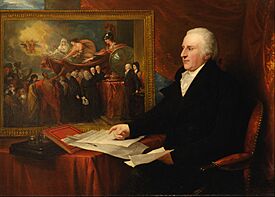
Benjamin West's Reception as a detail of John Eardley Wilmot
Artists like John Singleton Copley and Benjamin West painted many prominent Loyalists and scenes related to their experiences. Gilbert Stuart also painted a portrait of James De Lancey.
Loyalists have also appeared in many stories and books:
- The Adventures of Jonathan Corncob, Loyal American Refugee (1787) by Jonathan Corncob.
- "Rip Van Winkle" (1819), a short story by Washington Irving.
- The Spy: a Tale of the Neutral Ground (1821), a novel by James Fenimore Cooper.
- Oliver Wiswell (1940), a novel by Kenneth Roberts.
- The Book of Negroes (2007) by Lawrence Hill.
- The Fort (2010), a novel by Bernard Cornwell.
Famous Loyalists
- Benedict Arnold, a Patriot general who later joined the British side.
- Jonathan Boucher, an Anglican priest in Maryland.
- Thomas Brown, a Georgia planter and British officer.
- William Franklin, son of Benjamin Franklin and governor of New Jersey.
- Joseph Galloway, a speaker of the Pennsylvania Assembly.
- Thomas Hutchinson, the royal governor of Massachusetts.
- Boston King, a former enslaved person who became a Black Loyalist.
See also
 In Spanish: Lealista (Guerra de Independencia de los Estados Unidos) para niños
- Monarchism in the United States
- American Revolution – Nova Scotia theatre
- List of places named for Loyalists (American Revolution)
- Maryland Loyalists Battalion
