
Machu Picchu facts for kids
|
Machu Pikchu
|
|
| Lua error in Module:Wikidata at line 70: attempt to index field 'wikibase' (a nil value).
Machu Picchu in 2023
|
|

 Location in Peru

Location in South America
|
|
| Alternative name | Machupicchu |
|---|---|
| Location | Machupicchu District, Urubamba, Cusco, Peru |
| Region | Andes |
| Coordinates | 13°09′48″S 72°32′44″W / 13.16333°S 72.54556°W |
| Altitude | 2,430 m (7,972 ft) |
| Type | Llaqta (settlement) |
| History | |
| Founded | c. 1450 – c. 1470 |
| Abandoned | c. 1532 – c. 1565 |
| Cultures | Inca civilization |
| Site notes | |
| Discovered | Agustín Lizárraga (1902) Hiram Bingham (1911) |
| Condition | Preserved |
| Ownership | Peruvian Government |
| Management | Peruvian Ministry of Culture |
| Public access | Yes |
| UNESCO World Heritage Site | |
| Official name | Historic Sanctuary of Machu Picchu |
| Location | Latin America and the Caribbean |
| Criteria | Mixed: i, iii, vii, ix |
| Inscription | 1983 (7th Session) |
| Area | 38,160.87 ha (94,297.6 acres) |
Machu Picchu is an amazing ancient city built by the Incas high in the Andes mountains of southern Peru. This incredible stone city sits on a mountain ridge about 2,430 meters (7,970 feet) above sea level. It's located about 80 kilometers (50 miles) northwest of Cusco, overlooking the beautiful Sacred Valley and the Urubamba River. The area has a warm, humid mountain climate.
Many people call Machu Picchu the "Lost City of the Incas." It's one of the most famous symbols of the Inca people and a very important archaeological site in the Americas. The Incas built it around 1450. Experts believe it was a special estate for the Inca emperor Pachacuti. The city was left empty about 100 years later, probably around the time the Spanish arrived in Peru. Recent scientific tests show people lived there from about 1420 to 1530.
The buildings at Machu Picchu show off the amazing Inca architecture. They have finely built stone walls that fit together perfectly without mortar. Some famous buildings include the Temple of the Sun, the Temple of the Three Windows, and the Intihuatana stone. Local people knew about Machu Picchu for a long time. The Peruvian explorer Agustín Lizárraga visited in the early 1900s. But it was an American historian, Hiram Bingham III, who shared it with the world in 1911. Some believe its original Inca name might have been Huayna Picchu.
Peru declared Machu Picchu a National Historic Sanctuary in 1981. In 1983, UNESCO named it a World Heritage Site. It was also chosen as one of the New Seven Wonders of the World in 2007. In recent years, over 1.5 million people visit Machu Picchu every year. This makes it Peru's most popular international tourist spot.
Contents
What's in a Name?
Machu Picchu sits between two mountain peaks: Machu Picchu and Huayna Picchu. In the Quechua language, which the Incas spoke, machu means 'old'. Wayna (or huayna in Spanish) means 'young'. And pikchu means 'peak' or 'mountain'. So, Machu Picchu often means 'old mountain' or 'old peak'.
We don't know the exact name the Incas gave this city. But a study from 2021 suggests it might have been called "Huayna Picchu." This name comes from the smaller mountain next to it. The name "Machu Picchu" became popular after Hiram Bingham III wrote about it in 1911.
A Glimpse into the Past
Historians still discuss the exact timeline of Machu Picchu. Many believe construction started around 1450. This was about ten years after Emperor Pachacuti took power. However, a 2021 study used scientific dating methods on human remains. It found that people lived in Machu Picchu from about 1420 to 1530. It seems two great Inca emperors, Pachacuti and Túpac Inca Yupanqui, oversaw its building.
Most archaeologists agree that Emperor Pachacuti ordered Machu Picchu to be built. It was a special royal estate after he conquered the Urubamba Valley. It might have been a seasonal retreat for the emperor and his family. The city was used for about 80 years. It was then abandoned, likely because of the Spanish arrival in other parts of the Inca Empire. Many people living there might have also gotten sick from diseases like smallpox. These diseases arrived with travelers even before the Spanish soldiers reached the area.
Daily Life in the Ancient City

About 750 people lived in Machu Picchu when it was active. Most were support staff, called yanaconas, who lived there all the time. Even though it was Emperor Pachacuti's estate, religious leaders and skilled workers also lived there. They likely helped with the emperor's comfort and spiritual needs. In winter, fewer people stayed, mainly servants and religious specialists for upkeep.
Scientists have studied the bones found at Machu Picchu. They discovered that many residents came from different parts of the Inca Empire. These people had diverse backgrounds, including from the Andes, the coast, and even the Amazon. They lived, had families, and were buried together in Machu Picchu. Their bones showed signs of diets from various regions of Peru. This suggests they moved to Machu Picchu from other places. For example, some might have come from coastal areas. Their diet changed to include more corn once they arrived. Interestingly, these residents had fewer signs of arthritis and broken bones. This was different from people in other Inca sites. It means they likely didn't do as much heavy physical labor.
Animals were also part of life in Machu Picchu. Bones of llamas and alpacas were found, even though these animals usually live at higher altitudes. They were likely brought from other regions for their meat and wool. Guinea pigs were also found in special tomb caves. This suggests they were used in important ceremonies, possibly as offerings or for food. Six dogs were also found near human remains. It is thought they were companions to the people who passed away.
Farming the Mountain Slopes
.jpg)
The Incas were clever farmers. They grew most of their crops on hundreds of man-made terraces, called andenes. These terraces were amazing feats of engineering. They helped drain water well and kept the soil rich for farming. They also protected the mountain from erosion and landslides. Even so, some landslides happened during construction. The Incas were able to stabilize these areas and continue building.
The terraces also helped manage water for farming. This increased the amount of food grown. Maize (corn) was likely the most important crop. This was because of its special meaning in Inca ceremonies. Potatoes were also grown.
However, the farming area was only about 12 acres (4.9 hectares). Studies show this wasn't enough food for all 750 people living there. This means food was also brought in from nearby valleys. The area gets a lot of rain, over 1,800 mm (70 inches) per year. So, the terraces didn't need much extra watering. Inca engineers designed them to drain excess water. They built the terraces in layers. There were large stones at the bottom, then gravel, then sand and gravel, and finally rich topsoil. This topsoil was probably brought from the valley floor.
Special Ceremonies and Offerings
In Inca religion, special offerings were important. These were often made at sacred places called huacas. At Machu Picchu, there is little direct proof of human offerings. Instead, archaeologists found many animal offerings, especially llamas and alpacas. The Temple of the Condor and nearby caves might have been places for these rituals.
Many camelid bones found at the site are linked to burial rituals and other ceremonies. About 104 caves and rock shelters around Machu Picchu were used as burial places. They held the remains of about 174 people. These people were mostly support staff from different backgrounds, not the Inca elite.
Rediscovery and Modern Times
The Spanish Arrival and Abandonment

Machu Picchu was likely abandoned in the mid-1500s. This was around the time of the Spanish conquest. The Inca government collapsed, and diseases brought by Europeans spread. Later in the 1500s, Spanish records mention local people talking about "Huayna Picchu." This is believed to be the original name for the site.
Over many centuries, the jungle grew over the city. Few people outside the local area knew it existed. Some believe a German engineer, Augusto Berns, might have found and explored it in the late 1800s. Maps from as early as 1874 show references to Machu Picchu. A 1904 map even labeled it as Huayna Picchu.
Explorers and Their Discoveries

.jpg)
In 1902, Peruvian explorer Agustín Lizárraga led a trip to the area. After clearing thick plants, they found the stone city. Lizárraga carved his name and the year, "A. Lizárraga 1902," on a window of the Temple of the Three Windows.
In 1911, American historian Hiram Bingham III was searching for a lost Inca capital. A local villager, Melchor Arteaga, led him to Machu Picchu. Bingham found Lizárraga's carving. He was initially disappointed, thinking someone else had already discovered it. Bingham wrote in his journal, "Agustín Lizárraga is discoverer of Machu Picchu."
While Bingham first recognized Lizárraga, he later claimed to have found the site himself. He argued that he made Machu Picchu known to the world. Bingham organized another expedition in 1912. This team cleared the site and began excavations. Even though Bingham wasn't the first to visit, he is known for bringing Machu Picchu to international attention.
Bringing Artifacts Home
.jpg)
Between 1912 and 1915, Hiram Bingham took thousands of artifacts from Machu Picchu. These included pottery, silver statues, jewelry, and human bones. He took them to Yale University for study, promising to return them in 18 months. However, Yale kept the artifacts for many years. They argued that Peru didn't have the right facilities to care for them.
After many discussions, Yale agreed to return the disputed artifacts. The last group of items was delivered in November 2012. These artifacts are now on display at the Machu Picchu Museum–Casa Concha in Cusco. This museum is owned by the National University of San Antonio Abad del Cusco.
Ongoing Research
After Bingham's trips, Peru carried out restoration and limited excavations. From the 1970s to the 1990s, more focused digs and conservation projects took place. These found Inca artifacts like pottery, stone tools, and metal objects. Between 2014 and 2017, a special research program studied the site. They clarified how it was built, recorded offerings, and learned more about its purpose and people. Recent scientific dating confirms that Machu Picchu was mainly built and used in the early to mid-15th century.
Protecting a Treasure
Nature and Wildlife at Machu Picchu

In 1981, Peru created a "Historic Sanctuary" around Machu Picchu. This protected area covers about 325.92 square kilometers (125.84 square miles). It includes the ruins and a large part of the surrounding region. This area is rich in diverse plants and animals.
Machu Picchu is home to many species. You might find the Andean fox, puma, vizcacha, spectacled bear, and white-tailed deer. Over 420 types of birds live here, such as the cock-of-the-rock and the Andean condor. The sanctuary also has more than 550 tree species.
In 1983, UNESCO named Machu Picchu a World Heritage Site. They called it a "masterpiece of art, urbanism, architecture and engineering." It is also a "unique testimony" to the Inca civilization. This protection covers both the ancient city and its natural surroundings.
The Town Below the Ruins

Below the ruins, along the Urubamba River, is the modern town of Machu Picchu. It's also known as Aguas Calientes (meaning "hot springs"). This town has a post office, a train station, hotels, and other services for tourists. The train station is called Puente Ruinas. Tourist trains arrive here every morning from Cusco and return every afternoon. There is also a luxury hotel on the mountain, close to the ruins.
Machu Picchu has special connections with other towns around the world. It is officially twinned with places like Haworth in the United Kingdom, Fukushima in Japan, and Petra in Jordan.
Visiting Machu Picchu Today

Machu Picchu is a very popular place to visit. Since Hiram Bingham's expedition, more and more tourists have come each year. In recent years, visitor numbers have gone over 1.5 million annually. This makes it Peru's most visited tourist spot.
To protect the site, there are rules about how many people can visit. In the 1980s, a helicopter landing zone was created, but this practice was later stopped. In 2006, plans for tourist flights over the site were canceled. In January 2010, heavy floods closed Machu Picchu temporarily. It reopened on April 1, 2010.
To manage tourism, stricter rules were put in place in July 2011. The number of daily visitors was limited to 2,500. In 2018, a new entrance system was added. In 2024, the daily visitor limit was officially increased to 4,500. Up to 5,600 visitors are allowed during busy times.
In May 2012, UNESCO asked for more protection for the area around Machu Picchu. This was due to the fast growth of Aguas Calientes. Sadly, some tourists have died from altitude sickness, floods, or accidents. In 2014, there was a trend of inappropriate behavior by some tourists. This led to increased security to stop such actions.
Fernando Astete, who managed the National Archaeological Park of Machu Picchu for many years, received an award in 2020. This recognized his great work in preserving and studying Machu Picchu.
Machu Picchu closed to visitors in March 2020 because of the COVID-19 pandemic. In October 2020, it briefly opened for one stranded Japanese tourist. It reopened in November 2020 after eight months. Initially, only 675 visitors were allowed daily with strict health rules. During the 2022–2023 Peruvian protests, routes to Machu Picchu were blocked. Thousands of tourists were stranded and had to be airlifted out. Because of these problems, the site closed on January 22, 2023, and reopened on February 15, 2023.
Where is Machu Picchu?
.jpg)
Machu Picchu is in the Southern Hemisphere, about 13 degrees south of the equator. It is 80 kilometers (50 miles) northwest of Cusco. The city sits on the crest of Machu Picchu mountain, about 2,430 meters (7,970 feet) above sea level. This is over 1,000 meters (3,280 feet) lower than Cusco. Because of this, Machu Picchu had a milder climate than the Inca capital. It is one of the most important archaeological sites in South America. It is also one of the most visited tourist spots in Latin America and the most visited in Peru.
The Mountain's Secrets
Machu Picchu is located above a bend in the Urubamba River. The river surrounds the site on three sides. Cliffs drop vertically for 450 meters (1,476 feet) to the river below. The area often has morning mists rising from the river. Some believe the Incas chose this secret location for its sacred features. It might have been a special refuge for Inca leaders.

The city sits in a saddle between the Machu Picchu and Huayna Picchu mountains. It has views down two valleys. A nearly impassable mountain is behind it. The ground is mostly granite rock. The farming terraces, covering about 4.9 hectares (12 acres), helped the city's design. They also protected against water runoff and erosion. These terraces were built with stone walls and good soil drainage. At least ten Inca roads connect the city to nearby places. The main way to enter is through Inti Punku (Sun Gate). Another important path crosses the Inca Bridge.
Machu Picchu and other sites in the area are built over earthquake faults. Research from 2019 suggests this might not be a coincidence. The fault lines provided a natural source of already broken rock. This made it easier to find building materials.
Climate
Machu Picchu has a subtropical highland climate. This is found between the valley floor and the city's altitude. The average yearly rainfall is 2,010 mm (79 inches). The average yearly temperature is about 18°C (64°F). The site has steep slopes, thick plants, and a lot of rain. This leads to high humidity, usually 80–90%. The area is also often covered in clouds, like a cloud forest.
| Climate data for Machu Picchu (elevation 2,399 m (7,871 ft), 1991–2020 normals) | |||||||||||||
|---|---|---|---|---|---|---|---|---|---|---|---|---|---|
| Month | Jan | Feb | Mar | Apr | May | Jun | Jul | Aug | Sep | Oct | Nov | Dec | Year |
| Mean daily maximum °C (°F) | 20.6 (69.1) |
20.6 (69.1) |
21.0 (69.8) |
21.5 (70.7) |
21.9 (71.4) |
22.0 (71.6) |
22.1 (71.8) |
23.1 (73.6) |
23.4 (74.1) |
22.8 (73.0) |
22.8 (73.0) |
21.2 (70.2) |
21.9 (71.5) |
| Mean daily minimum °C (°F) | 11.8 (53.2) |
11.9 (53.4) |
11.9 (53.4) |
11.7 (53.1) |
10.8 (51.4) |
10.0 (50.0) |
9.4 (48.9) |
10.0 (50.0) |
11.1 (52.0) |
11.5 (52.7) |
12.0 (53.6) |
12.0 (53.6) |
11.2 (52.1) |
| Average precipitation mm (inches) | 340.7 (13.41) |
324.5 (12.78) |
340.6 (13.41) |
184.1 (7.25) |
73.4 (2.89) |
50.8 (2.00) |
54.2 (2.13) |
60.6 (2.39) |
76.2 (3.00) |
163.0 (6.42) |
172.5 (6.79) |
275.4 (10.84) |
2,116 (83.31) |
| Source: National Meteorology and Hydrology Service of Peru | |||||||||||||
Exploring the Ancient City's Design
City Layout and Sections

Machu Picchu is divided into two main parts. The first is the agricultural sector to the southeast. This area has many terraces for farming. The second is the urban sector to the northeast. This part contains homes, temples, and storage buildings. The urban sector is further split into an upper town (Hanan) and a lower town (Hurin).
The Hanan section includes the Sacred Plaza. This courtyard complex has the Main Temple and the Temple of the Three Windows. It also has a stone platform where the Intihuatana stone stands. The Hurin section has trapezoidal doorways and small rectangular compounds called kanchas. These include three large compounds with houses and workshops. They overlook the Main Square. There is also a large building thought to be an Acllahuasi (House of Chosen Women). Nearby is the Temple of the Condor, with ritual caves and a large carved stone.
The city's architecture fits perfectly with the mountains. About 200 buildings are arranged on wide terraces around a central square. The compounds, called kanchas, are long and narrow. This design made the best use of the land. Smart water channels provided water for the fields. Stone stairways built into the walls allowed access to different levels. The eastern part of the city was likely for homes. The western part, separated by the square, was for religious ceremonies. This section has the Torreón, a large tower that might have been an observatory.
The Popular District, or Residential District, was where common people lived. It had storage buildings and simple houses. The Guardian's house is a three-sided building. This style of Inca architecture is called wayrona. In 2005 and 2009, the University of Arkansas made detailed laser scans of the entire site. These scans help researchers study the ruins.
Important Buildings to See
The Temple of the Sun

The Torreón, or Temple of the Sun, is a round, two-part building. It is built among large granite blocks in the upper town. It sits on a rock above what Bingham called the "Royal Mausoleum." Like other important Inca temples, it has a curved wall. The lower part fills a cave-like space. It has finely crafted stone walls with trapezoidal niches. The natural rock here was shaped into steps and platforms.
The upper part sits on a shaped rock. This rock is surrounded by some of the city's best stonework. The top of the rock has carved steps and platforms. It also has a Z-shaped edge, often thought to be an altar. The upper chamber's wall has niches and three openings. The eastern and southeastern openings have stone pegs. The northern opening looks like a door but is damaged. A trapezoidal opening, called the “Serpent’s Door,” leads to a small platform. This platform overlooks pools and offers a view of Huayna Picchu. Studies suggest the Torreón was used for rituals and ceremonies related to the sun.
The Intihuatana Stone
.jpg)
.jpg)
The Intihuatana is a special stone located on a terraced hill in the urban sector. The Incas used this ritual stone. Its name comes from Quechua and means "place where the sun is tied." It is believed to point directly at the Sun during the winter solstice.
While its exact use is still discussed, many experts don't think it was a simple solar calendar. Instead, it might have been used for observing the sun's position horizontally. It was also aligned with sacred mountains and important directions. On November 11 and January 30, the Sun is almost directly above the pillar at midday, casting no shadow. On June 21, it casts the longest shadow on its south side. On December 21, it casts a much shorter shadow on its north side. Its location likely had a special meaning, connecting it to nearby peaks like Veronica, Salcantay, and Huayna Picchu.
Inti Mach'ay: Cave of the Sun Feast
Inti Mach'ay is a unique cave used for observing the Royal Feast of the Sun. This festival was celebrated during the Inca month of Qhapaq Raymi. It started earlier in the month and ended on the December solstice. On this day, noble boys became men through an ear-piercing ritual. They stood inside the cave and watched the sunrise.
Inti Mach'ay is considered one of the most important structures at Machu Picchu. Its entrances, walls, steps, and windows show some of the finest Inca stonework. The cave has a tunnel-like window, which is rare in Inca buildings. It's designed so that sunlight enters only for a few days around the December solstice. This precise alignment suggests Inti Mach'ay was a solar observatory. It was connected to the Capac Raymi festival. Inti Mach'ay is on Machu Picchu's eastern side, north of the "Condor Stone." Many caves in this area were used as tombs, but there is no evidence that Mach'ay was a burial ground.
The Temple of the Three Windows

The Temple of the Three Windows stands on the eastern side of the Sacred Plaza. This plaza is a 16-meter (52-foot) by 16-meter (52-foot) terrace in the heart of Machu Picchu's urban sector. Its single trapezoidal wall is built from large, finely worked white granite blocks. The way these blocks fit together is unique to the site.
This wall has three very large trapezoidal openings. Their tops and sides are each carved from single stones. Two smaller niches flank these openings. Four terraces at the base of the wall support the platform outside.
From inside the temple, you can see both sunrise and sunset over the ruins and mountains. It seems it once had a roof made of wood. During his 1911 visit, Hiram Bingham found a charcoal carving on the central window. It read "Lizárraga 1902," left by Agustín Lizárraga. This carving appeared in Bingham's early photos. It showed that local people knew about and had cleared parts of the site before Bingham arrived.
How the Incas Built Machu Picchu
.jpg)
The main buildings of Machu Picchu are built in the classic Inca style. This is called dry masonry. Large blocks of stone were carefully shaped and fitted together without any mortar.
The site might have been built on fault lines on purpose. This would provide natural drainage. It also gave them a source of already fractured stone for building. According to geologist Rualdo Menegat, Machu Picchu shows that the Inca civilization was "an empire of fractured rocks."
.jpg)
Building Machu Picchu on the mountain presented many challenges. The Incas solved these using local materials. One problem was earthquakes due to two fault lines. This made mortar almost useless. Instead, the Incas got stones from quarries at the site. One quarry was found in 2023 using special sensing tools. It was likely in the area between the Hurin and Hanan sections. Once mined, the Incas shaped the granite stones to fit together perfectly. This made the structures very stable.
Inca walls have many features that make them strong. Doors and windows are trapezoidal, wider at the bottom than the top. Corners are usually rounded. Inside corners often lean slightly into the rooms. Outside corners were often joined by L-shaped blocks. Walls are slightly offset from row to row, not perfectly straight.
Heavy rainfall meant terraces were needed to drain water. This prevented mudslides, landslides, erosion, and floods. Terraces were built in layers. They had stone chips, sand, dirt, and topsoil. This absorbed water and stopped it from running down the mountain. Similar layers protected the large city center from flooding. Many canals and reserves throughout the city provided water. This water could be used for irrigation and to prevent erosion.
Moving and placing the huge stones is still a mystery. It probably involved hundreds of men pushing stones up ramps. Some stones have knobs that might have been used to lift them. These knobs were usually smoothed away later. For larger stones, the Incas likely used ramps with gentle slopes. They also used wooden rollers, levers, and ropes made from plant fibers. Most stones were moved downhill. But some, like those at Ollantaytambo, were brought from far away.
Getting to Machu Picchu
Machu Picchu was connected to the Inca road system. It was also part of long-distance trade. This is shown by obsidian stones found near the entrance. These stones came from far-off places like Titicaca. This proves the Incas had a wide network for trading goods.
.jpg)
Today, visitors can reach Machu Picchu in three main ways. The most popular way is by train from Cusco or Ollantaytambo. Companies like PeruRail and Inca Rail operate this scenic route. The train takes visitors to the town of Aguas Calientes. From there, you can take a bus ride of 8.6 kilometers (5.3 miles) or walk to the Machu Picchu entrance.
Another popular route is the Inca Trail. This historic path was built by the Incas. It is called "the most famous hike in South America." Thousands of tourists hike it every year. The trail starts at Piscacucho (Km 82) or Q'oriwayrachina (Km 104). Depending on the start point, it can be up to 42.5 kilometers (26.4 miles) long. It reaches an altitude of 4,200 meters (13,780 feet) at Warmi Wañusqa. The trail goes through the Andes and past other archaeological sites. It finally reaches the Inti Punku (Sun Gate) at Machu Picchu. You need to book permits in advance through a tourism agency for this hike.
Alternatively, travelers can take a less common route. This involves traveling by road to a point near the Hydroelectric station. From there, they can walk or take a short train ride to Aguas Calientes. This option is usually cheaper and doesn't need advance booking. However, it is less recommended during the rainy season due to possible landslides.
A new paved road right to the historic site was under construction in late 2024 and is now completed or nearing completion. This highway is about 28.41 kilometers (22 miles) long. It reduces travel time to the heritage site from 4 or 5 hours to just 2 hours.
Images for kids
-
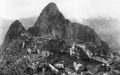
One of the first pictures of Machu Picchu, taken by Hiram Bingham III in 1912 after major clearing and before reconstruction work began
-
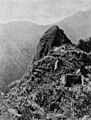
Partial view of Machu Picchu on 24 July 1911, with much of the site covered by dense vegetation.
-
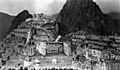
The Sacred Plaza, the Main Temple, and the Temple of the Three Windows after the 1912 clearing work. Above these structures is the Sacred Hill, which features the Intihuatana.


See also
 In Spanish: Machu Picchu para niños
- Iperú, tourist information and assistance
- Lares trek, an alternative route to that of the Inca Trail
- List of archaeological sites in Peru
- List of archaeoastronomical sites by country
- List of World Heritage Sites in Peru
- List of highest settlements
- Paleohydrology
- Putucusi, neighboring mountain
- Religion in the Inca Empire
- Salcantay Trek – alternative trek to Machu Picchu
- Tourism in Peru
