
Mjölnir facts for kids

Mjölnir is the famous hammer of Thor, the powerful thunder god in Norse mythology. People believed it was both a mighty weapon and a special tool for giving blessings. Stories about Mjölnir come from many old sources. These include the 11th-century Kvinneby amulet and two important books from the 13th century: the Poetic Edda and the Prose Edda. During the Viking Age, people in Scandinavia often wore small Mjölnir pendants. Thor and his hammer also appear on many ancient objects found by archaeologists. Even today, Mjölnir is a popular symbol seen in many places and worn by different groups.
Contents
What Does Mjölnir Mean?
The exact meaning of the name Mjölnir is a bit of a mystery to language experts. Some think it comes from words meaning 'lightning' or 'lightning-maker'. This would make sense for a thunder god's hammer! Others believe it might be linked to words for 'new snow' or 'white', suggesting 'shining lightning weapon'. A third idea is that it comes from words meaning 'to grind', making Mjölnir 'the grinder'.
Ancient Stories of Mjölnir
The Kvinneby Amulet's Message

The Kvinneby amulet is a small copper charm from the 11th century. It was found in Öland, Sweden, and people likely wore it around their necks. It has an old Norse inscription that asks Thor and his hammer for help. Experts translate part of it as:
- 'May the lightning keep all evil away from Bofi.'
- 'May Thor protect him with his hammer, which came from the sea.'
This amulet shows that stories about Thor and Mjölnir were popular even before the Eddas were written down.
Mjölnir in Poetic Edda Tales
The Poetic Edda is a collection of old Norse poems. Mjölnir appears in several of these exciting tales.
Thor's Hammer After Ragnarök
In the poem Vafþrúðnismál, the wise giant Vafþrúðnir tells Odin about the future. He says that after Ragnarök, a great battle that ends the world, Thor's sons, Móði and Magni, will inherit Mjölnir. They will then help bring peace.
Battling Giants with Mjölnir
The poem Hymiskviða tells how Thor used Mjölnir to fight evil giants. After getting a huge cauldron for the gods, Thor faced many giants who chased him. He swung Mjölnir and defeated them all.
Loki's Insults and Mjölnir's Threat
In Lokasenna, the trickster god Loki insults other gods. As he speaks, the gods repeatedly threaten him with Mjölnir. This shows how much they feared and respected the hammer's power.
The Story of Þrymr and the Stolen Hammer
The poem Þrymskviða focuses on Mjölnir. One day, Thor woke up to find his hammer missing. He was furious and asked Loki for help. Loki flew to Jötunheimr, the land of the giants. There, he found the giant Þrymr, who admitted he had stolen Mjölnir. Þrymr said he would only return it if the goddess Freyja agreed to marry him.
Loki returned to Asgard with this news. Thor and Loki asked Freyja to marry Þrymr, but she became so angry that her necklace, Brísingamen, broke. The gods then held a meeting to decide what to do. The god Heimdallr suggested that Thor dress up as Freyja. Thor hated the idea, but Loki convinced him it was the only way to get Mjölnir back.

So, the gods dressed Thor in a bridal gown and gave him Brísingamen. Loki dressed as "Freyja's" maid. They traveled to Jötunheimr in Thor's goat-pulled wagon. Þrymr was excited to see his "bride." At the wedding feast, "Freyja" ate and drank an incredible amount. Loki explained that "she" had not eaten for eight days because she was so eager to arrive. Þrymr tried to kiss "Freyja" but jumped back, saying her eyes were terrifying. Loki again explained that "she" had not slept for eight nights.
Finally, Þrymr called for Mjölnir to be brought to bless the "bride." As soon as "Freyja" saw the hammer, Thor grabbed it. He laughed and then used Mjölnir to defeat Þrymr and all the other giants at the wedding. This is how Thor got his hammer back.
Mjölnir in Prose Edda Stories
The Prose Edda is another important collection of Norse myths. It also tells many stories about Mjölnir.
Thor's Special Gear
The Prose Edda describes Thor's three special items: his hammer Mjölnir, his iron gloves Járngreipr, and his belt Megingjörð. Thor needed to wear his gloves to use Mjölnir. Giants knew Mjölnir well because it had defeated so many of them.
The Tale of Thor's Goats
One story tells how Thor and Loki stayed at a farmer's house. Thor killed his two goats, Tanngrisnir and Tanngnjóstr, for dinner. He told the family to put all the bones on the goatskins after eating. The farmer's son, Þjálfi, broke a leg bone to get to the marrow. The next morning, Thor used Mjölnir to bring his goats back to life. But one goat was lame because its bone had been broken. Thor was very angry, but the farmer's family apologized.

Thor Meets the Giant Skrýmir
Another tale describes Thor, Loki, and Thor's servants, Þjálfi and Röskva, traveling to Jötunheimr. They found a huge building to sleep in. During the night, an earthquake shook them. In the morning, Thor found an enormous man sleeping and snoring loudly. This man was Skrýmir, and the "building" they slept in was actually his glove! Skrýmir knew Thor's name. Later, Thor tried to hit Skrýmir with Mjölnir three times while he slept. Each time, Skrýmir just woke up and asked if a leaf or twig had fallen on him. Skrýmir later revealed he was the sorcerer Útgarða-Loki. He said Thor's blows were so powerful they had created deep valleys, but he had used magic to trick Thor.
Thor's Fight with Jörmungandr
The Prose Edda also tells a version of Thor's battle with the great serpent Jörmungandr. In this story, Thor throws Mjölnir and strikes off the serpent's head. However, the storyteller adds that he believes the serpent still lives in the sea, coiled around the world.
Mjölnir at Baldr's Funeral
The story of the god Baldr's funeral also features Mjölnir. The gods could not move Baldr's ship, so they called on the giantess Hyrrokkin. She arrived riding a wolf and pushed the ship, causing flames and earthquakes. Thor was so angry he wanted to use Mjölnir on her, but the other gods stopped him. Baldr's wife, Nanna, became very sad and passed away. She was placed on the ship with Baldr. Thor then used Mjölnir to bless the burning ship. A dwarf named Lit ran in front of Thor, and Thor kicked him into the flames.
How Mjölnir Was Made
The Prose Edda explains how Mjölnir was created. Loki had cut off the goddess Sif's golden hair. Thor was furious and threatened Loki. To fix things, Loki went to the dwarves. The Sons of Ivaldi made three amazing items: new golden hair for Sif, the ship Skíðblaðnir for Freyr, and the spear Gungnir for Odin.
Loki then bet his head with a dwarf named Brokkr that Brokkr's brother, Eitri, could not make three items just as good. As Eitri worked, a fly (Loki in disguise) bit him three times. First, Eitri made the golden boar Gullinbursti. Second, he made Draupnir, a golden ring that creates eight more rings every nine nights. Third, the fly bit Eitri's eyelid, making blood obscure his vision. Despite this, Eitri pulled a hammer, Mjölnir, from the forge.
The gods Odin, Thor, and Freyr judged the items. Brokkr explained that Mjölnir would always hit its target and return to Thor's hand. He also said it could shrink small enough to fit in Thor's shirt. The only flaw was that its handle was a bit short. The gods decided Mjölnir was the best of all the gifts.
Mjölnir in Real Life: Archaeological Finds
Archaeologists have found many real-life examples of Mjölnir. These finds help us understand how important the hammer was to people in the past.
Hammer Pendants and Amulets
About 1,000 pendants shaped like Thor's hammer have been found across Europe. Most are simple iron or silver designs. Some are more detailed. These pendants were found in many places, including ancient towns and hidden treasures. About 10% of them were found in graves, often in women's graves. People wore these hammer amulets as good luck charms.
Here are some examples of Mjölnir finds:
| Location discovered | Material & decoration | Dating | Other information | Ref(s) |
|---|---|---|---|---|
| Verdal Municipality, Trøndelag, Norway | Silver, decorated | Undated | Stray find | |
| Hilde, Stryn Municipality, Norway | Ring with nine hammers | 10th century | Found in a female cremation burial in a boat in a mound | |
| Kaupang, Larvik Municipality, Norway | Iron, undecorated | Around 800–960 | None | |
| Købelev, Lolland Municipality, Denmark | Inscription | 10th century | Only hammer found with a runic inscription; the text says "Hmar × is", meaning "This is a hammer". |
Scholars believe these hammer pendants became very popular during the Viking Age. They might have been a response to Christian cross pendants, as Christianity spread in the region.
The Eyrarland Statue

The Eyrarland Statue is a copper figure from around the 11th century. It was found in Akureyri, Iceland. This statue shows a seated figure that many believe is Thor, holding his famous hammer.
Mjölnir on Rune Stones
Mjölnir also appears on several runestones, which are large stones with carvings. Examples include stones in Denmark and Sweden. Some stones even show Thor fishing for the serpent Jörmungandr, and two of these carvings include his hammer.
Experts have noted that Thor is the only god known to have been asked to bless runestones during the Viking Age. This shows his special importance to the people.
Images for kids
-
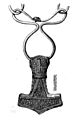
Drawing of a 4.6 cm gold-plated silver Mjölnir pendant found at Bredsätra on Öland, Sweden
-
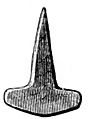
Drawing of a silver Thor's hammer amulet found in Fitjar, Hordaland, Norway
-
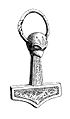
Drawing of Thor's hammer amulet from Mandemark, Møn, Denmark
-
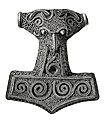
Drawing of a silver-gilted Thor's hammer found in Scania, Sweden
-
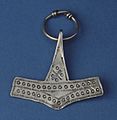
Photograph of a hammer from Rømersdal, Bornholm, Denmark, dated c. 790-1100 CE
-
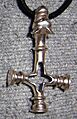
Replica of a silver pendant from the Viking period (c. 11th century) found in Foss, Iceland, sometimes described as "wolf cross" (vargkors). It could be interpreted both as a Christian cross and as a Heathen Thor's hammer (Mjolnir or Mjöllnir).
-
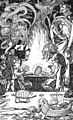
The third gift — an enormous hammer (1902) by Elmer Boyd Smith. The bottom right corner depicts the ship Skíðblaðnir "afloat" the goddess Sif's new hair.
-
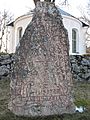
A runestone from Södermanland, Sweden, showing Thor's hammer.
-
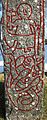
The Altuna stone from Sweden, showing Thor's fishing trip.
-
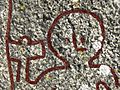
A close-up of Thor with Mjölnir on the Altuna stone.
-
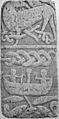
The Gosforth depiction, one of the stones showing Thor's fishing trip.


_vit_bakgr.jpg)
.jpg)


_Tor_detalj_0440.jpg)

More About Norse Mythology
- Hiddensee treasure
- Uchide no kozuchi
- Ukonvasara
