
Oak-leaved toropapa facts for kids
Quick facts for kids Oak-leaved toropapa |
|
|---|---|
 |
|
Scientific classification  |
|
| Kingdom: | Plantae |
| Clade: | Tracheophytes |
| Clade: | Angiosperms |
| Clade: | Eudicots |
| Clade: | Asterids |
| Order: | Asterales |
| Family: | Alseuosmiaceae |
| Genus: | Alseuosmia |
| Species: |
A. quercifolia
|
| Binomial name | |
| Alseuosmia quercifolia A.Cunn.
|
|
 |
|
| Estimated range | |
| Script error: The function "autoWithCaption" does not exist. | |
| Synonyms | |
|
|
Script error: No such module "Check for conflicting parameters".
The Alseuosmia quercifolia, often called Oak-leaved toropapa, toropapa, or karapapa (in Māori), is a special plant found in New Zealand. It belongs to the Alseuosmiaceae family. This plant grows as a shrub, reaching up to 2.5 meters (about 8 feet) tall. It has shiny green leaves that can look a bit different from one plant to another.
In spring, the Oak-leaved toropapa gets beautiful, sweet-smelling pink flowers. These flowers later turn into bright red berries in autumn. This plant is only found in the top part of New Zealand's North Island, especially in the Waikato area. Scientists currently consider it "Not threatened," meaning it's not in danger of disappearing.
Contents
What Does It Look Like?
The Alseuosmia quercifolia is a shrub that can grow up to 2.5 meters tall. Its branches are reddish-brown, and new shoots are a bright crimson color. The plant has shiny, bright green leaves. These leaves hang from brown stems called petioles, which are about 1 centimeter long. What's cool is that the shape of the leaves can be quite different on various plants!
This shrub flowers from September to October. Each flower cluster, called an inflorescence, usually has 2 to 6 flowers. These flowers are creamy-white or pink, and they smell wonderful! They have both male and female parts, which helps them make seeds. The flowers have a five-lobed cup (called a calyx) and a tube-like part (called a corolla) that sticks out about 11 millimeters.
The fruit of the Oak-leaved toropapa is plum-red and shaped like an oval. It's about 2.8 to 9.7 millimeters long. These fruits ripen in Autumn, usually from March to May. Each fruit can have 1 to 17 seeds, but on average, it has about 6 seeds. Each seed weighs about 0.19 grams.
-
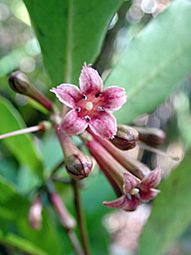
The flowers
-
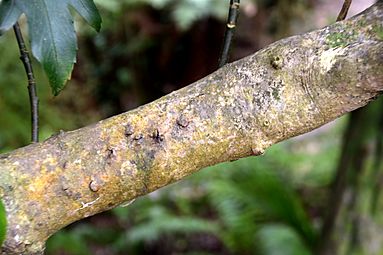
A branch
-
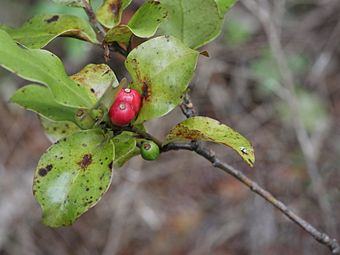
The fruit


.jpg)
How Scientists Name Plants
The A. quercifolia was first described by a botanist named Allan Cunningham in 1839. He and his brother, Richard Cunningham, collected plants and wrote about them. Allan Cunningham described eight different Alseuosmia species, including A. quercifolia. He noticed that Alseuosmia plants were different from other plant families because of their long, tube-shaped flowers, berry-like fruits, and how their stamens (male parts) were placed.
Over the years, other scientists studied these plants. In 1885, W. Colenso described a new species, A. pusilla. Later, other botanists like Thomas Kirk and Thomas Cheeseman thought A. pusilla was actually the same as A. quercifolia.
In 1978, another botanist named Rhys Gardner suggested that many of these Alseuosmia plants were actually hybrids (mixtures of different species). However, in 2000, M. F. Merrett and B. D. Clarkson disagreed. They argued that A. quercifolia is indeed its own unique species, and that's how it's recognized today. This shows how scientists keep learning and sometimes change their minds as they discover more!

What's in a Name?
The name Alseuosmia comes from Ancient Greek words meaning "perfume" or "scented grove." This makes sense because the flowers are very fragrant! The second part of its scientific name, quercifolia, means "oak-leaved." This refers to how some of its leaves look similar to those of an oak tree.
Where Does It Live?
The Alseuosmia quercifolia is only found in the North Island of New Zealand. You won't find it south of 38 degrees latitude, and it's also not common in the Coromandel or Bay of Plenty areas. It has been seen on Great Barrier Island and Waiheke Island. However, it grows most often in the lowland forests of the Waikato region.
This plant prefers places that get more than 1100 millimeters (about 43 inches) of rain each year. It likes cool areas that slope towards the south and have soil that drains water well.
Who Does It Live With?
Many other plant species grow near A. quercifolia. You'll often find it alongside Tawa, Hangehange, Rewarewa, Mahoe, and Supplejack.
Unfortunately, some animals like to eat this plant. These include pests such as brushtail possums, wild goats, and fallow deer. Hares might also browse on it. A type of cicada, called Melampsalta cingulata, lays its eggs on the plant's stems. This can cause the part of the stem above the eggs to die. Other creatures that can damage the leaves include slugs, snails, and the cocoons of the common leaf-roller.
In the past, birds like the hihi and korimako helped pollinate the flowers. It's also thought that moths play a role, especially a species called Epyaxa rosearia. The plant's berries are eaten and spread by birds like the Kōkako and Kererū. Long ago, the giant Moa and kākāpō also helped spread its seeds.
Can You Grow It?
You can grow A. quercifolia from both seeds and cuttings. If you plant seeds, they will usually sprout in spring. If you use cuttings (pieces of the plant), they take about 5 to 8 weeks to grow roots. Young seedlings are easy to spot because they have red petioles (leaf stems) and white veins in their leaves.
Growing from cuttings is usually very successful, almost 100% of the time! Growing from seeds is a bit harder. Even with perfect conditions like low light, a cool temperature of 13 degrees Celsius, and soaking the seeds in Gibberellic acid, only about 65% of them will grow.
It's easiest to grow this plant in pots. If you plant it outside, it needs a spot with some shade and rich soil. However, be aware that A. quercifolia can sometimes suddenly die, which is a bit of a mystery!
