
Paardekraal Monument facts for kids
Quick facts for kids Paardekraal Monument |
|
|---|---|
|
Paardekraal-monument
|
|

Paardekraal Monument
|
|
| General information | |
| Status | Extant |
| Type | Memorial |
| Address | Paardekraal Drive |
| Town or city | Kurgersdorp |
| Country | South Africa |
| Coordinates | 26°05′35″S 27°46′41″E / 26.093°S 27.778°E |
| Elevation | 1715m |
| Construction started | 1890 |
| Opened | 16 December 1891 |
| Client | South African Republic |
| Height | 18.29m |
| Design and construction | |
| Architect | Sytze Wierda |
| Main contractor | W.Y. Veitch |
The Paardekraal Monument is a special memorial located in Krugersdorp, South Africa. It remembers an important promise made by the Boers of the Transvaal region. On December 13, 1880, these Boers gathered here. They vowed to fight for their freedom from the British Empire. This promise happened just before a conflict known as the First Boer War.
Before the big monument was built, the Boers created a simple cairn. A cairn is a pile of stones. Thousands of stones were placed by the people who gathered. Each stone represented their strong promise. The official monument, built in 1890, now surrounds this original stone pile. It was built by the South African Republic (ZAR) to celebrate their independence from Great Britain.
Contents
Why the Boers Fought for Freedom
How the British Took Control
In January 1877, a small group of British police, led by Sir Theophilus Shepstone, entered the South African Republic. They settled in its capital, Pretoria. The British government wanted to unite all the states in southern Africa. This included the Cape Colony, Natal Colony, Orange Free State, and the South African Republic. They hoped to form a single, large confederation of states.
Another reason was money. The South African Republic wanted to build a railway. This railway would go to Delagoa Bay. It would help them avoid British control over trade routes. But the republic was almost out of money. Shepstone was supposed to get the people's support for British rule. However, his secret orders were to take over, no matter what the people thought.
Shepstone used the disagreements among the people. The people were not united. Many disliked their president, Thomas François Burgers. They especially didn't like how he handled problems with the Pedi people. On April 12, 1877, Shepstone officially took over the South African Republic. He made it a British Colony. The old president left for Holland. This ended the 1852 Sand River Convention, which had given the Boers their independence.
Boer Resistance and Unity
After the takeover, Shepstone led a long fight against the Pedi people. This fight ended in November 1879. Meanwhile, Paul Kruger tried twice to get their independence back. He went to London in 1877 and 1878, but he failed.
In the Transvaal, the Boers started to unite again. They used church meetings and social gatherings to become a strong group. They believed God had given them their language, land, and control. This belief brought them together. The British tried to stop their meetings and arrest their leaders. But the British didn't have enough people to stop them.
By 1880, the British leader in the Transvaal, Sir Owen Lanyon, was still trying to collect taxes. The Boers never liked paying taxes, even to their own government. That year, a Boer named Bezuidenhout refused to pay his tax bill. His wagon was taken and put up for auction. Piet Cronje and his armed friends stopped the auction. They took the wagon back to its owner. Lanyon saw this as a rebellion. He ordered arrests, but again, he didn't have enough people to carry them out.
The Great Gathering and the Vow
A large meeting was planned for the Transvaal Boers. It was meant to decide how they would get their independence. The meeting was originally set for January 8, 1881, at Paardekraal. But it was moved up to December 8, 1880. From December 8 to December 13, 1880, a huge crowd gathered. Between 8,000 and 10,000 Boer men, women, and children came to Paardekraal.
At the meeting, they decided to bring back their old government, called the Volksraad. Three men would lead the republic: Paul Kruger, Piet Joubert, and Marthinus Pretorius. A statement declaring their independence was written. It explained why they were taking action. On December 13, 1880, they declared their independence from British rule. They announced the return of the South African Republic.
After an important oath was read, 5,000 to 6,000 men showed their agreement. They each placed a stone on the hillside. This created the original stone cairn.
In the presence of Almighty God, the searcher of all hearts, and prayerfully waiting on His gracious help and pity, we, burghers of the South African Republic, have solemnly agreed, as we do hereby agree, to make a holy covenant for us and for our children, which we confirm with a solemn oath. Fully forty years ago our fathers fled from the Cape Colony in order to become a free and independent people. Those forty years have been forty years of pain and suffering. We established Natal, the Orange Free State and the South African Republic, and three times the English government has trampled on our liberty and dragged to the ground our flag, which our fathers had baptised with their blood and tears. As by a thief in the night has our republic been stolen from us. We neither may nor can endure this. It is God's will, and is required of us by duty to our fathers and by love to our children, that we should hand over intact to our children the legacy of the fathers. For that purpose it is that we have here come together and give each other the right hand as men and brethren, solemnly promising to remain faithful to our country and our people , and with our eyes fixed on God, to cooperate until death for the restoration of the freedom of our republic. So help us Almighty God.
The first shots of the First Boer War were fired on December 16, 1880, in Potchefstroom. The Boers tried to print their declaration there. But British troops fired on them. The first major fight happened on December 20, 1880. This was the Battle of Bronkhorstspruit. The First Boer War was short. It ended in March 1881 with the British army's defeat.
The first celebration at the stone cairn happened in 1881. It was called a Volksfees, or "people's festival." It celebrated the South African Republic's independence. This freedom was gained after the British lost the Battle of Majuba Hill. A peace treaty was signed in August 1881. It was known as the Pretoria Convention. More importantly, it was a religious thanksgiving to God. It celebrated the fulfillment of their vow. The ZAR's government decided that a celebration at the cairn would happen every five years on December 16.
Building the Paardekraal Monument
Designing and Constructing the Memorial
In 1886, land was given to the government for the monument. This land was about 100 meters from the cairn site. It came from a farm owned by M.W. Pretorius. He had rented parts of his farm to gold seekers. They were looking for more gold from the Witwatersrand Gold Rush. This gold rush started to the east in Johannesburg. Pretorius did not want this important memorial site to be disturbed.
In 1889, a local official named Landrost Human suggested building a formal monument. He proposed an obelisk, which is a tall, four-sided pillar. It would be built right on the cairn site.
The monument was built using white stone from the area. It stands about 60 feet (18.29 meters) tall. It has an opening at its base. This opening has an iron grate. Inside, the remains of the original stone cairn are kept. The monument stands on top of a hill. This is common for many Afrikaner monuments. The architect Sytze Wierda designed the monument. W.Y. Veitch built it. Paul Kruger officially opened the monument on December 16, 1891.
During the Second Boer War, British soldiers took over the Transvaal. They looted the original cairn stones from the gated chamber. They threw them into the Vaal River. The Paardekraal Monument became a protected heritage site on April 17, 1936.
Gallery
-
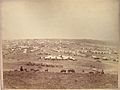
Gathering at the Monument -
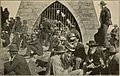
Gated base with original cairn stones -
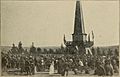
Gathering in 1899

_(14595684519).jpg)
_(14779995004).jpg)
