
Roberts Landing, California facts for kids
Quick facts for kids
Roberts Landing
|
|
|---|---|
|
Former settlement
|
|
.jpg)
Landing and residence of Captain William Roberts, as illustrated in Thompson and West's 1878 New Historical Atlas of Alameda County
|
|

 Roberts Landing
Location in California
|
|
| Country | United States |
| State | California |
| County | Alameda County |
| Elevation | 7 ft (2 m) |
Roberts Landing was a small community in Alameda County, California. Today, it is part of the city of San Leandro. It is located where San Lorenzo Creek meets San Francisco Bay, west of San Lorenzo.
In the 1800s, Roberts Landing had warehouses and a wharf. Farmers used it to ship their crops to San Francisco. Later, from 1906 to 1964, an explosives factory called the Trojan Powder Company operated there. After the factory closed, the land was cleaned up. Now, part of the area has houses, and a larger part is an open space called the San Leandro Shoreline Marshlands.
Contents
Where is Roberts Landing?
When Roberts Landing was first created in 1850, it was in the marshlands. These marshes were at the end of San Lorenzo Creek, which flowed into San Francisco Bay. The land had been given to California after the Mexican–American War (1846–1848).
San Lorenzo Creek starts in the Berkeley Hills. It flows west and empties into the east side of San Francisco Bay. In the past, the creek created large marshes near the bay. These marshes were full of fresh water, which then mixed with salty water closer to the bay.
Wildlife and Salt Farming
During the California Gold Rush (1848–1855), these marshes were a great place for hunting wild birds. People caught geese, ducks, and other birds to sell in San Francisco. Later, there was a big need for salt. So, people built levees and ditches to create salt farms in the marshes.
Today, Roberts Landing covers about 478 acres in San Leandro. After a big environmental clean-up, about 79 acres in the southeast part of the site have houses. The rest of the land is now restored wetlands and open space.
History of Roberts Landing
Early Years (1850–1906)
The landing was started in 1850 by Robert Thompson, Peter Anderson, and Captain William Roberts. It was first called Thompson's Landing. It was built on one of the biggest tidal channels in the San Lorenzo marshes. A road connected it to dry land.

William Roberts was born in Wales. He sailed to America and arrived in San Francisco in 1850. After a short time working in mining, he settled in San Lorenzo. He opened a landing for ships on land that Robert Thompson had bought. In 1856, Roberts bought out Thompson and changed the name to Roberts' Landing.
Roberts was the first to offer regular shipping services across the Bay to San Francisco. His ship, the Helen Eliza, carried both goods and people. Roberts Landing became the main shipping point for several nearby valleys. A road called Washington Boulevard was built to bring lumber to Roberts Landing. This lumber was then shipped to San Francisco.

Roberts grew his shipping business. He exported food from farms in Alameda County and brought in lumber for building. In the 1870s and 1880s, he had warehouses at the landing for hay and grain. He built his family home in San Lorenzo in 1869. The house is still standing today.
A train station called Robert was built near the landing in the 1870s. It was part of the South Pacific Coast railway line. Later, it was renamed West San Lorenzo station. The railway eventually caused Roberts' shipping business to decline.
Trojan Powder Company (1906–1965)
In the early 1900s, the wetlands at Roberts Landing were surrounded by dikes. The Pacific High Explosives Company started in 1906 to make Trojan powder in California. The Trojan Powder Works at Roberts Landing opened that year. This was the only Trojan Powder Company factory in the western United States. Its products were shipped by train from the San Lorenzo station.

Sadly, there were accidents at the factory. In 1907, Henry Jorgensen was killed in an explosion. On February 17, 1910, the Trojan Powder Works blew up. There were two small blasts, then a huge explosion. It was so powerful that it broke all the windows in a school two miles away. Five men died right away, and three more died later. One worker's body was thrown 500 feet into the marsh.
In 1912, the company changed its name to California Trojan Powder Company. After World War I, it became part of the larger Trojan Powder Company. On January 5, 1922, two more big explosions at the factory killed four employees. Four more people were hurt. The factory's buildings were destroyed.
The Trojan's Roberts Landing factory closed in 1964. After it closed, the company tried to get permission to build a waterfront community there, but they were not successful.
Modern Development
For over 30 years, there was much discussion about what to do with the site. The land needed a lot of cleaning because of the chemicals from the powder factory. People worried about hazardous waste. Eventually, the developer spent over a million dollars to clean the site.
In 1992, the City of San Leandro approved a plan for the site. The plan suggested that 79 acres would be used for housing. This would include 460 single-family houses and about 220 townhomes. The remaining 127 acres would be restored as wetland habitat and open space for the city.
Restoring the Wetlands
The restoration project involved cutting openings in the shoreline levees. This allowed the tides to flow into the marsh. They also made ditches bigger so water could move freely. Islands were created for wildlife. The marsh also had a special area of sand dunes, which was saved.
,_climbing.jpg)
By 2001, the tide gates were fully open, and the marsh was getting tidal water as planned. The marsh now has native plants like Salicornia (pickleweed) and Spartina (cordgrass). It is home to many animals, including shorebirds, waterfowl, and fish. Some of these species are threatened or endangered. For example, the endangered Clapper rail and Salt marsh harvest mouse live there.
Bay Trail and Roberts' House
The Bay Trail is a paved path for bikes and walkers along the shoreline. A section of this trail goes through Roberts Landing. It's a quiet path with benches where visitors can watch the bay.
Today, part of Roberts Landing is a housing area. William Roberts' original house, built in 1869, is still standing. It is privately owned.
Images for kids
-
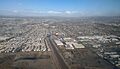
San Lorenzo from the west in 2016. San Lorenzo Creek is in the center, with restored marshlands in the foreground.
-
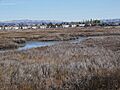
Marshlands at the site of Roberts Landing, with new housing in the background.


