
Sahara frog facts for kids
Quick facts for kids Sahara frog |
|
|---|---|
.jpg) |
|
| Conservation status | |
Scientific classification  |
|
| Kingdom: | Animalia |
| Phylum: | Chordata |
| Class: | Amphibia |
| Order: | Anura |
| Family: | Ranidae |
| Genus: | Pelophylax |
| Species: |
P. saharicus
|
| Binomial name | |
| Pelophylax saharicus (Boulenger, 1913)
|
|
 |
|
| Script error: The function "autoWithCaption" does not exist. | |
| Synonyms | |
|
Rana esculenta var. saharica Boulenger in Hartert, 1913 |
|

Script error: No such module "Check for conflicting parameters".
The Sahara frog (Pelophylax saharicus) is a type of frog that belongs to the Ranidae family. You can find these frogs naturally in countries like Egypt, Libya, Tunisia, Algeria, Morocco, and Western Sahara. They also live in parts of Spanish North Africa, like Ceuta and Melilla. Interestingly, some Sahara frogs have also been brought to Gran Canaria. In French, people call it grenouille verte d'Afrique du Nord, which means "green frog of North Africa." In Spanish, it's known as rana verde norteafricana.
Contents
What Does the Sahara Frog Look Like?
The Sahara frog is a fairly large frog. One female frog found in Morocco was about 104.5 mm (4.1 in) long from its snout (nose) to its vent (tail end). Sometimes, people might confuse it with another frog called Perez's frog (Pelophylax perezi).
Body Features of the Sahara Frog
The head of the Sahara frog is about as wide as it is long. Its snout is shaped like an oval, and its eyes have pupils that are horizontal, not round. Male Sahara frogs have two special sacs on their throat called vocal sacs. They use these sacs to make loud calls.
A raised line, or ridge, connects the frog's nostrils to its upper eyelids. This ridge then continues all the way down its back to its groin area. This line helps separate the frog's back from its sides. The hind feet of the Sahara frog have webbing between the toes, which helps them swim.
Colors and Patterns
The color of Sahara frogs can be different from one frog to another. Some are green, some are brown, and some have a mix of both colors. They might also have darker spots on their skin. You might even see some frogs with a yellowish or greenish line running down the middle of their back. Their legs always have spots or stripes.
Where Do Sahara Frogs Live?
The Sahara frog is native to North Africa. This means it naturally lives in countries like Western Sahara, Morocco, Algeria, Tunisia, Libya, and Egypt.
Preferred Homes for Sahara Frogs
These frogs love water! They are aquatic, which means they spend most of their time in or very close to water. You can find them in places like streams, pools in oases (watery spots in deserts), irrigation canals, lakes, and other bodies of water.
How Are Sahara Frogs Doing?
The Sahara frog is quite common in places where there's enough wetland habitat for them. A wetland is an area of land that is covered by water, like a swamp or marsh.
Conservation Status
The number of Sahara frogs has stayed pretty steady over time. However, there are some things that could threaten them in the future. For example, if too many frogs are caught, or if their water sources become polluted, their populations could decrease. The International Union for Conservation of Nature (IUCN) has looked at the Sahara frog's situation. They have decided that its conservation status is "least concern." This means that, for now, they are not worried about the species going extinct.
Sahara Frogs in France
In 2021, a group of Sahara frogs was found in a wetland called the Etang de Berre in Southern France. These frogs have been spreading to different areas and have been reproducing there since at least 2011. Because they are not native to France and are spreading, they are considered an "invasive species" in that region. Invasive species can sometimes cause problems for the native plants and animals in an area.
Images for kids
-
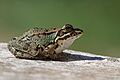
A Sahara frog in its natural habitat.
-

Map showing the range of the Sahara frog in North Africa.
