
St James' Church, Normanton facts for kids
Quick facts for kids Parish Church of Saint James |
|
|---|---|

The church from the neighbouring Ferry Field.
|
|
| Location | Main Street, Normanton |
| Denomination | Church of England |
| History | |
| Status | parish church |
| Dedication | Saint James |
| Architecture | |
| Functional status | active |
| Heritage designation | Grade I Listed building |
| Designated | 13 October 1966 |
| Administration | |
| Parish | Normanton on Soar |
| Diocese | Southwell and Nottingham |
| Province | York |
The Church of St. James is an old and important church in the village of Normanton on Soar, Nottinghamshire. It's a special building, officially called a Grade I listed building, which means it's very important for its history and beauty. It got this special status on October 13, 1966, because it's "of exceptional interest."
Contents
About St. James' Church
Where is the Church Located?
This amazing medieval church was built in the 1200s. You can find it in the south part of the village on Main Street. It sits right by the River Soar, which is the border between Nottinghamshire and Leicestershire. Because it's so close to the river, people used to call it "The Boatman's Church." There are even steps leading from the churchyard down to a small place where boats can tie up. In April 2014, the church's tall spire was repaired and cleaned up.
Who Leads the Church?
Since 1954, the church has had a priest-in-charge instead of a full-time rector. In 1991, the church joined with the nearby parish of Sutton Bonington. The current priest-in-charge, Rev. Michael J Brock, also leads the church in Sutton Bonington.
Church Services
The church holds regular services every week. On the first Sunday of each month, the village choir sings. You can visit the church during the day on Saturdays and Sundays.
Church History and Design
A Look Back in Time
St. James' Church is a very old medieval church, built in the 1200s. Even though it's not mentioned in the old Domesday Book from 1086, experts believe there was likely a church here even then. The church is shaped like a cross and has a tower in the middle. The oldest parts of the church show an Early English style of building. In 1889, the church was restored and updated. This work cost about £2020 back then! It's thought that the church was first dedicated to the Virgin Mary, but later it was rededicated to St James.
Inside the Church

The main part of the church, called the nave, was added in the 1200s. In the 1400s, the walls of the nave were made taller. This created a special open roof that was flatter than before. Windows were added later. In 1910, an expert noted that the timber roof from the 1400s was "excellent" and one of the best parts of the church. At the back of the nave, there's a large window made of five tall, narrow windows, called lancets. This window was also built in the 1200s.
The Font
_Font_.jpg)
The font, which is used for baptisms, is shaped like an octagon and has decorative patterns. It was made in the 1300s from a single block of stone. During the 1889 restoration, the font was moved to the back of the nave, under the west window.
Royal Coat of Arms

Above the arch leading to the chancel, you can see the royal coat-of-arms of King Charles II. It's dated 1683 and was put there by Samuel Sanders, who owned the local manor. This coat-of-arms is made of plaster and isn't painted. On either side, you can see the coat-of-arms of Samuel Sanders and his wife, Margaret. These were taken down during the 1889 restoration and put back up in 1913.
The Chancel
The chancel is the part of the church where services are held today. It's quite large for its age, almost as long as the nave. It was also added in the 1200s. In 1986, a fire damaged the chancel roof. It was repaired between 1988 and 1989, using some timber saved from the fire. Six former rectors of the church are buried here.
_Gargoyle_East.jpg)
The Organ
The church has a pipe organ built around 1900 by Alfred Kirkland. It has two keyboards. The organ used to be at the back of the nave. But after a new section was built in 1889, the organ was moved there.
Outside the Church
The Spire
The oldest part of the church is its tower, built in the early 1200s. A pointed spire was added soon after. This church is one of only two in Nottinghamshire that has a central tower with a spire.
_Gargoyle_West.jpg)
The Bells
The church tower holds four bells that date back to 1635. By 1887, two of the bells were cracked. So, in 1897, all four bells were melted down and recast by a company called John Taylor & Co. in Loughborough. These new bells had special messages inscribed on them, like "God save his church" and "I sweetly toling men do call to taste on meals that feeds the soule." In the 1950s, the bells couldn't be rung because they needed repairs. They were fixed and rehung in 1978 by the same company.
Gargoyles
_Gargoyle_Centre.jpg)
On the outside of the chancel, on the north wall, you can see three interesting gargoyles. These aren't just decorations; they are part of the church's drainage system, helping to direct rainwater away from the building.
Monuments and Memorials
Special Stone Carvings
The Church of St. James has several monuments and memorials inside. In the nave, there are three memorials. One is for John Bosworth from 1832, another for Elizabeth Cox from 1833, and a third for Anne Ragdale, who was the wife of a former rector, dated 1768. Anne Ragdale's monument has an inscription tablet with two decorated pillars on the sides and a fancy urn on top.
In the chancel, there are two more memorials. One is for Frances Willoughbie, from 1606. It shows a kneeling female figure. Frances died in 1606. There's also a memorial for William and Susanna Willougby from 1636, which has an inscription and two kneeling figures on top.
War Memorial
_War_Memorial.jpg)
Inside the church, there is a bronze war memorial. It remembers six villagers who lost their lives in World War I.
The names on the memorial are:
- Samuel Ernest Burley (Sergeant, died 1917, aged 27)
- Thomas Charles Burley (Private, died 1918, aged 21)
- George Clowes (Private, died 1915, aged 19)
- Charles Archibald Evans (Rifleman, died 1916, aged 22)
- Victor Henry Digby Mason (Private, died 1915, aged 18)
- George Ernest Roper (Able Seaman, died 1918, aged 19)
Past Church Leaders
Many priests have served at St. James' Church over the centuries. Some of them are even buried inside the chancel. Here are a few examples:
- Henry of Melsamby (started around 1236)
- Robert Elvington (1584-1628)
- John Bentley (1637-1648)
- John Ragdale (1736-1777)
- William Holmes (1777-1831)
- Arthur Clarke (1979-1993), who became the first priest of the united benefice in 1991.
- Michale J Brock (2015–Present)
Images for kids
-
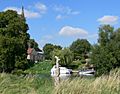
St. James' Church from across the River Soar
-
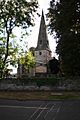
St. James' Church from Main Street
-
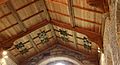
The restored chancel roof, completed in 1989.
-
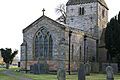
Exterior of the chancel of St. James' Church
-
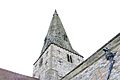
Tower and spire of St. James' Church
-
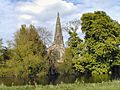
St James' Church from across the River


See also
- Grade I listed buildings in Nottinghamshire
- Listed buildings in Normanton on Soar
