
James the Great facts for kids
Quick facts for kids SaintJames the Great |
|
|---|---|

Portrait by Peter Paul Rubens, c. 1612–1613
|
|
| Apostle and Martyr | |
| Born | Bethsaida, Galilee, Roman Empire |
| Died | AD 44 Jerusalem, Judea, Roman Empire |
| Honored in | All Christian denominations that venerate saints |
| Canonized | Pre-Congregation |
| Feast | 25 July (Western Christianity) 30 April (Eastern Christianity) 30 December (Mozarabic Rite) |
| Attributes | Red Martyr, Scallop, Pilgrim's hat |
| Patronage | Places Spain, Guatemala, Seattle, Orlando, Levoča, Nicaragua, Cali, Guayaquil, Betis Church, Guagua, Pampanga, Badian, Cebu, Bolinao, Ibaan, Pasuquin, Plaridel, Bulacan, Paombong, Paete, Sogod, Cebu, Compostela, Cebu, Santiago, Santiago Acahualtepec, and some places in Mexico. Professions Veterinarians, equestrians, furriers, tanners, pharmacists, oyster fishers, woodcarvers. |
James the Great was one of the Twelve Apostles chosen by Jesus. People also call him Saint James the Great, James the Apostle, or simply Santiago in Spanish. He was an ancient fisherman who left his boat behind to become a leader in early Christianity.
He is called "the Great" or "the Elder" to tell him apart from another follower named James the Less. The title does not mean he was better than anyone else. Instead, it probably meant he was older or taller. James is remembered today as the beloved patron saint of Spain. Thousands of travelers walk across Europe every year to visit his famous resting place.
Contents
Life of Saint James in the Bible

James grew up in Bethsaida, a fishing village near the Sea of Galilee in the ancient Roman Empire. His father was a man named Zebedee, and his mother was Salome. Many historians believe Salome was a sister of Mary, making James a cousin of Jesus. James worked every day on the water alongside his brother, John the Apostle.
Answering the Call to Follow Jesus
One sunny day, James and his brother John were sitting in their fishing boat. They were mending their nets with their father by the shore. The Synoptic Gospels explain that Jesus walked by and called out to them. Right away, both brothers left their nets, their boat, and their jobs to follow him.
James quickly became one of the closest friends of Jesus. Along with his brother John and Peter, James formed a special group of three trusted leaders. Jesus invited only these three friends to witness several amazing moments.
Witnessing Miraculous Events
James saw many unforgettable wonders during his travels throughout Galilee and Judea. He was present in the room during the raising of Jairus' daughter, when a young girl came back to life.
James also climbed a tall mountain with Jesus and Peter. There, they watched the transfiguration of Jesus, where his clothes shone as bright as light. Later, during the sad night before Jesus died, James went to pray with him during the agony in the Garden of Gethsemane.
Why Was He Called a Son of Thunder?

James and his brother John had bold personalities and lots of energy. Jesus gave them the special nickname Boanerges, which means "Sons of Thunder." Sometimes their fiery temper got them into trouble.
Once, when people in a Samaritan town were unfriendly, the brothers asked Jesus if they should call down lightning from heaven. Jesus quickly corrected them and told them to be peaceful. Another time, the brothers and their mother asked for the best seats beside Jesus in heaven. The other apostles felt annoyed, but Jesus used the moment to teach them about humility and helping others.
The First Apostle to Die as a Martyr
After Jesus rose into heaven, the apostles traveled far and wide to spread their message. Life was dangerous for the early church. The Acts of the Apostles in the New Testament records that King Herod Agrippa began arresting believers.
In about the year 44, the king ordered James to be executed by the sword. Theologians such as Henry Alford believe he was executed in Jerusalem. This event made James a Red Martyr. He was the first of the original apostles to give his life for his faith, showing deep courage until the very end. Scholar F. F. Bruce noted that James died bravely, showing the mysterious workings of divine providence.
Journey to Ancient Spain
Preaching in Hispania

An ancient Spanish story written down in the 12th century Historia Compostelana tells of James traveling west. Before his death in Jerusalem, he wanted to bring his message to the edge of the known world.
James sailed across the Mediterranean Sea, stopping first on the island of Sardinia. He then landed at the sunny port of Cartagena in ancient Hispania. He walked across rocky roads in northern Spain, preaching through towns in Hispania Tarraconensis. In the city of Bracara Augusta, he taught the local people and helped a man named Peter of Rates become a local teacher.
A Vision by the River
While traveling in Spain, James grew tired and discouraged because few people were listening. According to legend, on January 2 in the year 40, the Virgin Mary appeared to him. She came to cheer him up on the banks of the Ebro River in the ancient town of Caesaraugusta.
Mary appeared standing high atop a beautiful pillar of stone. Today, this spot is celebrated as Our Lady of the Pillar. People still visit that very column inside the majestic Basilica of Our Lady of the Pillar in the city of Zaragoza. Comforted by this event, James finished his work in Spain and returned home to the Holy Land.
The Miraculous Sea Voyage
After James died in Jerusalem, his loyal friends wanted to give him a peaceful resting place. Spanish legends describe a wonder-filled journey across the open ocean. Followers named Theodore and Athanasius placed his body onto a boat with no sails and no oars.
Guided by gentle ocean currents and angels, the vessel drifted across the sea. It safely reached the shores of Galicia at the port of Padrón near Iria Flavia. A huge rock miraculously softened like wax to form a stone tomb around the saint.
The Legend of Queen Lupa
When the disciples landed in Galicia, they met a powerful local ruler named Queen Lupa. The ancient book known as the Codex Calixtinus tells that she tried to play a trick on them. She sent them to the ruler of Duio, hoping they would be captured.
The disciples escaped the trap and returned safely. Next, Queen Lupa told them to fetch two wild oxen from a mountain called Pico Sacro. She knew a fierce dragon guarded a spooky cave there leading to hell. The brave travelers carried a holy cross, which chased the monster away and tamed the wild bulls instantly. Amazed by this event, Queen Lupa joined Christianity and helped build a grand shrine in the woods of Libredon.
Santiago de Compostela and Pilgrims

For several centuries, people forgot where the tomb rested in the dense forests. In the 9th century, a holy man named Pelayo saw strange, glowing lights shining over the trees. He ran to tell Bishop Theodemir, who investigated the site.
King Alfonso II visited the spot and ordered a magnificent church built there. The location became known as Santiago de Compostela. Soon, believers from all over the world began walking hundreds of miles to pray at the crypt of the apostle.
The Famous Walking Trails
This journey across Europe is called the Way of St. James, or the Camino de Santiago. It became the most popular pilgrimage across Europe during the Early Middle Ages. Modern travelers still love the path today. Many people rediscover it through travel books, like the famous work by writer Walter Starkie.
Travelers walk across green hills, tall mountains, and quiet farmlands. In 2018 alone, over 327,000 people finished the walk. Anyone who hikes at least 100 kilometers receives an official certificate called a Compostela.
Special Holy Years
When July 25 falls on a Sunday, the church celebrates a special Jacobean holy year. During these sacred years, the cathedral in Spain unlocks a decorated stone doorway called the Holy Door.
Thousands of extra visitors pass through these doors during holy seasons. There were huge celebrations during the festival years of 2004, 2010, and 2021. The next exciting Jacobean celebration arrives in 2027.
Famous Symbols and Tales
The Scallop Shell

The most famous symbol of Saint James is the scallop shell, sometimes called a cockle shell. For hundreds of years, walkers pinned sea shells to their hats, coats, and bags. The shell showed everyone on the road that they were peaceful pilgrims.
The lines on the shell meet at one point, just like the many different trails meet at Santiago. In France, scallops are called coquille St. Jacques. People speaking the Dutch tongue call it a Jacobsschelp. In the northern Danish tongue, the badge is known as an Ibskal.
Tales from the Middle Ages
During the stressful wars of the Middle Ages, Spanish soldiers told legends about Saint James appearing on a white horse. They called this legendary figure Saint James the Moor-slayer, believing he protected their soldiers during the battle of Clavijo.
Knights shouted the lively battle cry ¡Santiago, y cierra, España! as they charged into field. The writer Miguel de Cervantes even mentioned this heroic knight in his famous adventure book Don Quixote. Spanish leaders also created the noble Order of Santiago, which was a special order of chivalry meant to defend travelers.
Remembering Saint James Today
Feast Days Around the World
Churches hold celebrations for Saint James on different calendar days throughout the year. The Catholic Church, along with Eastern Orthodox, Lutheran, and Anglican communities, celebrate his primary feast day on July 25.
Some historians think this summer date was picked to match the feast of Saint Christopher. In Eastern traditions following the old Julian Calendar, his memorial is remembered on April 30. He also shares a joint celebration on June 30 during the Synaxis of the Apostles. In Spain, the region of Galicia celebrates its huge National Day of Galicia on July 25 with fireworks and music.
Holy Places and Shrines

In the city of Jerusalem, visitors can tour the beautiful Cathedral of St. James in the historic Armenian Quarter. Believers preserve a peaceful chapel there, marked by red marble and six glowing lamps, marking where James gave his life.
Saint James is also honored in other faiths and traditions. In the Quran, the holy book of Islam, the followers of Jesus are honored as wise teachers. Writers in Muslim exegesis proudly list James alongside friends like Peter, John, Philip, and Matthew.
Members of The Church of Jesus Christ of Latter-day Saints also honor James. They teach that in 1829, heavenly messengers, including James, visited Joseph Smith and Oliver Cowdery. They believe the apostle helped restore ancient leadership through the Melchizedek priesthood after John the Baptist appeared with the Aaronic authority.
Patron of Many Lands and Workers
Saint James protects many people, places, and working jobs around the globe. Many towns and massive cities honor his name, including Santiago in Chile, along with communities across Guatemala, Nicaragua, and Mexico. In the United States, he watches over churches in cities like Seattle and Orlando. In the Philippines, colorful festivals take place in towns such as Bolinao, Ibaan, and at the historic Betis Church in Pampanga.
Workers also ask for his blessing. Because he traveled over mountains and waters, he is the friend of horse lovers practicing equestrian sports, animal doctors, and medicine makers. Because of his life near the sea, wood workers, leather tanners, and fishermen diving for oysters look to him for inspiration. His memory remains bright as a symbol of bold faith, adventure, and courage.
Images for kids
-
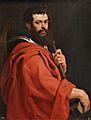
Portrait of Saint James painted by Peter Paul Rubens
-
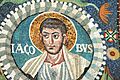
Mosaic portrait of James in Ravenna, Italy
-

Emblem shield showing pilgrim shells and a staff
-
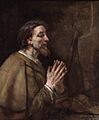
Rembrandt painting of the apostle resting with his traveler staff
-
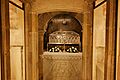
The crypt holding the tomb of Saint James in Spain
-
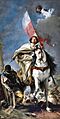
Art showing Saint James dressed in his military cloak
-
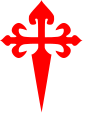
The Cross of Saint James shaped like a red sword
See also
 In Spanish: Santiago el Mayor para niños
- Apocryphon of James (also known as the Secret Book of James)
- Camino de Santiago
- Cathedral of St. James
- Hand of St James the Apostle
- Military Order of Saint James of the Sword
- Peter of Rates
- Saint James, son of Zebedee, patron saint archive
- James Matamoros
- St. James' Church
