
St John the Evangelist's Church, Corby Glen facts for kids
Quick facts for kids St John the Evangelist Church, Corby Glen |
|
|---|---|

Church of St John the Evangelist from the south-east
|
|
| 52°48′48″N 0°30′57″W / 52.8132°N 0.515708°W | |
| Country | England |
| Denomination | Church of England |
| Website | https://corbyglen.church |
| History | |
| Founded | 12th century |
| Dedication | John the Evangelist |
| Architecture | |
| Heritage designation | Grade I |
| Designated | 1968 |
| Architectural type | Norman, Perpendicular, Decorated |
| Specifications | |
| Materials | limestone, rubble |
| Administration | |
| Parish | Corby Glen |
| Benefice | Corby Glen Group of Parishes |
| Deanery | Deanery of Beltisloe |
| Diocese | Diocese of Lincoln |
| Province | Canterbury |
The Church of St John the Evangelist is a very important historical building in Corby Glen, Lincolnshire, England. It is a Church of England parish church dedicated to John the Evangelist. The church is about 14 kilometers (9 miles) south-east of Grantham. It is especially famous for its amazing medieval wall paintings from the 14th and 15th centuries.
St John's is part of the Corby Glen church area. It belongs to a group of churches in the Diocese of Lincoln. Other churches in this group include St Andrew's at Irnham, St Nicholas' at Swayfield, St Thomas a Becket at Bassingthorpe, St Mary Magdalene at Bitchfield, and St Thomas of Canterbury at Burton Coggles.


.jpg)
Contents
History of the Church
When the Domesday Book was written in 1086 (a big survey of England), there was no church or priest mentioned in Corby Glen.
Building the Church
The church building we see today started in the 12th century. Over time, more parts were added.
- In the 14th century, side sections called aisles were built. A special chapel for the Virgin Mary was added in the north aisle before 1319. A porch (entrance area) and a short tower were also built, and the main church area (chancel) was made bigger. The oldest wall paintings, found in the north aisle, are from this time.
- The 15th century saw big changes. The roof of the main part of the church (nave) was raised. A row of windows, called a clerestory, was added high up to let in more light. The chancel was extended, and two new windows were put in. Another chapel was created. The tower was made taller, and the old porch was replaced with a new one that had a room for the priest above it. More wall paintings were added during this period.
Later Changes and Discoveries
The church was repaired and new pews (church benches) were added in 1860. The tower was repaired again in 1928.
Church records, called parish registers, started in 1561. The first known priest for the Church of England in Corby was John Obyne in 1551.
In 1939, a churchwarden (someone who helps manage the church) made an exciting discovery. They found medieval wall paintings hidden under old, flaking paint!
Because of its history and beauty, St John's became a very important historical building in 1968. It is now a Grade I listed building.
Church Design and Features
St John's Church is built from stone blocks and rough stones. It has a main area (nave), a chancel (where the altar is), north and south aisles (side sections), a square tower, a south porch (entrance), and a chapel. The church shows different old building styles: Norman, Perpendicular, and Decorated.
Outside the Church
The bell tower has three levels and a decorative top edge. The top level, called the belfry, has openings for the bells and stone gargoyles that help drain water. At the bottom of the tower, there's an old carving that names the builder, Thomas de Somersby.
The north aisle, built in the late 13th century, has a pointed doorway and three windows. Some of these windows were added later in the 15th century. They have stone patterns called tracery. The windows high up in the nave (clerestory) are similar.
The south aisle is from the Decorated style, and its windows are from the 15th century. The south porch, also from the 14th century, has two floors. The upper floor used to be a room for the priest. Inside the porch, there are stone benches.
At the entrance to the churchyard, about 18 meters (20 yards) south-west of the church, there are beautiful iron gates from the early 1800s with stone pillars. These gates are also considered historically important.
Inside the Church
St John's Church can seat 206 people. The roof of the nave, from the late 14th century, is supported by stone carvings called corbels, which look like funny faces. The main arches inside are supported by columns with interesting tops.
The communion rail around the altar, from the 17th century, was put there to stop dogs from entering the sacred area! Near the south door, there's a strong iron-bound chest from the 15th century.
Some of the stained glass windows are memorials to people. Two shields and a figure of St John from the 15th century are in a window in the north aisle. Other windows also have small pieces of medieval glass. The aisles have old wooden pews from the 19th century.
The church's font (where baptisms happen) is from the 13th century. It is octagonal (eight-sided) and sits on a marble base added in 1893. The church also has a silver cup, called a chalice, from 1609.
Amazing Wall Paintings
The medieval wall paintings from the 14th and 15th centuries are the most special part of St John's Church. They are very detailed and cover large areas. One painting shows a "gigantic St Christopher," who was nearly 3.3 meters (11 feet) tall. It's a wonderful figure!
Other paintings show scenes from the birth of Jesus, including the Virgin Mary, the Child Jesus, and the Wise Men. There are also paintings of a shepherd and King Herod high up in the clerestory.
In the north aisle, you can see scenes like St Anne teaching the Virgin Mary. Another painting talks about the Seven Deadly Sins and warns people about swearing. In the middle of this painting, there's a Pietà (Mary holding Jesus after his crucifixion), surrounded by "devils and elegantly dressed youths."
A very rare painting in the UK is in the north aisle. It shows St Michael weighing a soul, with the Virgin Mary helping the soul. On the south aisle wall, there's a painting of a Tree of Jesse, which shows the family tree of Jesus.
Church Bells
The church has six bells that are used for change ringing, a special way of ringing bells in a pattern. Four of these bells were made for the church between 1580 and 1628. Two more bells, made in 1935, were added in 2013. When these new bells were hung, an older bell from 1988 was removed and sold.
In 1975, the original wooden frame for the bells was replaced with a strong steel one. At that time, a bell from the old grammar school was hung separately. This bell, made in 1691, is now rung for church services.
Church Organ
The church has a small organ with five stops, which was likely made by Taylor of Leicester. It was brought to the church in 1949 from Stamford School. It replaced an older organ that had been installed in 1890. The Taylor organ was repaired in 1997.
Gallery
-
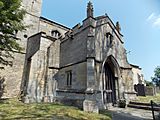
14th-century two-storey south porch, the upper floor a former priest room
-
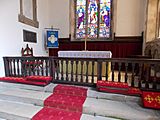
17th-century communion rail
-
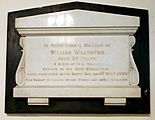
Memorial to William Willerton, captain of Chazeepore
-
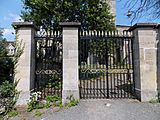
Listed church gates and gate pillars


