
Syd Kyle-Little facts for kids
Quick facts for kids
Syd Kyle-Little
|
|
|---|---|
.jpg)
Syd Kyle-Little on return from Patrol through Arnhem Land 1949
|
|
| Born |
Sydney Hamilton Kyle-Little
8 November 1918 |
| Died | 17 August 2012 (aged 93) Brisbane, Australia
|
| Burial place | Ashes scattered at Nadilmuk, Juda Point, Arnhem Land, Northern Territory |
| Alma mater | Sydney University |
| Occupation | Soldier, Patrol Officer, Business Man |
| Partner(s) | Marianne Lila |
| Children | Simon, Clinton, Scott, & Damien |
| Parent(s) | Arthur Sydney (Syd) Hamilton Kyle-Little Florence Kyle-Little nee Goodman |
Sydney Hamilton Kyle-Little (born November 8, 1918 – died August 17, 2012) was an Australian who had many different jobs. He was a soldier, a special officer who worked with Aboriginal people in the Northern Territory, and a high-ranking officer during a conflict called the Malayan Emergency. Later in his life, he became a successful businessman in both Asia and Australia.
Contents
Early Life and Family Background
Syd Kyle-Little was the first child of Syd Kyle-Little Senior and Florence Kyle-Little. His family had roots in Ireland and a history of serving in the military.
His father was a police officer, first with the Queensland Mounted Police and then in the Northern Territory. He was known for being a great horseman and very skilled at living in the Australian bush. He worked closely with Aboriginal people and they respected each other.
In 1923, Syd's family moved to Brisbane, Queensland, so their four sons could go to school.
Syd Junior spent a lot of time with Aboriginal people when he was young. He played and learned tracking skills with Aboriginal children. Later, he visited his uncle's cattle station in the Northern Territory, which gave him even more exposure to Aboriginal culture and the bush.
Military Service During World War II
In 1937, Syd Kyle-Little joined the Darwin Mobile Force. He stayed there until World War II began. Then, he joined the Australian Imperial Forces (AIF).
He was in Darwin when the Japanese bombed it. He also served at mission stations across the top of the Northern Territory. He reached the rank of Warrant Officer. In 1944, he joined the Special Investigation Bureau. He traveled with Americans on their ships around New Guinea, Borneo, and New Britain.
Syd faced many health challenges and injuries during the war. He got malaria and dengue fever in Darwin. He also hurt his hand while unloading ammunition and injured his back falling on a ship. These injuries caused him problems later in life.
Towards the end of World War II, while recovering in a military hospital, Syd applied for a new job. He wanted to become a Cadet Patrol Officer for the Native Affairs Branch in Darwin. This was an Australian government agency.
Becoming an Aboriginal Patrol Officer
In June 1946, after World War II, Syd Kyle-Little became a Cadet Patrol Officer with the Native Affairs Branch. His first assignment was in Arnhem Land. This was an area where Aboriginal culture and traditional laws were still very strong. Few Europeans had explored it. While he worked in other parts of the Territory, Arnhem Land was his main focus.
During the war, many Aboriginal people had moved closer to Darwin. They were drawn by things like tobacco and other goods. This caused some problems for the people living in Darwin.
Syd's main job was to look after the well-being of all Aboriginal people and to make sure Australian laws were followed. He believed that their welfare was the most important part of his job.

Exploring Arnhem Land
Syd Kyle-Little made three important journeys through Arnhem Land. He used native canoes and traveled on foot. These journeys helped him explore areas largely unknown to Europeans.
- One trip was a two-week journey by sea and land from Milingimbi Island to Koepanger Creek.
- Another was a two-month, 480-kilometer (300-mile) trek from Milingimbi to Oenpelli (now Gunbalanya).
- He also did a six-week, 320-kilometer (200-mile) trek with a police officer.
Traveling Through Seasons
The Northern Territory has two main seasons: a wet season (December to February) and a dry season (the rest of the year). Each season had its challenges for patrols.
- Wet Season: Traveling during the wet season meant dealing with floods, heavy rains, high humidity, and many biting insects like mosquitoes. Large swampy areas would appear.
- Dry Season: The dry season made walking easier and faster. However, finding fresh drinking water was a challenge. Aboriginal people knew where to find water in billabongs and soaks. Along the coast, large tidal rivers meant the water was undrinkable for many kilometers inland. Temperatures were almost always hot, usually over 30°C during the day.
Aboriginal people in Arnhem Land divide the year into four to six seasons. These seasons depend on the winds and weather. Syd always traveled with a small group of Aboriginal people. They knew a lot about the seasons, food, and water.
In 1946, he met two Aboriginal men, Oondabund and Narlebar. They spoke seven local languages, good English, and were skilled hunters and trackers. They became his assistants and good friends. Aboriginal people who helped on patrols were often paid with tobacco, but his assistants received a small payment.
Patrol Equipment and Dangers
For patrols in Arnhem Land, Syd usually traveled from Darwin by boat (a lugger) or sometimes by plane. From there, he used native canoes, walked, and sometimes swam across rivers.
He carried a 303 rifle and bullets, a large knife, a canvas sleeping bag, blankets, a mosquito net, spare clothes, a toothbrush, a compass, a diary, and soap. He found food and water from the land, using his own skills and those of his Aboriginal companions.
The main dangers were crocodiles in and near the water, and buffalo in the bush.
University Study
After working for 18 months, Syd and two other cadet officers went to the University of Sydney. They took a six-month course in Anthropology (the study of human societies and cultures), Criminal Law, and Tropical Medicine. They were the first Patrol Officers to take such a course.
After his studies, he went on patrol to Borroloola.
Aboriginal Trading Post Idea
In 1949, Syd Kyle-Little and another Patrol Officer, Jack Doolan, wanted to set up trading posts for Aboriginal people in their own country. The idea was to help Aboriginal people stay connected to their land. They could trade goods and get the things they needed. The first and only trading post was set up at what is now Maningrida.
To do this, they fixed up an old boat called the Amity. They used it to carry crocodile skins, woven baskets, and trepang (a type of sea cucumber) to Darwin to sell.
In 1981, Syd visited Maningrida with his family. His son Simon was working there as an Aboriginal adviser. While there, Syd's family met the families of his old Aboriginal assistants, Oondabunda and Narleba.
Travel and New Opportunities
In 1950, Syd decided to take a long holiday after some changes happened in the Native Affairs Branch. He first went to the UK and Ireland.
While in London, he gave a lecture to the Royal Anthropological Institute. He spoke about "The Aboriginal Tribes of Arnhem Land."
He then visited his great aunts in Ireland. While there, he received an invitation from the British Colonial Service. They wanted to interview him for a job as a Resettlement Officer in Malaya during a conflict called the Emergency.
When he returned to Darwin in early 1950, he resigned from his Patrol Officer job. He decided to take the new position in British Malaya.
The Malayan Emergency
Syd Kyle-Little's job as a Resettlement Officer was for the British Colonial Service. This job worked closely with the British military and the Malay police.
His first big task was to create a secure village called Kebun Bahru (New Garden) in Johor, Malaysia. This village was surrounded by barbed wire and had a strong police post in the middle. People who moved there received financial help for six months and a plot of land to farm.
In 1952, he joined the British-led Malayan Security Forces. He held the rank of Lieutenant Colonel in their Home Guard. He was in charge of defending all villages and towns in the State of Negri Sembian. His main office was in the capital city, Seremban.
In his book, The War that was called "An Emergency", Syd described the conflict as a difficult war against the Malay Communist Party. He used his jungle experience from World War II and his tracking skills from being a patrol officer. He also worked with Australian forces in the Emergency and helped recruit officers for the Home Guard.
As the Emergency was ending, Syd went on leave in December 1955 because he planned to get married. His military service ended on April 7, 1956.
Business Career
In 1957, Syd Kyle-Little and his new wife moved to Singapore. He started working in the business world as a manager for Wyeth International, a US pharmaceutical company. Before starting, he trained in Manila, where his first son was born. Then, he moved to Bangkok, Thailand, to be the manager there.
In 1968, the family returned to Australia. They wanted to raise and educate their sons in their home country.
Awards and Books
Syd Kyle-Little received the Distinguished Conduct Medal from Negeri Sembilan, Malaya. This award recognized his important work:
- He planned and carried out the creation of several large new villages.
- He performed a brave night rescue of a mother and her baby from a flooded, fast-flowing river.
Syd also wrote two books about his experiences:
- Whispering Wind — Adventures in Arnhem Land: This book was first published in 1957 and updated later. It shares his adventures as a Patrol Officer.
- The War That Was Called "An Emergency": Malaya 1951–1956: This book was published after he passed away in 2016. It tells the story of his time during the Malayan Emergency.
Images for kids
-
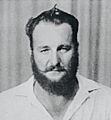
Syd Kyle-Little on return from Patrol through Arnhem Land 1949
-
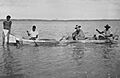
Syd Kyle-Little setting out from Milingimbi Island on his first patrol to the mainland of Arnhem Land in June 1946
