
Tin Ujević facts for kids
Quick facts for kids
Tin Ujević
|
|
|---|---|
 |
|
| Born | Augustin Josip Ujević 5 July 1891 Vrgorac, Kingdom of Dalmatia, Austria-Hungary |
| Died | 12 November 1955 (aged 64) Zagreb, PR Croatia, FPR Yugoslavia |
| Occupation | Poet |
| Language | Croatian |
| Nationality | Croat |
| Notable works | Lelek sebra Kolajna Auto na korzu Ojađeno zvono Žedan kamen na studencu |
| Signature | |
 |
|
Augustin Josip "Tin" Ujević (born July 5, 1891 – died November 12, 1955) was a famous Croatian poet. Many people think he was the greatest poet in Croatian literature during the 20th century.
After 1921, he started using the name Tin Ujević instead of Augustin.
Contents
Who Was Tin Ujević?
Early Life and Education
Tin Ujević was born in Vrgorac, a small town in a region called Dalmatia. He went to school in several Croatian cities. These included Imotski, Makarska, Split, and Zagreb.
He finished high school in Split. In Zagreb, he studied many subjects. These included the Croatian language and literature, old languages, Philosophy, and Aesthetics (the study of beauty).
Starting His Writing Career
In 1909, while still studying, Tin Ujević published his first poem. It was a sonnet called "Za novim vidicima" (Towards New Horizons). It appeared in a magazine called Mlada Hrvatska (Young Croatia).
Around 1912, he became active in a youth movement. Because of his involvement, he was sometimes put in prison. Before World War I began, he lived in different cities for a short time. He also spent a longer period in Split.
Years in Paris
A very important time for Tin Ujević was when he lived in Paris from 1913 to 1919. This period greatly shaped his political ideas and his poetry.
In 1914, after the death of another famous writer, Antun Gustav Matoš, Ujević wrote an essay about him. This essay was published in a literary magazine. That same year, a collection of poems called "Hrvatska mlada lirika" (Croatian Young Lyrics) was released. It included 10 of Tin Ujević's poems.
He also joined the French Foreign Legion for about three months. He left after a friend, Frano Supilo, encouraged him to.
Return to Croatia and Later Life
In 1919, Tin Ujević returned to Zagreb. He wrote two essays about his own life and thoughts. One was called "Mrsko Ja" (Hateful Me, 1922). In it, he talked about his political beliefs, saying he was no longer as hopeful as before.
The other essay was "Ispit savjesti" (Examination of Conscience, 1923). This essay is seen as one of the most honest writings in Croatian literature. In it, he looked closely at his own past.
From 1920 to 1926, Ujević lived in Belgrade. Then he moved between Split and Zagreb, and back to Belgrade and Split again. His first collection of poems, "Lelek sebra" (Cry of a slave), was published in Belgrade in 1920.
He was well-known in the artistic and free-spirited circles of Belgrade. He often visited famous places like Hotel Moskva and Skadarlija.
From 1930 to 1937, Ujević lived in Sarajevo. Then he moved to Split (1937–1940) and finally back to Zagreb. He lived in Zagreb until he passed away in 1955.
During World War II (1941-1945), he did not publish any books. He worked as a journalist and translator to earn a living. After the war, the government stopped him from publishing his literary works for some years. This was because he had worked as a translator for the Independent State of Croatia during the war.
In 1950, a selection of his works called "Rukovet" ("Handful") was published in Zagreb. Tin Ujević died on November 12, 1955, and is buried in Mirogoj Cemetery in Zagreb.
Tin Ujević's Lasting Impact
His Contributions to Literature
Besides his poetry, Tin Ujević also wrote many other things. He wrote essays, short stories, and articles for newspapers. He also studied different writers and translated philosophical discussions from many languages.
He translated many poems, novels, and short stories into Croatian. Some of the famous writers he translated include Edgar Allan Poe, Walt Whitman, and Marcel Proust.
Ujević wrote more than ten books of essays and meditations. But his most important work is his poetry. At first, he was influenced by other poets like Antun Gustav Matoš. However, he soon developed his own unique style.
He liked French and American modern poets such as Charles Baudelaire and Walt Whitman. He even translated their works. His first poetry collections, Lelek sebra and Kolajna, are considered some of the best modern Croatian lyrical poetry.
His work is now a classic part of Croatian literature. The British poet Clive Wilmer called him "one of the last masters of European Symbolism". Another writer, Anne Stevenson, said his poetry is like that of Thomas Hardy and Yeats.
Honors and Recognition
There are about 380 records of Tin Ujević's works in the National and University Library in Zagreb. Part of his original writings are kept there. He published his works in many newspapers and journals. Many articles were also written about him.
The Tin Ujević Award is the most important poetry award in Croatia.
In 2003, a Jadrolinija ferry was named MV Tin Ujević in his honor.
In 2005, Hrvatska Pošta (Croatian Post) released a stamp featuring Tin Ujević. This was to mark 50 years since his death.
By 2008, 122 streets in Croatia were named after Ujević. This makes him the ninth most common person for whom streets are named in Croatia.
Major Works by Tin Ujević
- Lelek sebra (Cry of a slave), 1920
- Kolajna (Necklace), 1926
- Auto na korzu (Car on the promenade), 1932
- Ojađeno zvono (Heavy-hearted bell), 1933
- Skalpel kaosa (Scalpel of chaos), 1938
- Ljudi za vratima gostionice (People behind inn doors), 1938
- Žedan kamen na studencu (Thirsty stone at the wellspring), 1954
His complete works, called Sabrana djela, were published in 17 volumes between 1963 and 1967. Many other editions of his poems, essays, and studies have also been published.
Images for kids
-
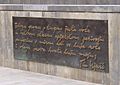
"Zelenu granu s tugom žuta voća..." Ujević's famous poem.
-
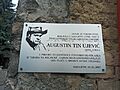
Memorial plaque on the wall of the house in Sarajevo where Tin Ujević lived from 1930 to 1937
-
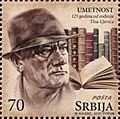
Ujević on a 2016 Serbian stamp


See also
 In Spanish: Tin Ujević para niños
