
Black-faced blenny facts for kids
Quick facts for kids Black-faced blenny |
|
|---|---|
,_Parque_natural_de_la_Arr%C3%A1bida,_Portugal,_2022-07-20,_DD_29.jpg) |
|
| Female | |
,_Parque_natural_de_la_Arr%C3%A1bida,_Portugal,_2022-07-29,_DD_32.jpg) |
|
| (Territorial) Male | |
| Conservation status | |
Scientific classification  |
|
| Kingdom: | Animalia |
| Phylum: | Chordata |
| Class: | Actinopterygii |
| Order: | Blenniiformes |
| Family: | Tripterygiidae |
| Genus: | Tripterygion |
| Species: |
T. delaisi
|
| Binomial name | |
| Tripterygion delaisi Cadenat & Blache, 1970
|
|
| Script error: The function "autoWithCaption" does not exist. | |
| Synonyms | |
|
|

Script error: No such module "Check for conflicting parameters".
The black-faced blenny (Tripterygion delaisi) is a small fish that lives on the seafloor. It belongs to the triplefin-blenny family, called Tripterygiidae. You can find these fish at depths from 3 to 40 meters (about 10 to 130 feet). They like to live on the bottom under big rocks, cliffs, or other places that offer shade.
Contents
About the Black-Faced Blenny's Look
Like all triplefin-blennies, the black-faced blenny has three fins on its back. This helps you tell it apart from other similar fish. For example, blennies have only one back fin, and gobies have two. The black-faced blenny has a pointy head and short feelers above its eyes.
How Black-Faced Blennies Change Color
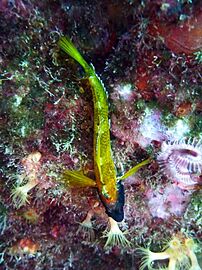
The name "yellow black-faced blenny" comes from the colors of the males. During the time they are looking for a mate, their body turns bright yellow. Their head also becomes black. If two males fight over their space, the head color changes to gray. This gray color is a sign that they are ready to fight.
Females, young fish, and males not looking for a mate have different colors. They are usually gray-brown with five dark stripes on their body. These colors help them blend in with their surroundings. Outside of the mating season, it is very hard to tell males and females apart without special tools.
-
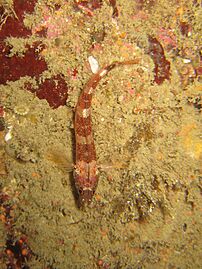
Female
-
-

A female black-faced blenny (back) and a male with a black head and yellow body (front)


How Big Do Black-Faced Blennies Get?
The black-faced blenny can grow up to 8 centimeters (about 3 inches) long. Males that have their own space are usually a bit bigger. They average about 6.1 cm (2.4 in). Males without their own space are smaller, around 4.7 cm (1.8 in). Females are about 5.0 cm (2.0 in) long. Fish found in deeper water are often larger than those in shallow water.
How to Tell Them Apart from Similar Fish
It is easy to spot a male black-faced blenny during mating season. They look very different from other fish. However, females, young fish, and non-territorial males look a lot like another fish called Tripterygion tripteronotus.
You can tell them apart by looking for a dark spot. The black-faced blenny has a dark spot near its tail, but T. tripteronotus does not. Also, the first spine on the first back fin of the black-faced blenny is the longest. For T. tripteronotus, the second spine is often as long or even longer.
Amazing Fluorescent Eyes
The eyes of the black-faced blenny have a special trick. Their eyes can glow a fluorescent red color! This glow comes from tiny crystals in their eyes. These crystals take in light from the water and then send it back out as red light. The fish can even control how bright this glow is. They can make it brighter when they are looking for food. The glow gets dimmer when they are stressed or resting.
Scientists have also found that fish living in deeper water have a more efficient glow. This means their eyes are better at producing the red light. This special ability helps them see in their dark environment. Black-faced blennies can actually see their own red glow. This helps them communicate with each other.
Black-Faced Blenny Life and Habits
What Black-Faced Blennies Eat
The black-faced blenny is a carnivore, meaning it eats meat. It mainly eats small crustaceans. These include tiny creatures like Harpacticoids, Tanaidaceans, Caprellids, and Amphipods. They cannot bite off pieces of their food. So, they can only eat prey that fits whole into their mouth.
Before catching food, the blenny watches its prey for a few seconds. Its first back fin twitches about twice per second. To catch the prey, it suddenly sucks the food into its mouth. If the prey is stuck to a surface, the blenny shakes its head sideways to pull it off.
How Black-Faced Blennies Move and Rest
When swimming long distances, the black-faced blenny moves its body and tail in a wavy motion. This helps it push through the water. Its side fins are tucked in, and its third back fin and tail fin are spread out.
For short swims, the blenny first raises all its back fins. Then, it quickly moves its side fins to push itself forward. While swimming, its back fins are folded down.
When resting, the black-faced blenny lifts the front part of its body. It leans on the bottom edge of its side fins and its belly fins. These fish sleep out in the open. They rely on their camouflage to stay hidden from danger.
If a blenny needs to scratch an itch, it turns on its side. Then, it rubs its body against the seafloor. When it yawns, it opens its mouth wide. It also spreads its gill covers and lowers its mouth floor. At the same time, it spreads its tail and all its back fins.
Black-Faced Blenny Reproduction
Male black-faced blennies have their own territories from early February to early September. Each male usually holds his territory for about 47 days. They can even keep the same territory for two years in a row. Mating happens from mid-March until June.
Males set up their territories under overhanging cliffs and rocks. These areas are about 1 meter (3 feet) wide. Inside this territory, there is a smaller nesting area, about 20 by 20 centimeters (8 by 8 inches). Males can find their way back to their territory from as far as 200 meters (650 feet) away.
Territory Fights
During the mating season, male blennies will protect their territory from other fish. This behavior stops after the mating season. How a male fights depends on the size of the fish trying to enter his space.
If the other male is smaller, the territory holder will ram it to make it leave. If the intruder is almost the same size, the territory holder swims in front of it. Both fish form a "T" shape. The territory holder then beats the intruder with its tail until it leaves.
If the intruder is as big or bigger, a real fight might happen. The territory holder warns the intruder by raising its first back fin. If the intruder does not leave, the territory holder slowly moves the front of its body up and down. This is called "rearing up." The intruder might do this too, which starts the fight.
The territory holder swims towards the intruder, beating its tail and spreading all its back fins. They will then move into a parallel or anti-parallel position. Both fish use their tails to hit each other. Later in the fight, they might ram and bite each other. Fights often have short breaks where the fish rest and "rear up." Most of the time, the territory holder wins and the intruder leaves.
Fights between female blennies are rare. Also, black-faced blennies usually do not fight with closely related species. If another male tries to bother a mating pair, both the male and female will ram the intruder until it leaves. If a female enters a male's territory when he is not ready to mate, he will ram her to drive her away.
Spawning and Laying Eggs
Females always start the egg-laying process. They either swim into a male's territory and start laying eggs, or they respond to a male's courtship dance. If a male is ready to mate but no female is nearby, he swims in loops from the seafloor upwards. These loops are horizontal if no female is around. They are directed towards a female if she is interested.
If not disturbed, a female will lay all her mature eggs in one session with the same male. A male can fertilize up to 490 eggs in a day! One complete egg-laying session lasts from 45 to 105 minutes. Each egg is laid one at a time.
The process has two steps for each egg. First, the female wiggles her whole body as she slowly swims over the seafloor. She uses a special part of her body to find a good spot to lay an egg. Once she finds a spot, her wiggling gets faster. Her first back fin spreads out. The male, who has been nearby, then moves closer. Both fish tremble as they release their eggs and sperm. After the egg is laid and fertilized, the male jumps away. The female then repeats the first step. To encourage the female, the male often swims in a figure-eight shape in front of her. Egg-laying stops when the female leaves the male's territory or stops wiggling for more than 20 seconds. After that, the male will chase her away.
Parental Care
After laying eggs, the female leaves. Only the male takes care of the eggs. Unlike many other fish, the male black-faced blenny does not fan fresh water over the eggs to give them more oxygen. However, he does clean the eggs by picking at them often. He also defends them from predators.
The main dangers to black-faced blenny eggs are blennies, young sparids, Crenilabrus species, crabs, and sea urchins. Even though some of these predators are much bigger than the male, a nest is rarely eaten when a male is guarding it. If the male is removed, all the eggs are usually eaten within half an hour. The male bites fish predators on their sides and fins. He bites crabs on their eye-stalks to scare them away. Sea urchins are also attacked, but they are the only threat a guarding male cannot fully defend his eggs against.
Dead eggs are removed by the male and usually eaten. If a dead egg is stuck, he carries it away from the other eggs and spits it out. If he accidentally picks up an egg that is hatching, he swims upwards and spits the baby fish out. This gives the tiny fish a better chance to be carried away by water currents.
Baby Blenny Development
Baby black-faced blennies hatch after about 19 to 20 days. They live as tiny floating creatures (plankton) for several weeks. After that, they return to living on the seafloor as young fish. The first young fish can be seen in July. All of their early development happens close to the shore.
Where Black-Faced Blennies Live
The black-faced blenny lives in two separate areas. One area is the western Mediterranean Sea and nearby parts of the Atlantic Ocean. This stretches from the British Isles in the north down to Casablanca and Morocco in the south. The second area is western tropical Africa, north to Senegal and the Macaronesian islands.
They live at depths between 3 and 40 meters (about 10 to 130 feet). However, they are most common between 6 and 25 meters (about 20 to 80 feet) deep. They prefer shady, dark places, like shaded rock faces, overhangs, and cracks. In the Atlantic Ocean, you can see them without cover even in shallow water. But in the Mediterranean Sea, they only appear without cover below 10 meters (33 feet) deep. This might be because of competition with other fish. In the Mediterranean, a similar fish, T. tripteronotus, lives in shallow waters (0 to 5 meters). But in the Atlantic, where T. tripteronotus is not found, the black-faced blenny can use those shallow areas.
The males of T. tripteronotus and T. melanurus both have red bodies with black heads. Red light is strong in shallow waters. But it becomes less noticeable in deeper water because water absorbs red light. This might explain why the black-faced blenny usually lives below 5 meters (16 feet) deep. In shallow waters, red is a stronger signal for mating. But yellow males, like the black-faced blenny, still show their colors well in deeper waters. This helps them find mates there.
Black-Faced Blenny Family Tree
Naming and Groups
The black-faced blenny belongs to the Tripterygion group within the Tripterygiidae family. This group has four species: T. delaisi, T. melanurus, T. tartessicum, and T. tripteronotum. All of these, except T. delaisi, are found only in the Mediterranean Sea.
The black-faced blenny itself has two types, called subspecies: T. delaisi delaisi in the Mediterranean Sea and T. delaisi xanthosoma in the Atlantic Ocean. You can tell them apart by how they try to attract mates. T. delaisi delaisi males swim in open water to court females. T. delaisi xanthosoma males stay on the ground when they are courting.
How Black-Faced Blennies Evolved
Scientists are still discussing how these different blenny species came to be. Here are some ideas:
- One idea is that T. tripteronotus and T. delaisi came from two groups of fish that were separated during the last ice ages.
- Another idea suggests that the Tripterygion species we see today are descendants of African fish that moved into the Mediterranean Sea many times.
- Some scientists think these species evolved either in the same place or in different places within the Mediterranean Sea.
- More recent studies suggest that the different Tripterygion species, including T. delaisi, split off quickly after a big event called the Messinian salinity crisis. This was a time when the Mediterranean Sea almost dried up.
- One study looked at the genes of T. delaisi. It found two main groups of T. delaisi: one around the eastern Atlantic islands and another along the Mediterranean and European Atlantic coasts. This suggests that the ancestors of Tripterygion spread from their home in western Africa to the Mediterranean Sea and the Atlantic Ocean.
Where the Name Comes From
The black-faced blenny was first described in 1970 by two scientists, Jean Cadenat and Jacques Blache. They named it after Michel Delais. He collected the first samples of this fish in Gorée, Senegal.
Images for kids
-

Female black-faced blenny
-
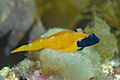
Territorial male black-faced blenny
