
Messinian salinity crisis facts for kids
The Messinian salinity crisis was a time when the Mediterranean Sea almost completely dried up. This amazing event happened between 5.96 and 5.33 million years ago (Ma). It was part of the Miocene epoch, a long period in Earth's history.
Imagine the huge Mediterranean Sea turning into a dry, salty basin! This happened because the connection to the Atlantic Ocean at the Strait of Gibraltar closed. Without fresh water flowing in, the hot climate caused the sea to evaporate.
Scientists found clues in sediment samples from the seafloor. These samples contain salt minerals, soil, and fossil plants. They show that the Strait of Gibraltar closed around 5.96 million years ago. This cut off the Mediterranean from the Atlantic.
The sea dried out almost completely within about a thousand years. This left a very deep, dry basin, up to 5 kilometers (3 miles) below normal sea level. Only a few super-salty lakes, like today's Dead Sea, remained. Later, around 5.5 Ma, more rain and river water flowed in. This created larger lakes with brackish water, similar to the Caspian Sea.
The crisis ended dramatically about 5.33 million years ago. The Strait of Gibraltar reopened, and the Atlantic Ocean rushed back in. This event is known as the Zanclean flood. It quickly refilled the Mediterranean basin.
Even today, the Mediterranean Sea is saltier than the Atlantic. This is because of its narrow connection and high evaporation. If the Strait of Gibraltar ever closed again, the Mediterranean could dry up in about a thousand years.
Contents
How Scientists Discovered This Event
Scientists first learned about this event in the 1800s. A Swiss geologist named Karl Mayer-Eymar studied fossils in layers of rock. These layers contained gypsum, a mineral often found where water has evaporated. He realized these layers formed just before the end of the Miocene Epoch.
In 1867, he named this period the Messinian. He chose the name from the city of Messina in Sicily, Italy. Since then, many other salt and gypsum layers across the Mediterranean have been found from the same time.
More Clues from the Seafloor
In 1961, scientists used seismic surveying to map the Mediterranean seafloor. They found a special layer, about 100 to 200 meters (330-660 feet) below the bottom. This layer, called the M reflector, looked like it was made of salt.
Later, in 1970, a research ship called the Glomar Challenger drilled deep into the seafloor. Geologists like William B. F. Ryan and Kenneth Hsu pulled up core samples. These samples contained many types of salt, like gypsum and rock salt. They also found gravel from ancient riverbeds and silts from floodplains.
Some cores even showed signs of dust storms. Tiny sea creatures called foraminifera had dried into dust and were blown by the wind. These layers of dust and salt showed that the Mediterranean had dried up and refilled many times.
Another strong piece of evidence came from ancient canyons. Rivers like the Nile carved deep valleys into the dry Mediterranean basin. The Nile's bed was cut 2,500 meters (8,200 feet) below sea level near Cairo! These canyons are now underwater, but they show how low the sea level once was.
Scientists also found fossilized mud cracks in many places. These cracks formed when muddy sediment dried out in the sun. All these clues confirm that the Mediterranean Sea experienced repeated drying and flooding.
When Did the Crisis Happen?
Scientists used special dating methods to figure out the timeline. The Messinian salinity crisis began about 5.96 million years ago. This was during the later part of the Miocene epoch.
During this time, the Earth's tectonic plates were moving. This caused changes in sea level and led to periods of erosion and sediment buildup. The connection between the Mediterranean and the Atlantic kept closing and opening.
The Mediterranean Sea was completely cut off from the Atlantic for a long time, from 5.59 to 5.33 million years ago. This caused the sea level to drop dramatically. In the driest periods (5.6–5.5 Ma), huge canyons formed around the Mediterranean, some as big as the Grand Canyon!
Later (5.50–5.33 Ma), the basin became a large "lake-sea" with many salt deposits. This period is sometimes called the "Lago Mare" event.
Finally, about 5.33 million years ago, the barrier at the Strait of Gibraltar broke. The Atlantic Ocean rushed back in, refilling the Mediterranean. This event, the Zanclean flood, marked the end of the crisis. The Mediterranean Sea has not dried up since then.
Many Times the Sea Dried and Refilled
Scientists estimate that over 1 million cubic kilometers of salt were deposited. This is 50 times more salt than is normally in the Mediterranean Sea! This huge amount suggests the sea dried up and refilled not just once, but many times.
Each time the sea dried, it left behind thick layers of salt. These drying periods often happened during cooler global temperatures. When the sea refilled, it was usually because the connection to the Atlantic reopened. This could happen due to tectonic plate movements or a river carving a path.
Geologist Kenneth J. Hsu studied core samples. He found layers showing a cycle: deep-sea mud, then signs of shallower water, then stromatolites (formed in shallow areas), and finally minerals from completely dry land. Then, suddenly, new layers of mud appeared, showing the sea had refilled.
This cycle of drying and refilling likely happened several times over hundreds of thousands of years. This helps explain why so much salt was left behind.
How Salt Layers Formed
Scientists have different ideas about how the salt layers formed across the Mediterranean.
- Some think salt was deposited at the same time in all basins, both shallow and deep. This would mean the entire sea level dropped at once.
- Others believe the salt formed at different times. They suggest that shallow areas dried first, then deeper parts as the sea continued to shrink.
- A third idea is that the sea level dropped slightly, but only shallow basins dried enough to deposit salt. The deeper parts remained connected to the Atlantic.
These ideas are still being debated by scientists. They use methods like cyclostratigraphy to compare the ages of sediment layers. This helps them understand if the salt deposits formed at the same time everywhere.
What Caused the Mediterranean to Dry Up?
Scientists believe a combination of factors caused the Messinian salinity crisis.
- Plate Tectonics: The movement of African and European tectonic plates played a big role. The area around the Strait of Gibraltar is a complex zone where these plates meet. Movements here likely closed and reopened the passages to the Atlantic Ocean.
- Climate Change: Earth's climate also changed during this time. Cooler periods in Milankovic cycles meant less sunlight reached the northern hemisphere. This led to less evaporation in the North Atlantic and less rainfall over the Mediterranean. With less water flowing in from rivers, the sea began to dry out.
- Sea Level Drops: Global sea levels also dropped by about 10 meters (33 feet) around 6.14 Ma. A larger drop of about 30 meters (98 feet) happened around 5.26 Ma. These drops made it easier for the connection to the Atlantic to close.
Scientists are still working to understand the exact combination of these causes.
What Was the Climate Like?
It's hard to imagine what the climate was like in the dry Mediterranean basin. There's no place like it on Earth today.
- Scientists think that summer temperatures in the lowest parts of the basin could have been extremely hot. Some estimates suggest temperatures might have reached 80°C (176°F)! This would have made it impossible for most life to survive.
- The air pressure would also have been higher because of the low altitude. This would have added to the heat stress.
- However, computer models suggest the warming might have been less extreme. The basin could have warmed by about 15°C (27°F) in summer and 4°C (7°F) in winter if completely dry. If some lakes remained, the warming would have been even less.
Without the Mediterranean Sea, the climate in surrounding regions would have been much drier. Areas like Italy, Greece, and the Balkans would have received less rain.
Effects of the Crisis
The Messinian salinity crisis had huge impacts on life and geography.
Effects on Living Things
- Marine Life: Many fish and other sea creatures in the Mediterranean died out. The sea's current pattern of biodiversity, with fewer species in the east, developed after this crisis.
- Land Mammals: Land mammals also saw changes. Because the Iberian Peninsula (Spain and Portugal) and North Africa were connected by dry land, animals could move between the two regions. This led to a mix of animal species.
- Island Life: The crisis also allowed land animals to reach islands like the Balearic Islands. Some of these animals, like the goat-antelope Myotragus, lived there in isolation for millions of years.
Changes to the Land
- New Land Bridges: The drying of the sea created land bridges. This allowed animals to cross from Africa to Europe.
- Extreme Heat: The low altitude of the basin meant it was incredibly hot in summer. This is supported by the presence of anhydrite, a mineral that forms in water warmer than 35°C (95°F).
- Deep Canyons: Rivers flowing into the dry basin carved their beds much deeper. The Nile, for example, cut its bed 2,400 meters (7,900 feet) deeper than its current level near Cairo.
Some scientists also believe that the Red Sea might have been connected to the Mediterranean at Suez and dried out along with it.
The Great Refilling
When the Strait of Gibraltar finally broke open, the Atlantic Ocean rushed back into the Mediterranean. Imagine a massive waterfall far bigger and more powerful than any on Earth today!
However, recent studies suggest the water didn't just plunge down one huge waterfall. Instead, it likely flowed through a channel that gradually descended into the dry Mediterranean basin. This refilling event, known as the Zanclean flood, was incredibly powerful. Scientists have found a huge deposit of debris southeast of Sicily, which they believe was left by this massive flood.
Images for kids
-
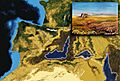
Artistic interpretation of the Mediterranean geography during its evaporative drawdown, after complete disconnection from the Atlantic. The rivers carved deep gorges in the exposed continental margins; the concentration of salt in the remaining water bodies led to rapid precipitation of the salt. The inset evokes the transit of mammals (e.g. camels and mice) from Africa to Iberia across the exposed Gibraltar Strait.
-
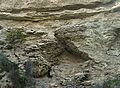
Cones of gypsum, which formed on the sea floor as a result of evaporation. Evaporation of one metre of seawater precipitates around 1 mm of gypsum.
-
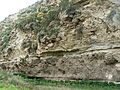
The scale of gypsum formation in the Sorbas Basin (Yesares member). The upward-growing cones suggest precipitation on the sea floor (not within sediments).
-
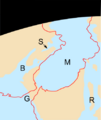
A possible palaeogeographical reconstruction of the west end of the Miocene Mediterranean. North to the left.{{unbulleted list
-
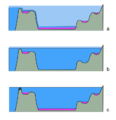
Hypotheses of evaporite formation during the MSC.


See also
- Messinian evaporite
- Atlantropa
