
Cross-country skiing facts for kids

Cross-country skiers in western Norway.
|
|
| Nicknames | Cross-country, XC skiing, Nordic skiing |
|---|---|
| Characteristics | |
| Type | Outdoor winter sport |
| Equipment | Skis, poles, boots, bindings |
Cross-country skiing is a fun winter activity where people glide across snowy land. Unlike alpine skiing, you don't use ski lifts. Skiers move themselves forward using their own power. It's a popular sport and a great way to explore nature. Some people even use it for travel, just like in the old days!
You can cross-country ski on many types of snowy ground. This includes wild, untouched areas and specially prepared trails. Modern cross-country skiing is very similar to the first ways people ever skied. All other types of skiing, like ski jumping and Telemark skiing, grew from it. Skiers move by stepping forward (called the classic style) or by pushing side-to-side like ice skating (called skate skiing). They also use ski poles to help push themselves along. This sport is enjoyed in many snowy places around the world, such as Europe, Canada, and the United States.
Competitive cross-country skiing is a big part of Nordic skiing sports. It's also combined with rifle shooting in a sport called biathlon. Another exciting type is Ski orienteering, where skiers use maps to find their way along snow trails.
Contents
Cross-Country Skiing: Glide Through Winter!
The Amazing History of Skiing

How Skiing Began Long Ago
The word "ski" comes from an old Norse word, skíð, meaning "stick of wood." Skiing started as a way to travel over snow almost 5,000 years ago in Scandinavia. Some evidence suggests it might have been practiced even earlier in what is now China. Ancient writings from around 550 CE describe the Sami people as "ski running Samis." Some experts believe the Sami have skied for over 6,000 years.
Skiing was a very important way to get around. For example, a story from 950 CE tells how King Haakon the Good sent his tax collectors out on skis. An old law from 1274 even said that skiers shouldn't disturb moose on private land. Over time, cross-country skiing changed from just a way to travel into a worldwide hobby and sport. Other types of skiing began to develop from it in the mid-1800s.
Early skiers often used one long pole or spear with their skis. The first picture of a skier with two ski poles appeared in 1741. In Norway, people used special skis for travel. One ski was short with fur on the bottom for grip, and the other was long for gliding. This allowed skiers to push themselves forward like a scooter. The Sami people used this method for a very long time.
Skis for Travel and War
Skis were also used in battles. The first records of soldiers on skis come from the 13th century in Denmark. These ski troops could travel as fast as light cavalry (soldiers on horseback). The army in Norway had special ski battalions from 1747.
Skis helped people deliver mail in the US Midwest around 1836. A famous Norwegian immigrant, "Snowshoe Thompson," carried mail across the Sierra Nevada mountains on skis from 1856. Explorers like Fridtjof Nansen crossed the Greenland icecap on skis in 1888. Roald Amundsen used skis on his South Pole Expedition in 1910. Skiing was even introduced to Japan in 1902 after Japanese soldiers died in a snowstorm.
From Travel to Sport: The Rise of Skiing

Norwegian army groups held ski contests in the 1700s. These included shooting while skiing fast, downhill races, and long races on flat ground. One of the first public ski competitions happened in Tromsø, Norway, in 1843. In Norway, "langrenn" means competitive skiing where the goal is to finish a set distance in the fastest time.
A newer way of skiing, called skate skiing, was tried in the early 1900s. But it didn't become popular until the 1980s. Johan Grøttumsbråten used a skating technique in a 1931 World Championship. This was one of the first times it was seen in competitive cross-country skiing. It became widely used after Bill Koch from the United States had great success with it in the 1982 World Championships. Norwegian skier Ove Aunli started using it in 1984 because he found it much faster.
Understanding Skiing Words
The word "ski" comes from the Old Norse word skíð, meaning "stick of wood." In Norway, people use different phrases for skiing. For example, "gå på ski" means "walk on skis" for general skiing. "Langrenn" means "long race" and refers to competitive cross-country skiing.
Fun Ways to Enjoy Cross-Country Skiing

Cross-country skiing is a great way to have fun outdoors. It includes ski touring and skiing on groomed trails. It's also a sport that people with vision or mobility challenges can enjoy. Another related activity is dog skijoring, where one or more dogs help pull a skier.
Exploring Nature: Ski Touring
Ski touring means skiing away from prepared trails and ski resorts. These trips can last for several days. The skis, bindings, and boots let your heel move freely, just like when you walk. This is different from Alpine skiing where your heel is fixed.
A special kind of ski touring is ski mountaineering. This involves finding your own way through snowy mountains. It often means knowing about avalanche safety and weather. Ski touring can sometimes be faster and easier than summer hiking in certain areas. In some countries, like Norway, there are many huts for skiers to use in winter. The Norwegian Trekking Association has over 400 huts along thousands of kilometers of trails.
Skiing on Prepared Trails

Skiing on groomed trails happens at special places like Nordmarka in Oslo. These trails are carefully prepared for both classic and skate skiing. Special snow machines compact the snow and create tracks for classic skiing. The people who groom the trails must adjust their equipment based on the snow's condition.
These ski areas often have courses designed to meet high standards for big events. These standards cover things like course length, how difficult the hills are, and other factors. Some places even have lights on certain trails for night skiing. These are called "lysløype" (light trails) in Norwegian. The first one opened in Norway in 1946.
Competing in Cross-Country Skiing
Cross-country ski competitions come in many forms. Races are held over different distances. Rules are set by groups like the International Ski and Snowboard Federation (FIS). National groups also organize races. There are also long-distance ski marathons, ski orienteering events, and Paralympic cross-country skiing for athletes with disabilities.
Big Races and Championships

The FIS Nordic World Ski Championships have been held for men since 1925 and for women since 1954. These championships used to happen every year, including during the Winter Olympic Games. After World War II, they were held every four years until 1982. Since 1985, they have taken place every two years in odd-numbered years. Important cross-country ski events include the Winter Olympics, the FIS World Championships, and the FIS World Cup races.
Other Exciting Ski Competitions
Cross-country ski marathons are long races, usually more than 40 kilometers. There are two main series for these marathons: the Ski Classics and the Worldloppet. Skiers can race in classic or skate style, depending on the event rules. Famous marathons include the Vasaloppet in Sweden and the Birkebeineren in Norway.
Biathlon combines cross-country skiing with rifle shooting. Skiers shoot at targets, and if they miss, they get a penalty, like extra distance or time. Each round, biathletes must hit five targets.
Ski orienteering is a race where skiers use a map to find their way through a snowy landscape. They need to choose the best routes while skiing fast. Special maps show which trails are good for skiing in the snow. This is one of the four main orienteering sports. Skiers often use a map holder on their chest.
Paralympic cross-country ski competition is for athletes with disabilities. This includes events for standing skiers, sitting skiers (who use wheelchairs), and visually impaired athletes. These events are divided into categories for different types of physical challenges.
How Skiers Move: Techniques

Cross-country skiing has two main ways to move forward: classic and skate skiing. The classic style is used on untouched snow or in prepared tracks. Skate skiing is for smooth, firm snow. Both styles use poles to help push the skier forward. Skiers also use different turns when going downhill.
Poles help skiers move forward. They can be used at the same time (common for skate skiing) or one after the other (common for classic skiing). Using both poles at once, called "double poling," is also used in classic skiing on flat or slightly downhill sections to go faster.
Classic Style: The Traditional Way
The classic style is often used on trails with two parallel grooves, called tracks. It's also the most common way to ski where there are no tracks. In this style, you push one ski forward while the other stays still, in a walking and gliding motion. In the "diagonal stride," you plant your poles on the opposite side of your forward-moving foot. In the "kick-double-pole," you plant both poles at the same time with every other stride.
Sometimes, especially on gentle downhills, you only use your poles to move. For going uphill, there are different techniques. The "side step" is for very steep slopes, where you move your skis sideways. The "herringbone" is for moderate slopes, where you step with your skis angled outwards. For gentle slopes, you use the diagonal technique with shorter steps and stronger pole pushes.
Skate Skiing: Like Ice Skating on Snow
In skate skiing, you push your skis away from each other at an angle, like ice skating. This is done on a smooth, firm snow surface. Skate skiing usually involves using your poles and upper body to add power. Three common techniques are "V1," "V2," and "V2 alternate."
- In "V1," you push with both poles every time one ski extends. This is good for climbing hills.
- In "V2 alternate," you push with both poles before the main ski extends. This helps maintain higher speeds, often on slight downhills.
- In "V2," you push with both poles every time either ski extends. This is often the fastest on flat ground and slight uphills.
To climb hills with skate skiing, you make your "V" shape wider. You also take more frequent, shorter steps and push harder with your poles. A special type is the "marathon skate," where one ski stays in the track while the other skates to the side.
Turning and Stopping Safely
When going downhill or needing to slow down, skiers use different turns. These include the snowplough turn (or "wedge turn"), the stem christie (or "wedge christie"), parallel turn, and the Telemark turn. The step turn helps maintain speed while going downhill or on flat sections outside of tracks.
Your Cross-Country Skiing Gear

Your cross-country skiing equipment includes skis, poles, boots, and bindings. These items change depending on:
- The technique you use (classic or skate).
- The type of snow and terrain (groomed trails or wilderness).
- Your skill level (from casual fun to elite competition).
Skis: Your Snow Gliders

Cross-country skis are lighter and narrower than skis used for alpine (downhill) skiing. The bottom of the ski is designed to glide smoothly. For classic skis, there's also a special "traction zone" under your foot. The bottom surface is usually made of plastic that helps reduce friction and can hold waxes. Glide wax is used on the front and back of classic skis and all over skate skis.
Types of Skis
Each type of ski has a different size and design:
- Classic skis: These are made for skiing in tracks. For adults, they are usually between 180 and 210 centimeters long. They get grip from a "grip zone" under your foot. This zone either has a textured pattern (like "fish scales") or uses a special grip wax. Skis are called "waxable" or "waxless" based on this. Waxless skis are easy to use for casual skiing. Waxable skis, if prepared correctly, offer better grip and glide.
- Skate skis: These are for skiing on smooth, groomed surfaces. They are usually about 5-15 cm longer than the skier's height. The entire bottom of a skate ski is a glide zone, made for maximum speed. You get traction by pushing off the edge of one ski onto the next, like ice skating.
- Back country skis: These are for ski touring in natural snow. They are typically heavier and wider than classic or skate skis. They often have metal edges for better grip on hard snow. Their shape helps you make turns. Back country skis can also use ski skins, which are strips of material attached to the bottom for climbing steep hills. These skins have hairs or a texture that stops you from sliding backward.
Gliding Surface
Glide waxes make the bottom of your skis slide faster. The wax can be melted onto the ski with an iron or applied as a liquid. Any extra wax is scraped off and then brushed smooth. Most glide waxes are made from paraffin mixed with other materials. The type of paraffin and additives changes based on the snow type, humidity, and temperature.
Since the 2021–2022 race season, certain fluorinated products are not allowed in FIS competitions. Before this, many race waxes used fluorinated chemicals to improve glide in specific conditions.
Traction Surface
Classic skis use a "grip zone" or "kick zone" under the foot for traction. This grip comes from either:
- Texture: Like "fish scales" or mohair skins built into the ski. These allow the ski to slide forward but not backward.
- Grip waxes: These are special waxes applied to the grip zone. Harder waxes are for colder, newer snow. If you choose the wrong wax, your skis might slip (wax too hard) or snow might stick to them (wax too soft). Grip waxes work by interacting with snow crystals. For icy or wet snow with coarse grains, skiers use a stickier substance called klister.
Boots and Bindings: Connecting You to Your Skis

Ski boots attach to the ski only at the toe, so your heel can move freely. Boots can be lightweight for racing or heavier and more supportive for back-country skiing.
Bindings connect your boot to your ski. There are three main types:
- Standardized system: These are the most common. The boot has a bar at the front of the sole that clicks into the binding. The two main types are NNN (New Nordic Norm) and SNS (Salomon Nordic System) Profil. Both have versions for groomed trails and back country.
- Three-pin: This system uses three pins that fit into three holes in the toe of the boot. It's mainly used for back-country skiing.
- Cable: A cable holds the heel down and pushes the toe of the boot into a gripping section. This is mostly used for back-country and Telemark skiing.
Poles: Your Power Boosters
Ski poles help you balance and push yourself forward. Modern poles are made from light materials like aluminium or carbon fibre. Older poles were made of wood or bamboo. At the bottom of each pole is a "basket" that helps you push against the snow. Baskets come in different sizes depending on how soft or firm the snow is. Racing poles have smaller, lighter baskets.
Poles for skate skiing are longer than poles for classic skiing. In the 1800s, people often used a single, long, strong pole for both cross-country and downhill skiing. Paired poles for competitive cross-country skiing became common around 1900.
Images for kids
-
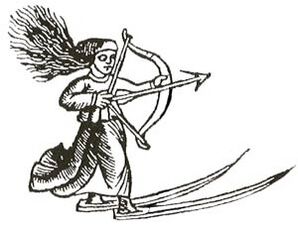
An early picture of a skier—a Sami woman or goddess hunting on skis by Olaus Magnus (1553).
-
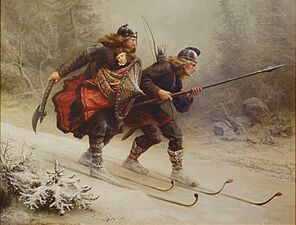
Loyal helpers transporting Prince Haakon IV of Norway to safety on skis during the winter of 1206. This is a painting from 1869 by Knud Bergslien.
-
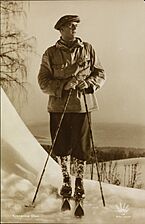
Olav V of Norway as crown-prince in 1939.
-
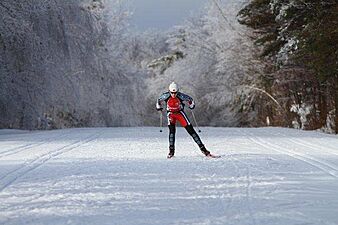
A skate-skier in Gatineau Park, Quebec, a popular ski area in North America.
-
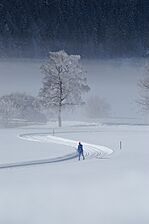
A recreational cross-country trail in Tyrol, groomed only for classic skiing.
-
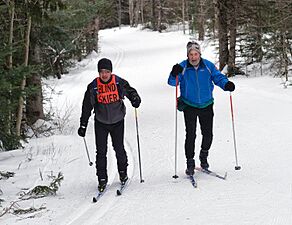
A blind cross-country skier with a guide at a regional Ski for Light event.
-
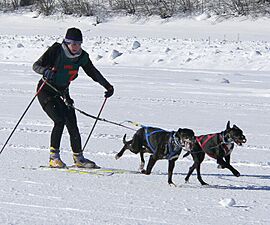
Dog skijoring—dogs help pull the cross-country skier.


