
Darling River facts for kids
Quick facts for kids Darling River |
|
|---|---|

Aerial view of the Darling River near Menindee
|
|
| Country | Australia |
| State | New South Wales |
| Cities | Bourke, Wilcannia, Menindee, Wentworth |
| Physical characteristics | |
| Main source | confluence of Barwon and Culgoa Rivers near Brewarrina, NSW 119 m (390 ft) 29°57′31″S 146°18′28″E / 29.95861°S 146.30778°E |
| River mouth | confluence with Murray River Wentworth, NSW 35 m (115 ft) 34°6′47″S 141°54′43″E / 34.11306°S 141.91194°E |
| Basin features | |
| River system | Murray River, Murray-Darling basin |
| Tributaries |
|
The Darling River is a very important river in Australia. It is also known as the River Darling. The Paakantyi people call it Baaka or Barka. It is the third-longest river in Australia. The Darling flows for 1,472 kilometers from its start in northern New South Wales. It joins the Murray River at Wentworth.
If you include its longest connecting rivers, the Darling River system stretches for 2,844 kilometers. This makes it the longest river system in all of Australia. It is the most famous waterway in Australia's outback.
Today, the Darling River faces challenges. Too much water is taken for farms. Pollution also affects it. Long periods without rain, called droughts, make things harder. This means the river's plants and animals struggle. For example, in 2019, during a big drought, the river barely flowed. Its water can be salty. The overall water quality has gone down. More rain in 2010 helped it flow better. Keeping the river healthy requires careful long-term planning.
Some areas and districts in New South Wales were named after the river.
Contents
Discovering the Darling River

For thousands of years, Aboriginal people have lived along the Darling River. The Barkindji people called it Baaka or Barka. Their name, "Barkindji," means "people of the Barka" or "people of the river."
European settlers began arriving in the areas where the Darling River starts around 1815. In 1828, explorers Charles Sturt and Hamilton Hume explored the area. Sturt named the river after the Governor, Sir Ralph Darling, in 1829. Later, in 1835, Major Thomas Mitchell explored about 483 kilometers of the river. He correctly guessed that it flowed into the Murray River.
An expedition in 1856 collected many fish species. They found 17,400 specimens for a museum.
The Darling River's flow changes a lot. It even dried up many times between 1885 and 1960. Still, in the late 1800s, it was a busy transport route. Farmers used shallow-draft paddle steamers to send wool from towns like Bourke and Wilcannia. The wool went to places like Morgan and Murray Bridge, where it was put on trains. Over the last 100 years, its use for transport has decreased.
Big floods happened in 1974 and 1976. In 1992, a harmful algae bloom spread along the river. This toxic algae grew because of things like phosphorus, water flow, and temperature.
In 2008, the government bought a large property called Toorale Station. This helped put 11 gigalitres of water back into the Darling. This water was specifically for the river's environment.
In 2019, many fish died in the Lower Darling River. Some experts said this happened because of decisions about water management. These decisions involved releasing water from lakes when it might have been better to keep it there. This event was very sad for the river's wildlife.
A large flood happened near Bourke in 2022. Even more fish died in 2023. Millions of fish, including bony bream, golden perch, silver perch, and Murray cod, were found dead near Menindee. This was caused by very low oxygen in the water and high temperatures.
Where the Darling River Flows
The Darling River is part of the huge Murray-Darling river system. This system is one of the biggest in the world. It collects water from a vast area of eastern Australia. The Darling River twists and turns, making its path three times longer than a straight line.
The land around the Darling is mostly flat plains. This means the river flows very gently, dropping only about 16 millimeters for every kilometer it travels. The Darling River officially starts near Brewarrina and Bourke. This is where the Culgoa River and Barwon River meet. Many smaller rivers feed into these, coming from the mountains in Queensland and New South Wales. Some of these important rivers are the Balonne River, Condamine River, Macintyre River, Gwydir River, Namoi River, Castlereagh River, and Macquarie River. Further downstream, other rivers like the Bogan River, Warrego River, and Paroo River also join the Darling.

Southeast of Broken Hill, you'll find the Menindee Lakes. These lakes used to connect naturally to the Darling River. A project called the Menindee Lake Scheme changed how often these lakes flood. Sadly, this has harmed many native plants like lignum and black box trees. Dams (weirs) and low water flows have also made it hard for fish to travel along the river.
The Darling River flows towards the southwest. It eventually meets the Murray River at Wentworth, New South Wales, right on the border between New South Wales and Victoria.
Important roads like the Barrier Highway at Wilcannia and the Silver City Highway at Wentworth cross the Darling. The Broken Hill railway line at Menindee also crosses it. North of Menindee, part of the river forms a boundary for Kinchega National Park. A dam (weir) was built at Menindee after a big flood in 1956. This helps control the river's flow.
The areas around the Darling River are home to different natural environments. The northern part is a temperate savanna. The southwestern part is known as the Murray Darling Depression.
Towns Along the Darling
Many towns are found along the Darling River. These include Brewarrina, Bourke, Louth, Tilpa, Wilcannia, Menindee, Pooncarie, and Wentworth. In the late 1880s, Wentworth was Australia's busiest inland port.
Steamboats first reached Brewarrina in 1859. This town was also a special meeting place for Indigenous Australians. They used ancient fish traps in the river to catch food. These amazing rock formations are over 40,000 years old. They are considered the oldest human-made structures on Earth!
Gallery
-
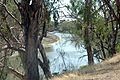
The Darling River from Bourke wharf (2010)
-
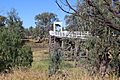
Old North Bourke Bridge, opened in 1883 (2014)
-
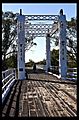
Lifting span of the old North Bourke Bridge
-
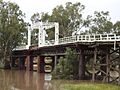
Old North Bourke bridge, in flood, northern side, North Bourke (2021)
-
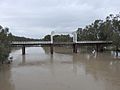
Old North Bourke bridge, in flood, southern side, North Bourke (2021)


.jpg)


See also
 In Spanish: Río Darling para niños
- Darling River hardyhead
- Great Darling Anabranch
- List of rivers of Australia § New South Wales
- List of Darling River distances
- Water security in Australia
- Darling Sedimentary Basin
