
Dover Patrol Monument facts for kids


The Dover Patrol Monuments are three special memorials. They were built to remember the brave sailors of the Royal Navy's Dover Patrol. This patrol helped protect ships during World War I. Sir Aston Webb designed these monuments. Two of them are tall granite towers, about 75 feet high. They were put up near Dover, England, and on the Cap Blanc-Nez near Calais, France, in 1921 and 1922. A third monument was built in Brooklyn, New York in 1931. The monument in the UK is a very important historic building.
Contents
What Was the Dover Patrol?
The Dover Patrol was a group of ships formed in July 1914. It started with 12 Tribal class destroyers. During World War I, many different types of ships joined the patrol. These included large cruisers, destroyers, submarines, and even small fishing boats called trawlers and drifters. They also used armed yachts and motor launches. Airplanes and airships helped too. Sometimes, French destroyers also joined the patrol.
Where Did They Work?
The patrol covered the southern part of the North Sea. It also watched over the eastern part of the English Channel. This included the narrow Straits of Dover.
What Did They Do?
The Dover Patrol had many important jobs:
- They escorted merchant ships, hospital ships, and troop transports. This meant they protected them from enemy attacks.
- They patrolled for German submarines.
- They cleared German mines from the sea.
- They also laid their own minefields and anti-submarine nets.
- Sometimes, they even fired cannons at German forces on the coast of Belgium and northern France.
Admiral Reginald Bacon led the patrol from 1914 to 1917. Then, Vice-Admiral Roger Keyes took over. Six members of the patrol won the Victoria Cross. This is a very brave award. They earned it during the Zeebrugge Raid in April 1918. In this raid, they blocked the entrance to the port of Bruges-Zeebrugge. This stopped German ships from leaving the port.
About 2,000 members of the Dover Patrol lost their lives during the war. After the war, people wanted to build a monument to remember them. They raised over £45,000 from the public. Even King Albert and Queen Elizabeth of Belgium donated money.
About the Monuments
Sir Aston Webb designed the granite memorial obelisks. He is famous for designing other important buildings. These include Admiralty Arch and the front of Buckingham Palace in London.
What Do They Look Like?
There are three of these tall monuments. One is at Leathercote Point near Dover, England. Another is at Cap Blanc Nez near Sangatte in northern France. The third is in New York City.
The monuments look a bit like ancient Egyptian architecture. Each one is a 75-foot tall obelisk. An obelisk is a tall, four-sided stone pillar that tapers to a pyramid shape at the top. It is made from large granite blocks. The obelisk stands on a tall stone base. This base has special frames on three sides for inscriptions.
The Dover Memorial
The first stone for the memorial near Dover (51°09′25″N 1°23′34″E / 51.15687°N 1.39270°E) was laid on November 19, 1919. Prince Arthur of Connaught did this honor. The completed monument was officially shown to the public on July 27, 1921. The Prince of Wales unveiled it.
What the Inscriptions Say
One side of the monument says when the stone was laid and when it was unveiled. It mentions Prince Arthur and the Prince of Wales.
Another side explains that the monument was built in 1920 and 1921. It was paid for by public donations. It also mentions the other two monuments in France and New York. It says that the names of those who died are in a special book. This "Book of Remembrance" is kept in the Town Hall in Dover. A copy is also at the church in St Margaret's at Cliffe.
The third side is a dedication. It says: "TO THE GLORY OF GOD / AND IN EVERLASTING / REMEMBRANCE OF / THE DOVER PATROL / 1914 - 1919 / THEY DIED THAT WE MIGHT LIVE / MAY WE BE WORTHY OF THEIR SACRIFICE". It also remembers sailors from both the Royal Navy and Merchant Navy who died in the Dover Strait during World War II (1939-1946).
The Book of Remembrance lists nearly 2,000 names of those who died. It is kept at St Margaret's Church, close to the monument. The monument is a very important historic site in the UK.
The Calais Memorial
A second obelisk (50°55′29″N 1°42′36″E / 50.92484°N 1.70988°E) stands on top of Cap Blanc Nez near Sangatte in France. Part of its inscription is in French. It says that the monument was opened by Flaminius Raiberti, the French Navy minister, on July 20, 1922. It also notes that the first stone was laid by Maréchal Foch on January 28, 1920.
Sadly, the memorial was blown up during the German occupation in World War II. It was rebuilt in 1962. There are still German bunkers in the nearby cliffs. An architect from Ghent, Leon de Keyser, designed this memorial. It was built by Martiny of Brussels. The memorial was made new again in 2007.
The New York Memorial
A third obelisk (40°36′41″N 74°02′03″W / 40.61144°N 74.03417°W) was put up in 1931. It is near the Verrazano-Narrows Bridge in John Paul Jones Park in Brooklyn, New York.
What the Inscriptions Say
The inscriptions on the New York memorial explain its purpose. One says: "THIS MONUMENT / TO THE DOVER PATROL / ERECTED AS A TRIBUTE TO THE / COMRADSHIP AND SERVICE OF THE / AMERICAN NAVAL FORCES / IN EUROPE / DURING THE WORLD WAR." It also mentions that monuments of the same design are in Dover, England, and Cap Blanc Nez, France. It states that public donations from Great Britain paid for them.
Another inscription is similar to the one in Dover: "TO THE GLORY OF GOD / AND IN EVERLASTING / REMEMBRANCE OF / THE DOVER PATROL / 1914-1919 / THEY DIED THAT WE MIGHT LIVE / MAY WE BE / WORTHY OF THEIR SACRIFICE". It also shows the date "1931".
The New York memorial was recently named a "WWI Centennial Memorial." This happened after it entered a competition called "100 Cities - 100 Memorials."
Images for kids
-
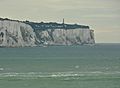
View of the memorial on the cliffs near Dover
-
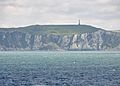
View of the memorial on the cliffs near Calais
-
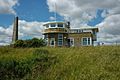
Former Coastguard Station beside the monument near Dover


