
Dulwich Hill facts for kids
Quick facts for kids Dulwich HillSydney, New South Wales |
|||||||||||||||
|---|---|---|---|---|---|---|---|---|---|---|---|---|---|---|---|
 |
|||||||||||||||
| Lua error in Module:Location_map at line 530: Unable to find the specified location map definition: "Module:Location map/data/Australia NSW metro Sydney" does not exist. | |||||||||||||||
| Population | 14,046 (2021 census) | ||||||||||||||
| • Density | 6,625/km2 (17,160/sq mi) | ||||||||||||||
| Established | 1892 | ||||||||||||||
| Postcode(s) | 2203 | ||||||||||||||
| Elevation | 42 m (138 ft) | ||||||||||||||
| Area | 2.12 km2 (0.8 sq mi) | ||||||||||||||
| Location | 7.5 km (5 mi) inner-west of Sydney CBD | ||||||||||||||
| LGA(s) | Inner West Council | ||||||||||||||
| State electorate(s) | Summer Hill | ||||||||||||||
| Federal Division(s) | Grayndler | ||||||||||||||
|
|||||||||||||||
 |
Dulwich Hill is a lively suburb located in the Inner West of Sydney, New South Wales, Australia. It's about 7.5 kilometres south-west of the main city centre. This area is part of the Inner West Council and stretches down to the beautiful Cooks River.
Contents
Welcome to Dulwich Hill!
A Glimpse into History
Dulwich Hill got its name from a place called Dulwich in London, England. Before 1892, when the name Dulwich Hill first appeared, it had a few different names. People once called it Petersham Hill. It was also known as Wardell's Bush, named after an early landowner, Dr Robert Wardell. Other names included South Petersham and Fern Hill.

In 1889, Dulwich Hill became connected to Sydney's growing tram network. This helped the area grow quickly in the early 1900s. Because of this growth, you can see many beautiful old buildings here. These include homes built in the Federation style, as well as Edwardian, Gothic, and Italianate designs. The tram system served the area until 1957.
One special old building is the former public school on Seaview Street. It was built around 1892 in the Romanesque style. Today, it is the Dulwich Hill High School of Visual Arts and Design.
Shops, Cafes, and Community
Dulwich Hill has two main shopping areas. One is a smaller group of shops on Wardell Road, close to the railway station. The main shopping area is found around Marrickville Road and New Canterbury Road. This area used to have the tram line running through it.
Today, you'll find many popular cafes and restaurants here. The local council improved the shopping strip in the early 2000s, making it even nicer. Dulwich Hill also has a library, which is part of the Inner West Library Service. There is also a post office for all your mailing needs.
Schools and Learning

Dulwich Hill is home to several schools. There are three primary schools: Dulwich Hill Public School, St Maroun's College, and St Paul of the Cross (a Catholic school). For older students, there is Dulwich High School of Visual Arts & Design on Seaview Street. This school was actually the first Visual Arts school in Australia!
Some famous people who went to the high school include Olympic swimmer Leisel Jones and opera singer Yvonne Minton.
Getting Around Dulwich Hill
Dulwich Hill has many ways to travel, making it easy to get around Sydney.
Trams of the Past
Long ago, until the late 1950s, electric trams ran through Dulwich Hill. They connected the suburb all the way to Circular Quay in the city centre. The tram line was a very important part of daily life for many years.
Modern Ways to Travel
Today, you can use trains, light rail, and buses to travel in Dulwich Hill.
.jpg)
Dulwich Hill railway station is on Wardell Road. As of late 2024, it is now served by the Metro North West & Bankstown Line. This means you can catch a modern Metro train directly to the Sydney CBD.
The Inner West Light Rail also starts at Dulwich Hill railway station. It has three other stops in the suburb: Dulwich Grove, Arlington, and Waratah Mills. The light rail offers another way to travel to the Sydney CBD, taking a scenic route.
Many bus routes connect Dulwich Hill to other parts of Sydney. Routes 426, 428, and 412 go to the Sydney CBD. Other routes like the 445, 418, and 425 connect to places like Campsie, Balmain, Bondi Junction, and Burwood. All these bus services are operated by Transit Systems.
Who Lives Here?
According to the 2021 census, 14,046 people live in Dulwich Hill. Most people (63.0%) were born in Australia. Other common birthplaces include England, Greece, Vietnam, New Zealand, and Lebanon.
English is spoken at home by most residents (67.4%). However, many other languages are also spoken, showing the diverse community. These include Greek, Arabic, Vietnamese, Portuguese, and Spanish.
When it comes to homes, many people in Dulwich Hill live in flats or apartments (57.0%). There are also separate houses (28.8%) and semi-detached homes (10.8%).
Local Sports and Parks
If you love sports, Arlington Recreation Ground on Williams Parade is the place to be! It's the home ground for the Dulwich Hill FC soccer club. This club plays in the NSW Super League, which is a high level of soccer in Sydney. The Stanmore Hawks soccer club also plays here.
Homes and Architecture
Dulwich Hill has many beautiful old houses, especially from the early 1900s. You can see well-preserved homes from the Federation and Interwar periods. Some areas, like the Abelgeldie Estate, are protected to keep their historic charm. The former freight line, which is now the light rail line, runs through Dulwich Hill. This area, once used for factories, now has many modern apartment buildings.
Places of Worship
Dulwich Hill has several places of worship for different faiths. These include Anglican, Catholic, Greek Orthodox, and Salvation Army churches.

Images for kids
-
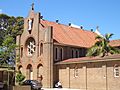
St Marouns Catholic Monastery
-
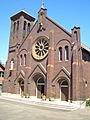
St Paul of the Cross Catholic Church


