
Flinders Chase National Park facts for kids
Quick facts for kids Flinders Chase National Park |
|
|---|---|
|
IUCN Category II (National Park)
|
|
| Location | South Australia |
| Nearest city | Kingscote |
| Area | 326.61 km2 (126.10 sq mi) |
| Established | 1919 1972 (national park) |
| Governing body | Department for Environment and Water |

Flinders Chase National Park is a very special protected area in South Australia. It's located at the western end of Kangaroo Island, which is about 177 kilometers west-southwest of Adelaide, the state capital. This park is like a safe home for many amazing animals, especially those that are endangered. It also features some incredible natural rock formations. Flinders Chase was the second place in South Australia to be officially named a national park.
The park is made up of three main parts. These include beautiful coastal areas around Cape du Couedic in the southwest, the central Gosse Lands, and the historic Cape Borda Lightstation area in the northwest.
Discover Flinders Chase National Park
Where is this Amazing Park?
Flinders Chase National Park is found on the far western side of Kangaroo Island in South Australia. It's about 110 kilometers west of Kingscote, which is a main town on the island. The park covers parts of areas known as Flinders Chase, Gosse, and Karatta.
The park is divided into a few sections. The largest part is around Cape du Couedic, featuring stunning coastlines and islands like Paisley Islet and the Casuarina Islets. Another important section is known as the Gosse Lands, located more inland. Finally, there's the area around the old lighthouse at Cape Borda.
A Home for Wildlife
Since it was created in 1919, Flinders Chase National Park has been a safe haven for many animals. Some of these animals were brought here from the mainland in the 1920s and 1930s to protect them. Over the years, more species were introduced, including koalas in 1923 and platypus in 1928.
Protecting Unique Animals
Today, you can still see many of these animals thriving in the park. It's common to spot kangaroos, goannas, and echidnas roaming freely. The park helps these creatures live safely in their natural environment.
The Story of the Little Penguins
For many years, Little penguins lived in Flinders Chase National Park. Records show them here in the 1920s, 1930s, 1940s, and 1950s. Sadly, it's believed that these penguin groups are no longer found in the park. One reason for their disappearance might be the increase in long-nosed fur seal populations. These seals are natural predators, and their numbers grew after commercial sealing stopped.
A Look Back: How the Park Began
The idea for Flinders Chase National Park started a long time ago. In 1906, a group of scientists suggested protecting this special area. The premier of South Australia at the time, Tom Price, agreed to set aside land as a nature reserve.
Early Efforts to Protect Nature
By 1909, even more land was added to this reserve. It was managed by a group called the Fauna and Flora Board. They wanted to create a safe place for animals like koalas and other mammals. They also hoped to protect birds like the malleefowl and the Australian brushturkey, which were facing threats from foxes on the mainland. The Rocky River area within the park was also seen as a perfect spot for platypus. The reserve was named Flinders Chase, a suggestion from Samuel Dixon.
Becoming a National Park
The park officially became a "flora and fauna reserve" on October 16, 1919. This meant it was a place specifically for protecting Australian plants and animals. However, in the early days, it was hard to enforce the rules without enough funding or rangers. In 1922, more land was added, making the reserve even larger.
Then, on April 27, 1972, Flinders Chase was officially declared a full national park under a new law called the National Parks and Wildlife Act 1972. This was a big step in ensuring its long-term protection. Later, in 1993, a part of the national park became a separate protected area called the Ravine des Casoars Wilderness Protection Area.
Incredible Natural Sculptures
Flinders Chase National Park is famous for its amazing geological features. Two of these are so special that they are listed as geological monuments.
- Remarkable Rocks are truly unique. These are huge, naturally shaped rock formations that look like sculptures. They are balanced on top of a granite outcrop, making them a fantastic sight for visitors.
- Cape du Couedic is another stunning geological monument. It's a dramatic headland with rugged cliffs and beautiful coastal views.
Facing the Challenge of Bushfires
Like many natural areas in Australia, Flinders Chase National Park has faced challenges from bushfires. In December 2007, lightning strikes caused a large fire that burned about 60,000 hectares of land within the park and the nearby Ravine des Casoars Wilderness Protection Area.
The park was also severely impacted during the 2019–20 Australian bushfire season. These fires caused significant damage, including the complete destruction of the Visitor Centre. Despite these challenges, the park continues to recover and protect its precious wildlife and landscapes.
Images for kids
-
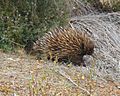
An echidna at Flinders Chase National Park
-
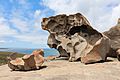
Remarkable Rocks
-
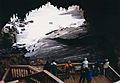
Admirals Arch
-
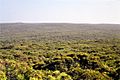
View from Bunker Hill lookout
-
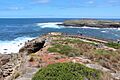
Cape de Couedic
-
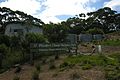
Flinders Chase Visitor Centre


See also
 In Spanish: Parque nacional Flinders Chase para niños
- Protected areas of South Australia
- Loch Vennachar
- 2007 Kangaroo Island bushfires
- Rocky River (Kangaroo Island)
- Field Naturalists Society of South Australia
