
Florida semaphore cactus facts for kids
Quick facts for kids Florida semaphore cactus |
|
|---|---|
 |
|
| Planting a semaphore cactus in a pine rockland | |
| Conservation status | |
Scientific classification  |
|
| Kingdom: | Plantae |
| Clade: | Tracheophytes |
| Clade: | Angiosperms |
| Clade: | Eudicots |
| Order: | Caryophyllales |
| Family: | Cactaceae |
| Genus: | Consolea |
| Species: |
C. corallicola
|
| Binomial name | |
| Consolea corallicola Small
|
|
| Script error: The function "autoWithCaption" does not exist. | |
| Synonyms | |
|
Opuntia corallicola |
|
Script error: No such module "Check for conflicting parameters".
Consolea corallicola, also called the Florida semaphore cactus, is a very rare cactus. Another common name for this plant is the semaphore pricklypear. Botanist John Kunkel Small first named and described this plant. It is found only in the state of Florida in the United States. In the wild, it lives naturally only in the Florida Keys.
Today, scientists consider this unique plant to be one of the rarest wild plants. Only a small handful of natural individuals still survive on Earth. It faces many serious dangers in the wild. Because of these threats, dedicated scientists work very hard to protect and save it.
Contents
What Does the Florida Semaphore Cactus Look Like?
This prickly plant is actually a small tree that can grow up to eight feet tall. Its green pads can reach lengths of about 40 centimeters. The pads are covered with long, sharp, pink spines. These spiky needles protect the cactus from thirsty desert and coastal animals. In fact, some of these sharp spines grow over 12 centimeters long. The spines on the main trunk always point straight down toward the rocky soil. These downward-pointing trunk spines are the largest ones on the entire plant.
The plant produces unusual flowers that bloom throughout the entire year. However, most blossoms appear between the cooler months of December and April. Each flower has thick outer flower parts and bright red inner parts. The colorful blossoms can grow up to 2.5 centimeters in length. Unlike sweet-smelling garden roses, these flowers produce an odor like spoiled meat. This foul scent helps the plant attract specific types of pollinating insects.
The Florida semaphore cactus gets its common name from old railroad signals. Semaphore signals were tall mechanical poles with long, movable wooden arms. Train dispatchers used these wooden arms to send important safety messages to trains. The branches and pads of this upright cactus spread out sideways just like them. It looks almost like a prickly railroad signal standing quietly on the rocky shore.
Where Does the Semaphore Cactus Live in Nature?
This desert-like plant loves to grow in very harsh, rocky places. It thrives on Key Largo limestone rock that is thinly coated with sand. Pockets of rich organic soil called humus gather inside the small rock holes. These shallow rock pockets hold just enough nutrition to support the plant's roots.
The cactus lives in coastal hardwood forest hammocks in South Florida. It also grows in the transition zone, or ecotone, near saltwater mangrove swamps. Because these areas sit close to sea level, tides easily wash over them.
The semaphore cactus shares its coastal home with many other native tropical plants. It grows beside sea grasses like Sporobolus virginicus along the shore. Tough coastal buttonwood trees known as Conocarpus erectus grow close by. Other native neighbors include the Florida silver palm, Maytenus phyllanthoides, and wild Manilkara bahamensis. It even lives near toxic poisonwood trees named Hippomane mancinella. A cousin called Opuntia stricta var. dillenii also shares this limestone ground.
Historically, this spiny tree lived across many islands within the sunny Florida Keys. Naturalists first discovered the species on Big Pine Key back in 1919. Sadly, human development caused its disappearance from that particular island. Today, purely wild plants live on only two tiny islands. One wild group survives on Little Torch Key. Another small group grows safely on Swan Key. Scientists also planted several cutting pieces on North Key Largo to help them.
Plant Reproduction and Growth Cycle
The Florida semaphore cactus is a colonial organism that forms large plant clusters. As it grows, the main trunk sprouts small baby stems called pups. These pups spread out and root into the surrounding limestone rock. Even though a cluster looks like many separate plants, they are one individual. They all share the exact same genetic code through asexual reproduction.
Because these stems clone themselves, true genetic diversity is dangerously low. What seems like a huge group of plants may be just one individual. Today, fewer than twenty distinct genetic individuals survive in the wild.
Furthermore, these wild plants face major difficulties with normal seed reproduction. One entire island population contains only male flowers. Without female flowers nearby, these male plants cannot produce any fertile seeds. The other surviving wild populations also lack female plants to make seeds. Because of this, wild plants can only reproduce by sprouting new clones.
Saving an Endangered Species from Extinction
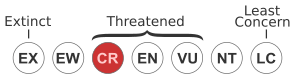
The Florida semaphore cactus is one of the most endangered plants today. Conservation groups classify the species as critically endangered across its native home. In 2013, the federal government protected it under the Endangered Species Act of 1973. Two other rare Florida plants, Chromolaena frustrata and Harrisia aboriginum, received protection then too.
The species faces several huge environmental problems in the wild:
- An invasive creature called the cactus moth, or Cactoblastis cactorum, eats stems.
- This South American alien insect was brought to the Caribbean to control weeds.
- It flew over to Florida and quickly began gobbling up rare native cacti.
- Tiny scale insects drink sap and weaken the fragile cactus branches.
- Fungal plant infections, like crown rot from Fusarium oxysporum, destroy cactus tissue.
- Another harmful fungus known as Phomopsis also attacks the stems.
- Rising water from global sea-level rise pushes salty ocean water into groundwater.
- Powerful coastal waves from a violent hurricane can drown and uproot plants.
- People unlawfully stealing wild plants for private gardens threatens survivors.
- Bulldozing land causes total habitat loss for remaining wild populations.
Botanists and park rangers are working tirelessly to rescue the semaphore cactus. Between 1996 and 2004, experts tried moving nursery-grown plants back into wild habitats. Unfortunately, many of those early planted specimens suffered damage from high ocean tides. Other young plants were eaten by hungry caterpillars or buried by fallen leaves. At one state park, workers accidentally damaged a planting during trail improvements.
Fortunately, botanists have had amazing success growing this cactus inside safe greenhouse nurseries. Captive mother plants grow vigorously when protected from invasive bugs and salty water. Biologists continue to monitor wild sites and test safer coastal locations for restoration. By guarding surviving plants, scientists hope to protect this prickly Florida treasure forever.
Images for kids
-
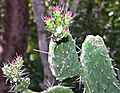
A Florida semaphore cactus showing its tall trunk and long spines
-
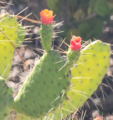
Young semaphore cactus planted in a protected pine rockland


See also
 In Spanish: Consolea corallicola para niños
