
G. Flint Taylor facts for kids
Quick facts for kids
G. Flint Taylor
|
|
|---|---|
| Born | |
| Nationality | American |
| Occupation | Attorney |
| Years active | 46 |
| Known for | Advocacy for people alleging forced confessions from police torture |
G. Flint Taylor (born April 16, 1946) is an American human rights and civil rights lawyer from Chicago, Illinois. He has worked on many important cases involving police brutality, government wrongdoing, and issues related to the death penalty.
Taylor focuses on public interest law. This means he helps people who claim they were treated unfairly by police or wrongly convicted of crimes. In 2015, Taylor was part of a group that helped the City of Chicago make a big decision. The city agreed to give payments and support to people who said they were mistreated by police. This was the first time a city government did something like this.
Contents
Early Life and Education
George Flint Taylor Jr. was born in Farmington, Maine. He was named after his great-grandfather, George Flint, who was a state senator in Maine. Taylor's family history includes some of the English Pilgrims who arrived in America on the Mayflower in 1620.
Taylor went to Westborough High School in Massachusetts. He was a great athlete, earning ten varsity letters in basketball, football, and baseball. He later studied American History at Brown University, graduating in 1968. In 1972, he earned his law degree from Northwestern University School of Law.
Starting His Legal Career
During his second year of law school, Taylor started working with lawyers who helped political groups. These groups included the Black Panther Party and the Young Lords Organization. In August 1969, Taylor and other law students and lawyers started the People's Law Office (PLO) in Chicago.
The Fred Hampton Case
One of Taylor's most famous cases involved the death of Black Panther Party leader Fred Hampton. Police said Hampton was killed in a shootout at his apartment in 1969. Taylor and his team at the People's Law Office filed a civil rights suit. They did this after a police raid on December 4, 1969. During the raid, police shot and killed Hampton and another activist, Mark Clark. Four other people were also hurt.
Taylor and his colleagues went to the apartment right after the raid. They spent ten days gathering evidence. An FBI expert later found that out of more than 90 bullets fired, almost all came from the police. Many Chicago citizens visited the apartment to see the evidence.
In 1970, Taylor and his team sued police and government officials. They asked for $47.7 million for the families of Hampton and Clark, and for the survivors. They later found out the FBI was also involved through a secret program called COINTELPRO. This program was designed to "destroy" the Black Panther movement.
The civil lawsuit went to trial in 1976 and lasted 18 months. This was one of the longest federal court cases ever. During the trial, it was discovered that the FBI had hidden important documents. Taylor and his law partner, Jeffrey Haas, were even jailed for protesting what they felt were unfair decisions by the judge. The judge eventually dismissed the case.
Taylor, Haas, and their colleague Dennis Cunningham appealed the decision. In 1979, the appeals court said the evidence showed a conspiracy among the police, the local prosecutor, and the FBI. The court also said the government should be punished for hiding FBI documents. In 1982, the case was settled for $1.85 million.
The Greensboro Case
On November 3, 1979, members of the Ku Klux Klan and American Nazi Party drove into Greensboro, North Carolina. Police officers were not present. These groups fired into a crowd of people protesting against the Klan. Five people were killed and ten were wounded. The protesters were part of a "Death to the Klan" march.
Later, in criminal trials, all the Klansmen and Nazi defendants were found not guilty by all-white juries.
In 1980, a group of lawyers, including Taylor, filed a civil rights lawsuit. They claimed there was a conspiracy among the Klan, Nazis, Greensboro police, and the FBI. They said these groups knew about the planned violence but did not protect the protesters. In 1985, during a ten-week trial, Taylor and his co-counsel questioned many witnesses. The jury found some defendants responsible. This was seen as an "historic victory" because it was the first time anyone was held accountable for the killings in what became known as the Greensboro Massacre.
Chicago Police Misconduct Cases
In 1987, Taylor and his partners began representing Andrew Wilson, a prisoner who said he was tortured by Chicago Police Commander Jon Burge. Wilson claimed he was shocked with electricity and forced to confess to a murder. In 1989, Wilson's case went to trial.
During the trial, Taylor received anonymous letters. These letters claimed that what happened to Wilson was part of a long history of police mistreatment. The letters said Burge led this pattern of mistreatment, mostly against African-American detainees. This led Taylor to find other people who claimed they were mistreated. However, the judge did not allow this evidence in the first trial. The jury could not reach a decision.
The case was retried. After a second trial, an all-white jury found Burge not guilty. But the appeals court later overturned this decision. The appeals court said the first judge made unfair decisions that hurt Wilson's case. Eventually, Wilson was awarded over $1 million for lawyer fees and $100,000 in damages.
Over the years, more than 100 men said they were mistreated by police under Burge's command. They described being shocked or threatened with guns. In 1993, the Chicago Police Department fired Burge. They found that there was "systematic" mistreatment at his police area.
Taylor and his partners continued to represent victims. In 1994, they began representing Aaron Patterson, who also claimed he was forced to confess. In 2003, Illinois Governor George Ryan pardoned Patterson and three others on death row. The Governor said their claims of mistreatment showed the justice system was "terribly broken."
Taylor and his colleagues also helped Darrell Cannon and Michael Tillman, who were also victims of police mistreatment. Cannon was freed in 2007 and Tillman in 2010.
In 2011, Taylor's team won a court decision that named former Chicago Mayor Richard M. Daley as a defendant in a police mistreatment case. They claimed there was a citywide effort to hide the truth.
Taylor and his team worked for decades to get criminal charges against Burge. In 2008, Burge was charged with lying in a civil case about mistreating suspects. He was found guilty in 2010 and sentenced to 4½ years in prison. Burge was released in 2014.
When Burge was released, Taylor and others urged the Chicago City Council to pass a law. This law would set aside $20 million for payments to the victims of police mistreatment.
Historic Payments for Victims
For over a year, the plan for payments had been stuck in the Chicago City Council. Pressure grew before the 2015 Chicago mayoral election. Mayor Rahm Emanuel was seeking a second term. Activists collected 40,000 signatures to show public support for the plan.
After a large rally in 2015, a team of negotiators, including Taylor, began talks with the city. The city's first offer did not include direct payments to victims. Taylor's team insisted on this. A compromise was eventually reached. It included financial payments to living victims.
In May 2015, Chicago aldermen unanimously approved a $5.5 million package. This package would pay about 60 living victims up to $100,000 each. These were people with valid claims of mistreatment while in police custody under Burge. Also, living survivors and their families, and the families of deceased victims, would get access to services. These included psychological counseling and free tuition to the City Colleges of Chicago.
The aldermen also approved building a public memorial for the deceased victims. They also made it a rule that Chicago public schools must teach students in eighth and tenth grades about the history of police brutality related to Burge. At the Council meeting, Mayor Emanuel officially apologized on behalf of the city. Taylor said that the "non-financial reparations make it truly historic."
Darrell Cannon, one of the victims who received payments, spent 24 years in prison. He said the payment package "is something that sets a precedent that has never been done in the history of America." Taylor hopes this will be a "beacon for other cities" dealing with similar issues.
Awards and Recognition
In March 2002, Chicago magazine named Taylor one of the city's "30 Tough Lawyers."
Other awards he has received include:
- 2014: The IVI-IPO Legal Eagle Award for advancing justice.
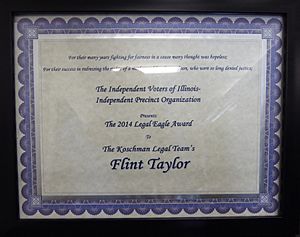 2014: The IVI-IPO's Legal Eagle Award, given annually to lawyers who have advanced the cause of justice, was presented to G. Flint Taylor. (Shared with Locke Bowman, Director of the MacArthur Justice Center and Alexa Van Brunt, Clinical Assistant Professor of Law and attorney for the MacArthur Justice Center). The three were recognized for their work on behalf of the family of David Koschman, who died in 2004 after being punched by Richard J. Vanecko, a nephew of former Chicago Mayor Richard M. Daley.
 - 2011: Northwestern Law School's Distinguished Alumnus Award for his "outstanding commitment to public service."
- 2010: National Lawyers Guild Chicago Chapter's Arthur Kinoy People's Law Award for his "commitment to the struggle for justice for the survivors of torture."
- 2009: First Defense Legal Aid's First Defender Award for his "tireless commitment to protecting the civil rights of Chicago citizens."
- 2009: Rainbow PUSH Coalition Father of the Community Award for "service and dedication to family and community."
- 2009: National Lawyers Guild's Ernie Goodman Award for "extraordinary achievement."
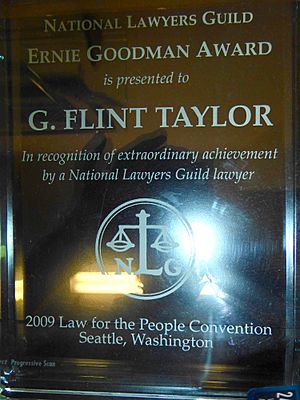 2009: National Lawyers Guild's Ernie Goodman Award given to G. Flint Taylor at its convention in Seattle "in recognition of extraordinary achievement by a National Lawyers Guild lawyer."
 - 2008: Cook County Bar Association's William R. Ming Jr. Award for "outstanding and substantial contribution to the causes of civil rights and individual liberties."
- 1977: Operation PUSH Letter of Commendation "Advocate For Our Freedom."


Cases Before the U.S. Supreme Court
Taylor's first case before the U.S. Supreme Court was in 1980. He successfully defended the appeals court's decision in the Fred Hampton case. In 1985, Taylor successfully argued that federal prison guards should not be protected from lawsuits when they serve on prison disciplinary committees. In 1993, he argued a case where the Court made an exception to a prosecutor's protection from lawsuits.
Other Important Cases
In the early 1980s, Taylor worked on cases in New Orleans. These cases involved claims of mistreatment and killings by New Orleans police officers. Taylor also worked on "street files" cases in Chicago. These cases revealed that Chicago police detectives had a secret system for hiding evidence that could prove a criminal defendant's innocence.
The Ford Heights Four Case
In the late 1990s, Taylor joined other lawyers to help four men. These men had spent more than ten years in prison for a 1978 murder they did not commit. They were known as the Ford Heights Four. DNA tests later proved they were innocent. The men received a $36 million settlement for their wrongful convictions. Taylor called this case another example of "outrageous police misconduct."
The Ryan Harris Case
In 1998, Chicago police accused a seven-year-old boy and his eight-year-old friend of a serious crime involving an 11-year-old girl, Ryan Harris. DNA evidence later showed that neither boy could have committed the crime, and they were cleared. In 2005, Taylor and his team won a multi-million-dollar settlement for the seven-year-old boy. Taylor said the case showed "systemic misconduct" throughout the Chicago police department.
The Ryan Harris case led to important changes in Illinois law. Now, a lawyer must be present when children under 13 are questioned about serious crimes. Chicago police also require a parent or guardian to be present when kids under 13 are suspected of any major crime and are questioned.
Writing and Public Advocacy
Taylor writes for various academic journals, legal publications, and online blogs. He often writes about police misconduct and racism. He has also published opinion pieces in Chicago's major newspapers. He continues to criticize efforts to hold police accountable for mistakes.
Taylor has spoken about these topics before the Chicago City Council, the Cook County Board, U.S. Congressional Committees, and the Inter-American Commission on Human Rights.
In his book The Torture Machine: Racism and Police Violence in Chicago, Taylor shares many stories about his fight for human rights against unfairness in the justice system.
|
