
Girih facts for kids

Girih (pronounced "gee-ree") means "knot" in Persian. These are beautiful Islamic geometric patterns found in buildings and crafts. They are made from angled lines that weave together, creating amazing designs.
People think Girih patterns were inspired by old Roman knot designs from long ago. But the special math behind Girih, with its many lines of symmetry, came from new ideas in the Islamic world after the 800s. The first Girih patterns appeared around the year 1000. This art style became very popular and grew until the 1400s.
Artists create Girih patterns in different ways. They can use a compass and ruler, or special girih tiles that have lines on them. Sometimes, patterns are made with two layers of design, like at the Darb-e Imam shrine built in 1453. Old pattern books helped artists copy these designs.
The Topkapı Scroll from the 1400s shows how Girih patterns were made using these tiles. You can see Girih patterns on many materials. These include stone screens, plaster walls in mosques, metal decorations, and wooden carvings.
Contents
The Story of Girih Designs
Where Girih Began

Many people believe Girih designs were inspired by old Roman knot patterns. These patterns appeared in places like Roman Syria around the 100s AD. However, the special math that makes Girih patterns so balanced and symmetrical came from new ideas in the Islamic world. These mathematical discoveries happened after the 800s.
Early examples of these designs can be seen in the Umayyad Mosque in Damascus, Syria. Built around 709–715, it has window screens with wavy, interlaced patterns. Later, around 1078, straight-line Girih patterns appeared in buildings like the Ribat-i Malik caravanserai in Uzbekistan.
Girih became very popular in buildings. This shows how closely linked Islamic architecture, math, and craftsmanship were. In those times, building design was seen as a type of practical geometry. Every big building project needed a "muhandis," which means a geometer or mathematician.
Early Art and Math Discoveries
The oldest known Girih pattern in a book is from a Quran manuscript. It was made in Baghdad around the year 1000. This book had beautiful designs of interlocking octagons and fancy writing.
In woodwork, one of the oldest examples is a 13th-century pulpit, called a minbar, in the Mosque of Ibn Tulun in Cairo. Woodworkers made Girih patterns in two main ways. One way was to create a wooden screen with star and polygon shapes. The spaces could be left open or filled. The other way, called gereh-chini, involved making small wooden pieces of different shapes. These pieces were then put together to form a complex design.
A smart Persian mathematician named Abu al-Wafa' Buzjani studied geometric patterns in the 900s. He wrote a book called A Book on Those Geometric Constructions Which Are Necessary for a Craftsman. In it, he showed craftsmen how to draw polygons and other shapes. This book was very important for teaching artists how to create Girih patterns.
The word "girih" was used in Turkey for these patterns by the late 1400s. Around this time, artists also started making special books filled with Girih patterns, like the famous Topkapı Scroll.
While some early forms of Girih appeared in the 900s, the fully developed patterns became common in Iran in the 1000s. They were a major part of designs in the 1000s and 1100s. You can see them in carved panels at the Kharraqan towers in Iran, built in 1067. Sometimes, plant designs were mixed with Girih patterns.
Girih designs continued to be used by different empires, like the Seljuq and Ilkhanate. In the 1300s, other plant-based patterns became more popular. However, Girih remained an important art form in buildings across Central Asia.
How Girih Patterns are Made


Drawing with Tools
Girih designs are made of geometric shapes like stars and polygons. Artists have many ways to create them. As early as the 1200s, they made patterns with 5-sided and 10-sided symmetry.
The most traditional way to draw these patterns is with a compass and a straightedge (a ruler without markings). Artists would first draw a basic grid. Then, they would use their tools to carefully draw the Girih pattern.
Even today, some artists use these old methods. They might use a tool called dividers to mark out points on paper. Then, they connect these points with a pencil and straightedge. These patterns often create a tessellation, which means they tile a surface perfectly without any gaps.
Using Shapes Together
An early expert on Islamic patterns, Ernest Hanbury Hankin, studied how these designs were made. He noticed that many patterns were created by placing different polygons (shapes with straight sides) next to each other. The spaces left between these polygons would also form symmetrical shapes.
For example, if you place many octagons (8-sided shapes) together, the spaces in between them become squares. Each octagon can then be used to create an 8-pointed star. You can see this at Akbar's tomb in India, built between 1605 and 1613. Hankin was amazed by how skilled these artists were at finding the right combinations of shapes.


Special Girih Tiles
By the 1400s, some Girih patterns were made using special girih tiles. These are five different tile shapes, each with lines drawn on them. When these tiles are fitted together without gaps, the lines on them connect to form a complete Girih pattern.
It's not clear exactly when artists started using these tiles instead of just a compass and ruler. It was likely around the early 1200s. Artists used many different ways to create designs, so it's not like only one method was ever used.


Patterns within Patterns
The Girih patterns at the Darb-e Imam shrine in Isfahan, Iran, built in 1453, are very complex. They show patterns at two different sizes. From far away, you can see a large pattern. As you get closer, you notice a smaller, more detailed pattern that is part of the larger one.
These patterns don't seem to repeat in a simple, regular way. This suggests that Girih tiles were used to create them, rather than just a compass and ruler. Artists used clever rules to divide and arrange the tiles. This created designs that look endlessly complex, even if they don't repeat perfectly.
Old Pattern Books and Templates


The Topkapı Scroll, created in the late 1400s, is a very important book. It shows how Girih tiles were used to make patterns. The drawings in this book clearly show the Girih lines on top of the tiles that created them. This helps us understand exactly how they were built.
Once an artist created a repeating pattern, they could make a template from it. This template was like a paper cutout of the design. They could then use it to easily copy the pattern onto any surface they wanted to decorate. The grids in the Topkapı Scroll might have been used as these kinds of templates. Other old books also contained repeating patterns for artists to use.
Girih in Different Materials
-
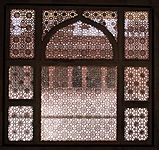
Girih stone screens at the tomb of Salim Chishti, Fatehpur Sikri, 16th century.
-
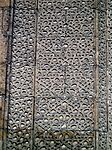
Girih in plasterwork at the Hunat Hatun Complex, Kayseri.
-
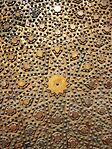
Girih in metal: a 12-pointed star on a gate at Sultan Hassan's mosque, Cairo.
-
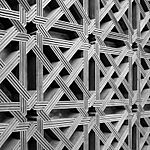
Girih in wood: a grille in the Great Mosque of Cordoba.


Where You Can See Girih Patterns
Beautiful Windows

Girih patterns are often used in architecture, especially on windows. In Iranian architecture, the fanciness of windows could show how important or wealthy the owner was.
A great example is the Azad Koliji pavilion in Dowlatabad Garden in Iran. The Girih patterns on its windows create a cool effect. When you look through, you see the real garden outside. But the Girih patterns themselves, with colourful glass behind them, create an "artificial garden" illusion. This mix of real and abstract designs gives you lots to imagine!
Decorating Domes

Girih patterns are also widely used on the curved surfaces of domes. Special techniques are needed for this. One important method is called "Dast-Garden." This method means that the number of points on a star polygon in the pattern changes depending on how curved the dome surface is. As the dome curves less, the stars might have fewer points. This shows how closely the Girih pattern adapts to the shape of the dome.
Walls with Endless Designs

You can find Girih patterns all over the walls of some Islamic architecture buildings. The lines in these patterns connect to each other, forming a continuous network across the entire surface. Girih patterns on walls can have many different geometric shapes, like decagons, hexagons, bowties, and rhombuses.
A special technique called "self-similar transformation" helps artists make these patterns flow smoothly. This technique helps match the edges of different shapes, making the whole design look perfect. The widespread use of Girih for decorating interiors connects to Islamic beliefs. The repeating nature of Girih patterns, which can seem to expand forever, reminds people that humans cannot fully understand the "infinite meaning of the world" created by God. These patterns also help viewers look at the designs in different ways, seeing the hidden structures within them.
See also
- Islamic interlace patterns
- Muqarnas
- Topkapi Scroll
