
Muqarnas facts for kids
.jpg)
.jpg)
Muqarnas (Arabic: مقرنص) is a special kind of 3D decoration found in Islamic architecture. It's also known as Mocárabe in Spain. Imagine rows of small, niche-like shapes stacked on top of each other, creating a beautiful, complex pattern. People sometimes call them "honeycombs" or "stalactites" because of how they look.
Muqarnas is a key part of Islamic buildings. You'll often see it in domes, arched entrances called iwans, and other special spots. Its main job is to make a smooth, decorative change from one part of a building to another. For example, it helps connect the square walls of a room to a round dome above. This creates an amazing visual effect with light and shadows playing across the sculpted surfaces.
This unique decoration likely first appeared in the 11th century in Iraq. Soon after, it became popular across the Islamic world. Different regions developed their own styles and ways of building muqarnas.
Contents
What Does Muqarnas Mean?
The exact origin of the word muqarnas is a bit of a mystery. It first appeared in Arabic writings around the 12th century. Some experts think it comes from the Greek word korōnis, which means "cornice" or "fancy molding." Others believe it's from the Arabic word qarnasi, meaning "intricate work." There's even a theory it relates to an Aramaic word for "hammering."
The Spanish word mocárabe comes from the Arabic term muqarbaṣ. This word was used for muqarnas in the western parts of the Islamic world.
How Muqarnas Is Built

Muqarnas is made from many small, niche-like pieces, or "cells." These cells are put together in a geometric pattern, often with several lines of symmetry. Each cell is a simple shape, but when combined, they create very complex designs. They overlap and stick out, like corbels, forming a stunning 3D artwork.
The way light and shadow play on these individual cells creates a beautiful effect. This is why many people compare muqarnas to "stalactites" found in caves or the cells of a "honeycomb."

You'll typically find muqarnas on the underside of domes, arches, and vaults. It's also common in the mihrab (a prayer niche) of a mosque. Its main purpose is to be decorative and to smoothly connect different parts of a building. For example, it helps bridge the gap between a round dome and a square room below.
The materials and size of the cells vary by region. In places like Syria, Egypt, and Turkey, muqarnas is often made of stone. In North Africa, it's usually plaster or wood. In Iran and Iraq, builders used bricks, sometimes covered with plaster or colorful tiles. Some plaster muqarnas are even hung from a hidden frame above.
-
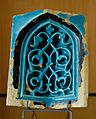
A single muqarnas cell made of earthenware with a turquoise glaze. This piece is from the Shah-i-Zinda in Samarkand (early 15th century).
-
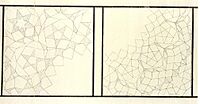
An old architect's plan for two muqarnas vaults, from the Topkapı Scroll (likely from the late 15th or 16th centuries).


The History of Muqarnas
Early Beginnings
_-_panoramio_(2).jpg)
The first buildings with muqarnas date back to the 11th century. They appeared in different places almost at the same time, including Iraq, North Africa, Iran, Central Asia, and Upper Egypt. This has led experts to wonder if it developed in many places at once or spread from one original spot.
Some of the earliest hints of muqarnas were found in stucco pieces from Nishapur, Iran, from the 9th or 10th century. The oldest examples still standing are in places like the Arab-Ata Mausoleum in Uzbekistan (977–978) and the Duvazdah Imam Mausoleum in Iran (1037–1038). These early forms helped connect domes to square rooms.

The oldest complete muqarnas dome that survived until recently was at the Imam Dur Mausoleum in Samarra, finished in 1090. (Sadly, this shrine was destroyed in October 2014.) Because of this and how quickly muqarnas spread, some believe it mainly developed in Abbasid Iraq in the early 11th century.
In Egypt, the first known muqarnas examples are from the Fatimid period, around 1085. A very detailed use of muqarnas can be seen on the outside of the Aqmar Mosque in Cairo, built in 1125.
Muqarnas Styles Across Regions
By the 12th century, muqarnas was popular everywhere. Different regions then started to create their own unique styles.
Muqarnas in Syria, Iraq, and Iran

Muqarnas was used in the Abbasid Palace in Baghdad in the late 12th or early 13th century. The vaults there are special for their detailed carvings. Large muqarnas domes were also built in Iraq and eastern Syria between the mid-12th and mid-13th centuries. These often looked like pine cones from the outside, such as the dome of the Mausoleum of Zumurrud Khatun.
Later, under the Timurids in Central Asia (late 14th and 15th centuries), amazing muqarnas vaults were created. They even used muqarnas on the outside of domes. In Safavid Iran (16th to early 18th centuries), muqarnas vaults were often covered in colorful tiles. By the 18th century, they started using mirror glass mosaics, like in Chehel Sotoun in Isfahan.

Muqarnas also decorated vaults and entrances in Mughal architecture in India. These often combined small, diamond-shaped cells with star patterns. Mughal muqarnas were frequently covered with detailed arabesque designs made from molded plaster.
Muqarnas in Egypt and Syria (Mamluk Period)

From the 13th to early 16th centuries, muqarnas made of carved stone was common in Ayyubid and Mamluk architecture in Egypt and Syria. The Mamluk sultan Baybars brought the Syrian style of muqarnas-covered entrance portals to Egypt. These entrances became very grand, like the one at the Mosque-Madrasa of Sultan Hasan in Cairo.
Muqarnas in Anatolia and the Ottoman Empire

In Anatolia (modern-day Turkey), the Anatolian Seljuks used muqarnas in mihrabs, on column tops, and over entrance portals. These portals often had a pyramidal or triangular shape.

The Ottomans continued this tradition, using muqarnas in their architecture. However, its importance lessened in the 16th century. It was mainly used in entranceways, niches, and column capitals. By the 18th century, as European styles became popular, muqarnas was used less and less.
Muqarnas in North Africa and Spain
.jpg)
In the western Islamic world, muqarnas was introduced by the Almoravid ruler Ali ibn Yusuf. Early examples are in the Almoravid Qubba in Marrakesh, Morocco (around 1117 or 1125), and the Great Mosque of Tlemcen, Algeria (1136). The first full muqarnas vaults in this region are in the Qarawiyyin Mosque in Fez, built between 1134 and 1143. These vaults are made of plaster and beautifully painted.

Muqarnas reached its peak in the Alhambra in Granada, Spain, built by the Nasrids. The dome in the Sala de Dos Hermanas (Hall of the Two Sisters) is one of the most amazing muqarnas domes. It has at least 5,000 cells that spread out from the center.
Muqarnas was also used by non-Muslim builders in Spain, in what is called Mudéjar art. It continued to be used in chapels, synagogues, and palaces until the 17th century.
Muqarnas Outside the Muslim World
_-_Interior_02.jpg)
Muqarnas also appeared in Christian buildings in areas influenced by Islamic art. You can see it in some Arab-Norman architecture in 12th-century Sicily. The most impressive example is in the Cappella Palatina in Palermo (around 1140). It has a large rectangular muqarnas vault made of painted wood.
Armenian architecture in the 13th century also used muqarnas, influenced by Islamic styles. Examples are found in the Geghard Monastery and the Gandzasar Monastery in Armenia. These show how architectural ideas were shared across different cultures at that time.
The Meaning Behind Muqarnas
Experts have different ideas about what muqarnas might symbolize. Some, like Oleg Grabar, suggested that the large muqarnas domes in the Alhambra represented the rotating heavens.
Another idea is that muqarnas domes were meant to show how the universe was seen by some early Muslim thinkers. By breaking up a dome's smooth surface into many small, complex units, architects might have been showing a universe made of tiny parts, all held together by God. This idea suggests that the "rotating heavens" meaning might have come later.
Muqarnas domes were often placed above entrances. This could symbolize a passage or a threshold between two different worlds. It suggests a journey from everyday life to something more spiritual or eternal.
Gallery
-
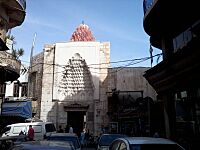
The outside of the Bimaristan of Nur al-Din in Damascus (1154). Notice the muqarnas over the entrance.
-
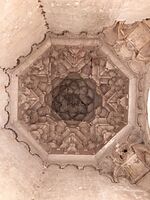
A muqarnas cupola inside the mihrab of the Tinmal Mosque in Morocco (around 1148).
-
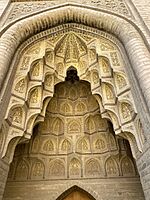
Muqarnas in one of the iwans of the Abbasid Palace in Baghdad (late 12th or early 13th century).
-
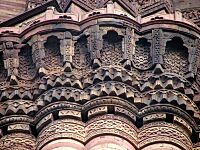
Muqarnas corbelling around the balcony of the Qutb Minar in Delhi (1199–1220).
-
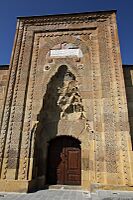
The entrance portal of the Alaeddin Mosque in Niğde, Turkey (1223).
-
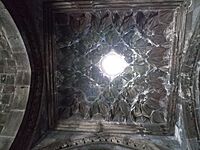
A muqarnas vault with a central opening in the gavit (narthex) of the Geghard Monastery in Armenia (13th century).
-
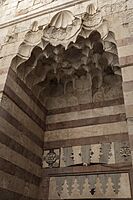
A flat muqarnas vault in the portal of the Madrasa as-Sallamiya in Jerusalem (1338).
-
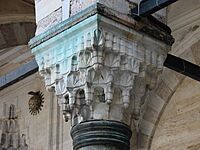
A muqarnas capital inside the courtyard of the Bayezid II Mosque in Istanbul (1500–1505).
-
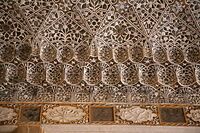
A muqarnas cornice inside the Sheesh Mahal (Hall of Mirrors) in the Amber Fort in Amer (17th century).
-
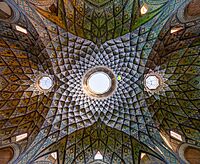
Muqarnas vaults over the Amin al-Dawla Caravanserai (19th century) inside the Kashan Bazaar, Iran.
-
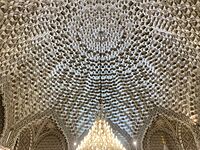
A modern muqarnas vault inside the main prayer hall of the Abu Hanifa Mosque in Baghdad.
-
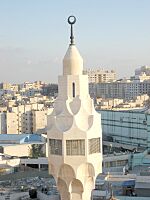
Upward- and downward-facing muqarnas on the minaret of the Hatem Mosque in Alexandria.


.jpg)

.jpg)


.jpg)
See Also
- Islamic geometric patterns
- Mathematics and art
- Symbolism of domes
