
Greater Egyptian jerboa facts for kids
Quick facts for kids Greater Egyptian jerboaTemporal range: Late Pliocene – Present
|
|
|---|---|
 |
|
| Conservation status | |
Scientific classification  |
|
| Kingdom: | Animalia |
| Phylum: | Chordata |
| Class: | Mammalia |
| Order: | Rodentia |
| Family: | Dipodidae |
| Genus: | Jaculus |
| Species: |
J. orientalis
|
| Binomial name | |
| Jaculus orientalis Erxleben, 1777
|
|
| Script error: The function "autoWithCaption" does not exist. | |
Script error: No such module "Check for conflicting parameters".
The greater Egyptian jerboa (Jaculus orientalis) is a small rodent that looks a bit like a tiny kangaroo! It belongs to the Dipodidae family. You can find these amazing creatures in countries like Algeria, Egypt, Libya, Morocco, Saudi Arabia, and Tunisia. Sadly, it might no longer live in the Negev Desert in Israel.
These jerboas love dry places. Their natural homes include dry shrubland, sandy beaches, and even farm fields.
Contents
What is a Greater Egyptian Jerboa?
An adult greater Egyptian jerboa is about 13 centimeters (5 inches) long from its head to its body. Its tail is even longer, reaching about 20 centimeters (8 inches)!
Their fur is yellowish-brown or sandy-brown on top. Their tummy is white. Their back legs are super long, about four times longer than their front legs. This helps them hop around. Their feet have furry pads, which makes it easier to move on sand.
The tail is mostly bare, but it has a big tuft of hair at the end. This tuft is black at the bottom and white at the tip. The jerboa uses its tail like a prop. It helps the animal balance when it stands or hops on its back legs.
Where Does It Live?
The greater Egyptian jerboa lives in North Africa. You can find it in Morocco, Algeria, Tunisia, Libya, and Egypt. It also lives in the Judaean Desert and on the Sinai Peninsula.
It used to live in the Negev Desert too, but it might not be there anymore. These jerboas can live in many different places. This includes deserts, semi-deserts, sand dunes near the coast, and even grassy fields or farmland.
Daily Life and Habits
The greater Egyptian jerboa is a friendly animal. It likes to live with others of its kind. They dig burrows in the ground. These burrows can be up to 2 meters (6.5 feet) long!
They stay inside their burrows during the day. This keeps them safe from the heat and predators. When the sun goes down, they come out to look for food. They eat seeds, young plant shoots, and roots. Sometimes, they even store food in special rooms inside their burrow.
These jerboas probably don't need to drink water. They get all the moisture they need from the food they eat. They have also been seen eating desert truffles. These are a type of mushroom that grows underground.
Reproduction and Life Cycle
Greater Egyptian jerboas usually have babies between November and July. The mother makes a special nesting room in her burrow. She might line it with some animal fur to make it cozy.
A mother jerboa is pregnant for about 40 days. She usually has two to five babies at a time. They only have one litter of babies each year. The young jerboas take a long time to grow up.
When they are first born, their back legs are the same length as their front legs. They drag themselves around using their front legs. Slowly, their back legs get longer. By four weeks old, they start walking on all four legs. They begin to hop on two legs when they are about seven weeks old.
Is It Endangered?
The greater Egyptian jerboa lives in many places. It is quite common in most of these areas. It is a nocturnal animal, meaning it is active at night. There are no big threats to its survival right now.
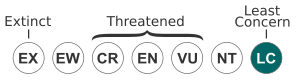
Its population is stable. The International Union for Conservation of Nature says it is a "least concern" species. This means they are not worried about it becoming endangered anytime soon.
Images for kids
-
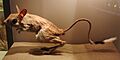
A stuffed specimen of a greater Egyptian jerboa. You can see its long hind legs and tail.

