
List of Lepidoptera of Indiana facts for kids
Did you know that Indiana is home to many different kinds of butterflies and moths? These amazing insects are part of a group called Lepidoptera, which means "scaly wings." Their wings are covered in tiny, colorful scales! This list will introduce you to some of the cool butterflies and moths you might spot flying around Indiana.
Contents
- Butterflies
- Moths
- Images for kids
Butterflies
Butterflies are often seen flying during the day. They usually have bright colors and thin bodies. When they rest, their wings are often held upright.
Swallowtail Butterflies (Papilionidae)

Swallowtails are some of the largest and most colorful butterflies. Many of them have "tails" on their hindwings, which look a bit like the tails of swallow birds.
- Pipevine swallowtail, Battus philenor
- Zebra swallowtail, Eurytides marcellus
- Black swallowtail, Papilio polyxenes
- Eastern tiger swallowtail, Papilio glaucus
- Spicebush swallowtail, Papilio troilus
White and Sulphur Butterflies (Pieridae)


This family includes many common white and yellow butterflies. You often see them fluttering in gardens and fields.
White Butterflies (Pierinae)
These butterflies are mostly white or pale yellow.
- Cabbage white, Pieris rapae
- Olympia marble, Euchloe olympia
- Falcate orangetip, Anthocharis midea
Sulphur Butterflies (Coliadinae)
Sulphur butterflies are usually bright yellow or orange.
- Clouded sulphur, Colias philodice
- Orange sulphur, Colias eurytheme
- Cloudless sulphur, Phoebis sennae
- Sleepy orange, Eurema nicippe
Gossamer-winged Butterflies (Lycaenidae)


This family includes small, delicate butterflies. They often have shiny, metallic colors or tiny "tails" on their hindwings.
Copper Butterflies (Lycaeninae)
Copper butterflies often have bright orange or reddish-brown colors.
- American copper, Lycaena phlaeas
- Bronze copper, Lycaena hyllus
Hairstreak Butterflies (Theclinae)
Hairstreaks get their name from the thin, hair-like tails on their hindwings.
- Coral hairstreak, Satyrium titus
- Gray hairstreak, Strymon melinus
- Henry's elfin, Callophrys henrici
Blue Butterflies (Polyommatinae)
These small butterflies are often blue, especially the males.
- Eastern tailed-blue, Everes comyntas
- Spring azure, Celastrina ladon
- Silvery blue, Glaucopsyche lygdamus
Metalmark Butterflies (Riodinidae)
Metalmarks are small butterflies with unique patterns. They often have shiny, metallic spots on their wings.
- Northern metalmark, Calephelis borealis
- Swamp metalmark, Calephelis muticum
Brush-footed Butterflies (Nymphalidae)


This is the largest family of butterflies. They are called "brush-footed" because their front legs are small and hairy, like brushes.
Fritillary Butterflies (Heliconiinae)
Fritillaries are often orange with black spots.
- Great spangled fritillary, Speyeria cybele
- Silver-bordered fritillary, Boloria selene
Admirals, Ladies, and Commas (Nymphalinae)
This group includes many well-known butterflies.
- Painted lady, Vanessa cardui
- Red admiral, Vanessa atalanta
- Question mark, Polygonia interrogationis
- Mourning cloak, Nymphalis antiopa
- Common buckeye, Junonia coenia
Admirals and Viceroys (Limenitidinae)
These butterflies are known for their beautiful patterns.
- Red-spotted purple, Limenitis arthemis astyanax
- Viceroy, Limenitis archippus
Satyr Butterflies (Satyrinae)
Satyr butterflies often have "eyespots" on their wings. They usually fly in shady, wooded areas.
- Northern pearly-eye, Enodia anthedon
- Little wood-satyr, Megisto cymela
- Common wood-nymph, Cercyonis pegala
Monarch Butterflies (Danainae)
The Monarch is famous for its long migration.
- Monarch, Danaus plexippus
Skipper Butterflies (Hesperiidae)


Skippers are a mix between butterflies and moths. They have stout bodies and hooked antennae. They fly very fast and erratically.
Duskywings and Checkered-Skippers (Pyrginae)
These skippers are often dark-colored.
- Silver-spotted skipper, Epargyreus clarus
- Dreamy duskywing, Erynnis icelus
- Common checkered-skipper, Pyrgus communis
Grass Skippers (Hesperiinae)
Many grass skippers are small and brown or orange.
- Least skipper, Ancyloxypha numitor
- Fiery skipper, Hylephila phyleus
- Tawny-edged skipper, Polites themistocles
- Zabulon skipper, Poanes zabulon
Moths
Moths are usually active at night. They often have thicker, hairier bodies than butterflies. When they rest, their wings are typically held flat or tent-like over their bodies.
Giant Silkworm Moths (Saturniidae)
These are some of the largest and most beautiful moths. Their caterpillars often spin large silk cocoons.
Giant Silkworms (Saturniinae)
These moths are known for their impressive size and patterns.
- Luna moth, Actias luna
- Polyphemus moth, Antheraea polyphemus
- Cecropia moth, Hyalophora cecropia
Buck Moths (Hemileucinae)
This group includes moths that are active during the day.
- Io moth, Automeris io
- Eastern buck moth, Hemileuca maia
Royal Moths (Ceratocampinae)
These moths often have striking colors and patterns.
- Imperial moth, Eacles imperialis
- Regal moth, Citheronia regalis
- Rosy maple moth, Dryocampa rubicunda
Sphinx Moths (Sphingidae)
Sphinx moths, also called hawk moths, are strong, fast flyers. Many can hover like hummingbirds.
Hummingbird Moths (Macroglossinae)
These moths often resemble hummingbirds.
- Pandora sphinx, Eumorpha pandorus
- Hummingbird sphinx, Hemaris thysbe
Hornworm Moths (Sphinginae)
The caterpillars of these moths are often called "hornworms" because they have a horn-like tail.
- Carolina sphinx, Manduca sexta
- Elm sphinx, Ceratomia amyntor
Eyed Sphinx Moths (Smerinthinae)
These moths often have large "eyespots" on their hindwings.
- Twin spotted sphinx, Smerinthus jamaicensis
- Walnut sphinx, Amorpha juglandis
Owlet Moths (Noctuidae)
This is a very large family of moths. Many are dull-colored, but some have bright hindwings.
Underwing Moths (Noctuinae)
Many of these moths have hidden bright colors on their hindwings.
- Large yellow underwing, Noctua pronuba
- Stalk borer, Papaipema nebris
Looper Moths (Plusiinae)
The caterpillars of these moths often move in a "looping" way.
- Connected looper, Plusia contexta
- Golden looper, Argyrogramma verruca
Dagger Moths (Acronictinae)
These moths are often gray and fuzzy.
- Harris's three spot, Harrisimemna trisignata
Euteliid Moths (Euteliidae)
These are a smaller family of moths.
- Beautiful eutelia, Eutelia pulcherrima
Erebid Moths (Erebidae)
This is another very large and diverse family of moths. It includes many well-known groups like underwings and tiger moths.
Forester Moths (Agaristinae)
These moths are often active during the day and have bright colors.
- Eight-spotted forester, Alypia octomaculata
- Beautiful wood-nymph, Eudryas grata
Underwing Moths (Erebinae)
Many moths in this group have brightly colored hindwings that are hidden when they rest.
- Mother underwing, Catocala parta
- Darling underwing, Catocala cara
- Clouded underwing, Catocala nebulosa
- White underwing, Catocala relicta
Tiger Moths (Arctiinae)
Tiger moths are often brightly colored and fuzzy. Many have patterns that warn predators they are not tasty.
- Virgin tiger moth, Grammia virgo
- Harnessed tiger moth, Apantesis phalerata
Images for kids
-
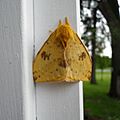
Io moth, Automeris io - male
-
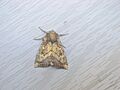
A live Papaipema cataphracta
-
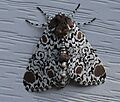
Harris's three spot moth
-
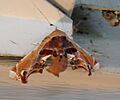
Beautiful eutelia
-
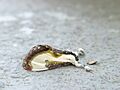
Beautiful wood-nymph
-
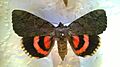
Catocala cara
-
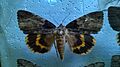
Catocala nebulosa


