
Jesse Jackson facts for kids
Quick facts for kids
Jesse Jackson
|
|
|---|---|

Jackson in 1983
|
|
| United States Shadow Senator from the District of Columbia |
|
| In office January 3, 1991 – January 3, 1997 |
|
| Preceded by | Seat established |
| Succeeded by | Paul Strauss |
| Personal details | |
| Born |
Jesse Louis Burns
October 8, 1941 Greenville, South Carolina, U.S. |
| Died | February 17, 2026 (aged 84) Chicago, Illinois, U.S. |
| Political party | Democratic |
| Spouse | |
| Children | 6, including Santita, Jesse Jr., and Jonathan |
| Education | North Carolina Agricultural and Technical State University (BS) Chicago Theological Seminary (MDiv) |
| Signature |  |
Jesse Louis Jackson (born Burns; October 8, 1941 – February 17, 2026) was an American civil rights leader, politician, and a Baptist minister. He was a close helper of Martin Luther King Jr. during the civil rights movement. Jesse Jackson became one of the most important civil rights leaders of his time. From 1991 to 1997, he worked as a shadow senator for the District of Columbia. He was the father of U.S. Representative Jonathan Jackson and former U.S. Representative Jesse Jackson Jr.
Born in Greenville, South Carolina, Jackson started his work for fairness in the 1960s. He created organizations that later joined to form the Rainbow/PUSH Coalition. In the 1980s, he also worked on international issues. He ran for president in 1984 and 1988, becoming a strong voice for change. He finished second in the 1988 Democratic presidential race.
Jackson did not run for president again. In 1990, he was chosen as the District of Columbia's shadow senator. He served one term, working to gain more rights for the District. Jackson also hosted a TV show called Both Sides with Jesse Jackson on CNN. He was known for speaking out against unfair treatment and for supporting policies that helped people. He is remembered as a very important African-American activist.
Contents
Early Life and Education
Growing Up in South Carolina
Jesse Louis Jackson was born on October 8, 1941, in Greenville, South Carolina. His mother was Helen Burns. His stepfather, Charles Henry Jackson, adopted him, and Jesse took his last name. Jesse said he considered both men his fathers.
As a child, Jesse Jackson faced challenges. He lived under Jim Crow laws, which meant Black people had to use separate facilities and sit in the back of buses. He attended a racially segregated school, Sterling High School. There, he was elected student class president and was a talented athlete in baseball, football, and basketball. These experiences motivated him to work for a better future.

College Years and Activism
After high school in 1959, Jackson chose to go to college instead of playing professional baseball. He first attended the University of Illinois on a football scholarship. Later, he transferred to North Carolina A&T, a historically black university in Greensboro, North Carolina. He said he changed schools because he felt limited by racial prejudice.
At North Carolina A&T, Jackson played quarterback and became student body president. He actively joined local civil rights protests. These protests were against segregated libraries, theaters, and restaurants. He earned a degree in sociology in 1964. Then, he went to Chicago Theological Seminary. He left in 1966 to focus fully on the civil rights movement. He became an ordained minister in 1968. In 2000, he received his Master of Divinity degree based on his earlier studies and life's work.
Civil Rights Activism
Working with Martin Luther King Jr.
Jesse Jackson became well-known for his strong voice and leadership. In 1965, he took part in the Selma to Montgomery marches in Alabama. These marches were organized by Martin Luther King Jr. and other civil rights leaders. King was impressed by Jackson's energy and skills. He soon gave Jackson a role in the Southern Christian Leadership Conference (SCLC). Jackson was tasked with setting up an SCLC office in Chicago.

In 1966, King chose Jackson to lead the Chicago part of SCLC's economic program, Operation Breadbasket. He became its national director in 1967. Operation Breadbasket aimed to help Black people find jobs. It also encouraged Black consumers to support Black-owned businesses. Under Jackson, the program held popular weekly meetings. These meetings featured leaders and religious services with music.
After King's passing in 1968, Jackson continued his work. He helped with SCLC's Poor People's Campaign in Washington, D.C. He managed a large tent city for the campaign. Jackson later decided to start his own organization to continue his important work for justice.

Founding Operation PUSH and the Rainbow Coalition
Jackson started a new organization called People United to Save Humanity (Operation PUSH) on December 25, 1971. He later changed the name to People United to Serve Humanity. Operation PUSH focused on politics and aimed to improve economic opportunities for Black people and all poor communities. The organization worked to encourage businesses to provide more jobs and opportunities for Black people. It also ran programs for housing, social services, and voter registration.
In 1984, Jackson created the Rainbow Coalition. This group aimed to bring together different people—like white, Hispanic, Black, Arab, Jewish, women, Native Americans, farmers, businesspeople, environmentalists, peace activists, young, old, and people with disabilities—to work for common goals. He stepped down as president of Operation PUSH to run for president, but remained involved as chairman. The two organizations later merged.
Early Activism for Equal Rights
On July 16, 1960, while home from college, Jackson joined seven other African Americans in a sit-in at the Greenville Public Library in South Carolina. The library only allowed white people. The group was arrested for "disorderly conduct." Their pastor paid their bail. This action helped lead to the reopening of both the main library and the branch for Black people.
International Activism
Diplomacy and Peacemaking Abroad
Jackson's influence grew to include international issues in the 1980s and 1990s. In 1983, he traveled to Syria. There, he helped secure the release of an American pilot, Navy Lt. Robert Goodman, who was being held by the Syrian government. After Jackson spoke directly with President Hafez al-Assad, Goodman was released. This effort helped boost Jackson's popularity.
In June 1984, Jackson helped negotiate the release of 22 Americans held in Cuba. He was invited by Cuban president Fidel Castro. Before the 1991 Persian Gulf War, Jackson went to Iraq. He spoke with Saddam Hussein to ask for the release of foreign citizens held there. He successfully secured the release of several British and 20 American individuals.
Jackson was a strong supporter of ending Apartheid in South Africa. He worked with leaders like Pope John Paul II and Mikhail Gorbachev. Jackson was with Nelson Mandela when Mandela was released from prison in South Africa. In 1997, he traveled to Kenya as a special envoy for President Bill Clinton. His goal was to promote fair elections. In April 1999, during the Kosovo War, he went to Belgrade. He negotiated the release of three U.S. prisoners of war.
Jackson also spoke at a large anti-war demonstration in London in 2003. This protest was against the invasion of Iraq. In 2004, he visited Northern Ireland to encourage peace and better community relations. In 2005, he traveled to Venezuela to meet with President Hugo Chávez. He said there was no evidence Venezuela threatened the U.S. He also spoke at the International Peace Foundation in 2009, promoting peace in a globalized world.
Political Activism
Running for President
During the 1980s, Jesse Jackson became widely known as a politician and a spokesperson for civil rights. In May 1983, he spoke to the Alabama Legislature. He was the first African-American man since the Reconstruction era to do so. He talked about focusing on economic fairness for everyone.
On November 3, 1983, Jackson announced he would run for president in the 1984 election. He was the second African American to run a nationwide campaign for president as a Democrat. His campaign encouraged many Black Americans to register and vote for the first time. He won primaries in states like South Carolina, the District of Columbia, and Louisiana.
At the 1984 Democratic National Convention, Jackson gave his famous "Rainbow Coalition" speech. He described America as a quilt with "many patches, many pieces, many colors, many sizes, all woven and held together by a common thread." He spoke about uniting different groups of people. He also apologized for past comments that had caused hurt. His speech called for unity and progress.
Jackson ran for president again in 1988. His campaign platform included ideas like universal health care, better education, and affordable housing. He also spoke about protecting the environment. He performed very well in the primaries, winning in states like Virginia, Georgia, Louisiana, Mississippi, Alabama, and Michigan. He showed that he could gain support from many different voters.
Later Political Work
After his presidential campaigns, Jackson continued his political work. In 1990, he was elected as a "shadow senator" for the District of Columbia. This was an unpaid role where he worked to gain statehood for the District of Columbia. He served in this position until 1997.
Jackson also hosted a CNN talk show, Both Sides with Jesse Jackson, from 1992 to 2000. He was a strong voice for liberal ideas. He became a close advisor and friend to President Bill Clinton. In 1997, Clinton appointed him as a "Special Envoy for the Promotion of Democracy in Africa."
In 1993, Jackson joined a gathering at the Lincoln Memorial. This event marked the 30th anniversary of the March on Washington for Jobs and Freedom. He continued to advocate for civil rights and economic justice.
Activism in the 2000s and 2010s
In the 2000 presidential election, Jackson supported Vice President Al Gore. When the election results in Florida were very close, Jackson called for a fair counting of all votes. He worked to ensure that minority voters were not unfairly treated.
Jackson continued to speak out on important issues. In 2003, he was arrested for protesting at Yale University to support striking workers. In 2007, he supported then-Senator Barack Obama in the presidential primaries. He later attended Obama's victory rally in Chicago, visibly moved by the historic moment.
Jackson participated in the 2017 Women's March in Washington. He spoke about protecting civil rights and voting rights. He also supported Colin Kaepernick and other NFL players who protested injustice by kneeling during the national anthem. In 2019, he encouraged inmates to vote as part of a voter registration drive.
Recent Activism
In 2020, Jackson endorsed Bernie Sanders for president. Later, he supported Joe Biden, predicting that African Americans would vote overwhelmingly for him. After Biden won, Jackson called for bold action and leadership to address the nation's challenges.
Jackson continued to advocate for justice in cases of police misconduct. He supported families seeking accountability and called for police reform. He also supported the withdrawal of U.S. troops from Afghanistan. In 2021, he was arrested while protesting for voting rights and a higher minimum wage. In 2023, he attended an event on the Edmund Pettus Bridge. This event commemorated the 59th anniversary of Bloody Sunday.
In July 2023, Jackson announced he would step down as the leader of Rainbow/PUSH. This decision was due to his age and health challenges. He had been diagnosed with Parkinson's disease in 2017. He was also hospitalized twice in 2021 for COVID-19 and a head injury. Leaders like Chicago Mayor Brandon Johnson and civil rights activist Al Sharpton praised his lifelong dedication to social justice.
Personal Life
Family and Friends

Jesse Jackson married Jacqueline Lavinia Brown on December 31, 1962. They had five children together, including Santita, Jesse Jr., and Jonathan Luther.
His younger brother, Charles "Chuck" Jackson, was a singer. Jesse Jackson was also a Prince Hall Freemason. He had friendships with many notable people, including Senator Ted Kennedy, Senator Bernie Sanders, singer Aretha Franklin, and civil rights leaders John Lewis and Al Sharpton.
Health Challenges
In September 2008, Jackson was hospitalized for dehydration and stomach pains. In November 2017, he was diagnosed with Parkinson's disease. In August 2021, he and his wife were hospitalized with COVID-19. His wife was released, but Jackson continued to receive care for Parkinson's.
In November 2025, Jackson was hospitalized again for a neurological disorder. It was revealed that he had been diagnosed with Progressive Supranuclear Palsy (PSP) in April 2025. He used a wheelchair and needed help with his health care. He was released from the hospital in late November 2025.
Death and Tributes
Jesse Jackson passed away on February 17, 2026, at the age of 84. His family shared the news of his death.
Many leaders and activists shared their tributes to him. These included U.S. President Donald Trump, Al Sharpton, former US Presidents Bill Clinton and Barack Obama, and Vice President Kamala Harris. Other civil rights leaders like Martin Luther King III and Bernice King also honored his memory. They all recognized his lasting impact on the fight for civil rights and justice.
Interesting Facts About Jesse Jackson
- Jackson became an ordained minister in 1968.
- He received a Master of Divinity Degree in 2000. This was based on his earlier studies and his life's work.
- On November 4, 2008, Jackson attended the rally for Barack Obama's election victory. He was seen crying before Obama spoke.
- He supported federal laws that would allow gay people to marry.
- In the 2016 United States presidential election, he supported Hillary Clinton.
- During the 2019 Venezuelan presidential crisis, he delivered food to activists. These activists were staying at the Venezuelan embassy in Washington, D.C..
- Ebony Magazine named Jackson to its list of "100 most influential black Americans" in 1971.
Honors and Awards
Jesse Jackson received many awards for his work and leadership:
- In 1979, he received the Jefferson Award. This was for his great public service to disadvantaged people.
- In 1988, the NAACP gave Jackson its President's Award. The next year, they gave him the Spingarn Medal.
- In 1991, Jackson received the American Whig-Cliosophic Society's James Madison Award for Distinguished Public Service.
- In 1999, he received the Golden Doves for Peace journalistic prize.
- In August 2000, President Bill Clinton awarded Jackson the Presidential Medal of Freedom. This is the highest honor for civilians in the United States.
- In 2002, scholar Molefi Kete Asante included Jackson on his list of 100 Greatest African Americans.
- In 2008, Jackson was given an Honorary Fellowship from Edge Hill University.
- In a 2006 poll, Jackson was voted "the most important black leader."
- In August 2009, he was crowned Prince Côte Nana by the King of Krindjabo. This means he inherited the title of High Prince of the Agni people of Côte d'Ivoire.
- In 2021, Jackson was appointed Commander of the Legion of Honor. This is France's highest award. French President Emmanuel Macron gave it to him for his civil rights work.
- In December 2021, Jackson was elected an Honorary Fellow of Homerton College, Cambridge.
- In 2022, Jackson received an Honorary Doctor of Humane Letters degree from Benedict College.
Famous Quotes by Jesse Jackson
- "Never look down on anybody unless you're helping him up."
- "Time is neutral and does not change things. With courage and initiative, leaders change things."
- "No one should negotiate their dreams. Dreams must be free to fly high. No government, no legislature, has a right to limit your dreams. You should never agree to surrender your dreams."
- "If you fall behind, run faster. Never give up, never surrender, and rise up against the odds."
- "I was born in a slum, but the slum wasn't born in me."
- "If my mind can conceive it, and my heart can believe it, I know I can achieve it."
- "Both tears and sweat are salty, but they render a different result. Tears will get you sympathy; sweat will get you change."
Images for kids
-
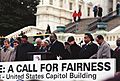
Jackson (third from left) and Al Sharpton (third from right) at an anti-impeachment rally in support of President Bill Clinton (fourth from left), December 17, 1998
-
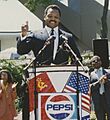
Jackson speaking at the Goodwill Games in Seattle, 1990
-
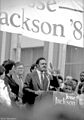
Jesse Jackson campaigning in San Francisco 1988
-
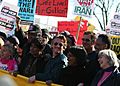
Jackson at an anti-war rally in 2007 with Sean Penn
-
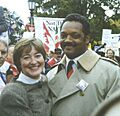
Jackson with Canadian water rights environmental activist Maude Barlow, 2005
-
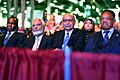
Jackson at the Islamic Society of North America convention in Chicago in September 2016
-

Jackson with Lisa Ellis (right) at a Democratic fundraising event in South Carolina in 2022
-
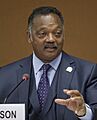
Jackson at the United Nations in March 2012
-
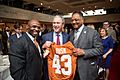
Jackson with Charlie Strong and George W. Bush in April 2014
-
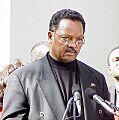
Jackson outside the Florida Supreme Court, 2000
-
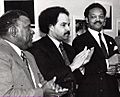
Jesse Jackson (right) with Curt Anderson (center) and Decatur "Bucky" Trotter (left) during a Maryland Legislative Black Caucus meeting in Annapolis, Maryland (1988)
-
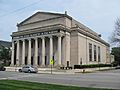
The Rainbow/PUSH national headquarters in Kenwood, Chicago
.jpg)
_(cropped1).jpg)


.jpg)


.jpg)


See also
 In Spanish: Jesse Jackson para niños
