
Olivia P. Stokes facts for kids
.jpg)

Olivia Pearl Stokes (born January 11, 1916 – died May 24, 2002) was an amazing leader. She was a religious educator, a Baptist minister, an author, and a civil rights activist. Dr. Stokes was the first African American woman to earn a doctorate degree in religious education. She worked hard to help people who were often ignored or treated unfairly.
Most of her work focused on religious education. She also helped train leaders and worked to change unfair ideas about women and African Americans. Olivia Stokes loved learning about African cultures. She created programs to help people better understand African civilizations.
Contents
Early Life and Family
Olivia Pearl Stokes was born on January 11, 1916, in Middlesex, North Carolina. Her family owned a large farm called Stokes Place. They were known as one of the few well-off Black families in North Carolina who owned land. Olivia was the second of four children born to Bessie Thomas Stokes Vann, a schoolteacher, and William Harmon Stokes.
When Olivia was seven, her father passed away. In 1925, her mother sold their land and moved the family to Harlem, New York. Her mother wanted her children to get a good education. In Harlem, they joined the Abyssinian Baptist Church.
From a young age, Olivia learned a lot about Christian Baptist and African cultures. Her mother taught her these values and encouraged her to be a leader in the community. Olivia's mother was a great role model for her. Olivia spent her childhood outside of school at Abyssinian Baptist Church and the Young Women's Christian Association (YWCA). Both were close to her family home.
Her Education Journey
Olivia started elementary school in New York at Public School 89. She was inspired by many writers, scholars, and community leaders. She once wrote, "We were taught as children that we were as great as anybody."
She later attended Junior High 136. Her English teacher encouraged her to apply to Hunter College High School, a special school for gifted students. Olivia went to Hunter College in 10th grade. She and Barbara Watson were the only two Black students there.
After her stepfather died, Olivia moved to Wadleigh High School. She then spent 12 years taking night classes at City College. She worked full-time at the YWCA and then at the Baptist Educational Center. She finished her undergraduate degree in 1947 at New York University (NYU). In 1948, she earned her master's degree in Religious Education.
After her master's, Stokes received a special scholarship at Columbia University's Teachers College. She earned her doctorate degree (Ed.D.) in Religious Education in 1952. She was the first African American woman to achieve this. Her research looked at how Protestant churches in New York City trained their leaders.
Family and Community Values
Olivia Pearl Stokes came from a free, upper-middle-class Black family. Her family deeply valued education, community involvement, and their Christian faith. These beliefs shaped her life from a young age.
Her family, the Stokeses, owned hundreds of acres of land in North Carolina. They were one of the few Black land-owning families in the state. They were well-known in the county and even employed both white and Black workers. Olivia's grandfather, T.O. Stokes, gave land to build the Stokes Chapel, which is now a federal landmark.
Olivia's family also taught her about the important contributions of Africa to the world. They learned about African ways of life, cultures, and governments.
Olivia was very close to her sister Beatrice. They shared many interests, even though Olivia was strong-minded and Beatrice was more gentle. Olivia found great joy in her work in the church and in education. She loved helping her students and colleagues learn and be curious.
Early Career Highlights
Stokes began her career in 1935 at the YWCA. In 1941, she became the associate director of the Baptist Educational Center. This school trained ministers and church members from 157 churches. It trained over 500 Baptists, mostly Black people, in Harlem every week. During this time, she also led the New York State Christian Youth Conference.
Important Connections
Through her work, Olivia Stokes met many important academics, activists, and artists in New York. Some of these famous people included:
- Benjamin Mays, a leader in the academic community.
- Fred Patterson, who led the United Negro College Fund.
- Marian Anderson, the first African-American soloist at the New York Metropolitan Opera.
- Langston Hughes, a famous poet and activist.
- Jackie Robinson, the first African American to play in Major League Baseball.
- Ella Fitzgerald, a famous American jazz singer.
Leading in Churches and Civil Rights
In 1953, Stokes became the Director of Religious Education for the Massachusetts Council of Churches. She was the only Black staff member and held a position usually held by white men. She noticed that many people felt they had to choose between their jobs and their faith during the summer. She also saw that some church leaders were not well-trained.
To help, she created an education program for Protestants at resort churches. These classes were scheduled so workers could attend without missing work. She also worked with a diverse team to create educational books for churches.
While in Massachusetts, Stokes taught at Harvard, Andover Newton Theological School, and Boston University. She also advised early childhood programs at Tufts University. When asked to speak to the board of the National Urban League, she saw it as a chance to show that Black leaders could be just as effective as white leaders. She spoke to the Massachusetts Senate, becoming the first woman to lead prayers at the opening of the senate.
In 1966, Stokes became an ordained minister in the American Baptist Church. She had turned down offers before because she felt she could do more as an educator. After becoming a minister, she joined the National Council of Churches as the associate director of Urban Education. In this role, she helped create the Black Curriculum Resource Center. She also brought together religious educators from across the United States. During the Civil Rights Movement, she helped Black and white civil rights leaders connect through their Christian faith.
Her Work with African Culture
Olivia Stokes grew up surrounded by African culture. Her mother worked with Christian missionaries who traveled to Africa and knew a lot about African history. Olivia's great-aunt, Alberta Thomas, was also involved in Marcus Garvey's Back-to-Africa movement.
As Olivia got older, she became known for her deep study of African culture, especially the roles of women and families. She created educational materials to help American schoolchildren understand Africa better. She also wrote children's books like Why the Spider Lives in Corners: African Facts and Fun and The Beauty of Being Black: Folktales, Poems, and Art From Africa. These books shared African culture, art, and the many different cultures within African countries. She encouraged churches to include lessons about African heritage in their teachings.
Stokes began traveling to Africa in 1958. She led many tours for graduate students, taking 20 trips between 1958 and 1981. She also worked to improve education in Africa. From 1973 to 1976, she helped build a graduate program to train educators in Nigeria, working with five Nigerian universities.
Other Community Work
Besides her church and education work, Stokes was also a teacher. From 1973 to 1976, she was an associate professor of education at Herbert H. Lehman College. She also helped create a program there to train teachers for diverse cultures. Later, she taught part-time at New York University and served as a pastor at Emmanuel Baptist Church in Brooklyn.
She was also a trustee of Berea College and an education consultant for many theological schools. She led White House Conferences on Education in 1955, 1960, and 1979. In 1976, Stokes helped start the Harlem Guidance Center. This center helps children in Harlem who are struggling in school by supporting their families.
Olivia Stokes was also a talented writer. In 1952, Jackie Robinson offered her a job as a sports writer for NBC. But Stokes loved helping her community more, so she chose to continue her work at the community center.
Awards and Recognition
Olivia Pearl Stokes was a member of several important groups, including Delta Kappa Delta and the National Association for the Study of Afro-American Life and History.
She received many awards for her work:
- In 1957, she won the Sojourner Truth Award from the Negro Business and Professional Women's Clubs.
- In 1976, she received the Bethune Achievement Award from the National Council of Negro Women.
Images for kids
-
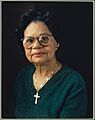
Stokes c. 1982
-
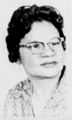
Photograph of Stokes
