
Pallava dynasty facts for kids
Quick facts for kids
Pallava dynasty
|
|||||||||||||||
|---|---|---|---|---|---|---|---|---|---|---|---|---|---|---|---|
| 275–897 | |||||||||||||||

Pallava territories during Narasimhavarman I c. 645. This includes the Chalukya territories occupied by the Pallavas.
|
|||||||||||||||
| Status | Dynasty | ||||||||||||||
| Capital | Kanchipuram | ||||||||||||||
| Common languages | |||||||||||||||
| Religion | Hinduism, Jainism, Buddhism | ||||||||||||||
| Government | Monarchy | ||||||||||||||
|
• 275–300
|
Simhavarman I | ||||||||||||||
|
• 885–897
|
Aparajitavarman | ||||||||||||||
| Historical era | Classical India | ||||||||||||||
|
• Established
|
275 | ||||||||||||||
|
• Disestablished
|
897 | ||||||||||||||
|
|||||||||||||||
| Today part of | India Sri Lanka |
||||||||||||||

Template:Pallava The Pallava dynasty was a powerful kingdom in South India that lasted for over 600 years, from about 275 to 897 CE. They ruled a large area known as Tondaimandalam, which is part of modern-day Tamil Nadu and Andhra Pradesh. The Pallavas were very important in shaping the history and culture of southern India.
This dynasty became strong after the Satavahana Empire declined. The Pallavas had previously worked for the Satavahanas. They grew into a major power under great rulers like Mahendravarman I (600–630 CE) and Narasimhavarman I (630–668 CE). Their capital city was Kancheepuram.
The Pallavas were often in battles with other kingdoms. They fought the Chalukyas to the north and the Cholas and Pandyas to the south. Eventually, the Chola ruler Aditya I defeated them in the 9th century.
The Pallavas are famous for their amazing temples and sculptures. They especially loved building Hindu temples. A great example is the Shore Temple in Mamallapuram, which is a UNESCO World Heritage Site. They also created the Pallava script, which later influenced many other writing systems in India and Southeast Asia, like the Tamil and Khmer scripts. A famous Chinese traveler named Xuanzang visited their kingdom and praised their good rule.
Contents
- What Does "Pallava" Mean?
- Where Did the Pallavas Come From?
- Who Were Their Rivals?
- Royal Titles and Names
- Languages and Writing
- Religion in the Pallava Kingdom
- Amazing Pallava Architecture
- Pallava Society
- Key Pallava Rulers
- Pallavas and the Cholas: A Family Connection?
- Other Connections
- Images for kids
- See also
What Does "Pallava" Mean?
The name "Pallava" has interesting meanings. In Sanskrit, it means "a creeper" or "a branch." In Tamil, it can mean "arrow" or "spruce."
Where Did the Pallavas Come From?
Historians have different ideas about where the Pallavas originally came from. It's a bit of a mystery!
- Some believe they started as helpers to another powerful kingdom, the Satavahanas, in the northern part of Andhra Pradesh. When the Satavahanas became weaker, the Pallavas grew stronger and moved south to Kanchipuram.
- Another idea is that the Pallavas began right in Kanchipuram (in modern-day Tamil Nadu) and then expanded their rule northward.
- There's also a theory that they were connected to a Chola prince named Ilandiraiyan. He was said to be from the Tondaimandalam region, which was the heart of the Pallava kingdom.
- Some legends even connect them to a famous warrior from the ancient story Mahabharata and a princess from a group called the Nagas.
What we do know is that early Pallava records, like those found on copper plates, were written in Prakrit and Sanskrit. These records show similarities to earlier powerful empires like the Satavahanas and Mauryas. Their early coins also looked like those of the Satavahanas.
Who Were Their Rivals?
The Pallavas were a powerful kingdom, but they weren't the only ones! They often had to defend their lands and expand their power by fighting other strong kingdoms in South India.
Fighting the Cholas
The Pallavas and the Cholas were often rivals. The Pallavas took control of Kanchipuram, which became their capital, from the Cholas. However, the Cholas sometimes managed to take it back. The Pallavas finally secured Kanchipuram in the mid-6th century and held it until the 9th century.
Conflicts with the Kadambas
The early Pallavas also had many battles with the Kadambas. These two kingdoms often fought for control and power in the region.
Dealing with the Kalabhras
Around 500 CE, a group called the Kalabhras invaded the Tamil country, causing a lot of trouble for the Pallavas. But by the end of the 6th century, a Pallava king named Simhavishnu managed to defeat them. After this, the Tamil region was mainly divided between the Pallavas in the north and the Pandyas in the south.
Royal Titles and Names
Pallava kings often used special honorific titles called Birudas. These were descriptive names that showed their power or qualities. For example, King Mahendravarman I used the title Shatrumalla, which means "a warrior who overthrows his enemies." His grandson, Paramesvara I, was called Ekamalla, meaning "the sole warrior." Important Pallava kings were also known as Mahamalla, or "great wrestler."
Languages and Writing

The Pallavas used several languages in their kingdom. Their inscriptions, which are like official records carved on stone or copper plates, have been found in Tamil, Prakrit, and Sanskrit.
Tamil was a very important language for the Pallavas, especially in their later years. However, Sanskrit was also widely used, particularly by kings like Simhavishnu and Narasimhavarman II for literature.
The Pallava Script
The Pallavas developed their own writing system called the Pallava script. This script was a type of Brahmic script. It was so important that it became the basis for the Tamil script and Grantha script. The Pallava script also traveled to Southeast Asia around the 6th century and influenced many writing systems there, like the Khmer script used in Cambodia.
Religion in the Pallava Kingdom
The Pallavas were mainly followers of Hinduism. They often gave land and gifts to Hindu gods and priests (Brahmins). Some kings even performed ancient Vedic sacrifices.
However, the Pallavas were also very tolerant of other religions. The famous Chinese monk Xuanzang visited Kanchipuram during the reign of Narasimhavarman I. He reported that there were many Buddhist monasteries and Hindu temples in the city. Interestingly, Bodhidharma, a semi-legendary founder of Zen Buddhism, is believed by some Indian traditions to have been the third son of a Pallava king.
Amazing Pallava Architecture
.jpg)

The Pallavas were incredible builders! They helped change how temples were made in South India. Before them, many temples were carved directly into rocks (rock-cut architecture). The Pallavas started building temples with separate stones (structural temples).
The earliest Pallava temples, from about 610 to 690 CE, were rock-cut. Later, from 690 to 900 CE, they built many structural temples. King Mahendravarman I and his successors created many rock-cut cave temples.
Some of their most famous creations are the rock-cut temples at Mamallapuram. These include excavated halls with pillars and monolithic shrines, which are temples carved from a single large rock, known as Rathas. Many early temples were dedicated to the god Shiva.
Great examples of Pallava architecture include the Kailasanathar Temple in Kanchipuram and the Shore Temple built by Narasimhavarman II in Mamallapuram. These magnificent structures show the Pallavas' skill and artistic vision.
Pallava Society
The Pallava period (from about 575 to 900 CE) was a time of big changes in southern Indian society. This era saw the rise of grand temple building and the growth of devotional (bhakti) religious groups like the Alvars and Nayanars. It also saw the establishment of important learning centers for Sanskrit and a new way of kingship, where a powerful ruler governed many different people.
Key Pallava Rulers
The Pallava dynasty had many important rulers throughout its long history. Here are some of the most well-known:
Early Pallavas
- Simhavarman I (275–300 CE)
- Vishnugopa I (350–355 CE)
- Simhavarman II (436–460 CE)
- Nandivarman I (480–510 CE)
Later Pallavas


This period saw the Pallava kingdom become a major power.
- Simhavishnu (575–600 CE): He helped defeat the Kalabhras and expanded the Pallava kingdom.
- Mahendravarman I (600–630 CE): A very important king who started building many rock-cut temples. He was also a writer.
- Narasimhavarman I (Mamalla) (630–668 CE): A great military leader and builder, known for the rock-cut temples at Mamallapuram.
- Paramesvaravarman I (670–695 CE): Another king known for his military and architectural achievements.
- Narasimhavarman II (Raja Simha) (695–722 CE): He built the famous Shore Temple.
Later Pallavas of the Kadava Line
After Paramesvaravarman II, a different branch of the Pallava family, known as the Kadavas, took over.
- Nandivarman II (Pallavamalla) (732–796 CE)
- Dantivarman (795–846 CE)
- Nandivarman III (846–869 CE)
- Aparajitavarman (879–897 CE): The last Pallava king, who was defeated by the Cholas.
Pallavas and the Cholas: A Family Connection?
Some historians believe there might have been a connection between the Pallavas and the Cholas. One theory suggests that the Pallavas were originally from Tondaimandalam. A Chola prince named Ilandiraiyan is sometimes seen as the founder of the Pallava dynasty.
Legends say Ilandiraiyan was the son of a Chola king and a Naga princess. He was found with a "Tondai" twig (a type of creeper) around his leg, which is how he got the name Tondaiman Ilam Tiraiyan. He later ruled the northern part of the Chola kingdom, which became known as Tondaimandalam.
Other Connections
The Pallava royal families also had influence in other parts of Asia. Their style of rule and even the "Varman" ending in their names were seen in kingdoms like Kedah in the Malay Peninsula and Champa (in modern-day Vietnam). Some historians think there were strong links between the Hindu kingdoms of Indonesia and the Pallava dynasty.
Images for kids
-
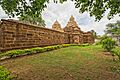
Vaikuntha Perumal Temple, Kanchipuram, Tamil Nadu, considered as one of the oldest temples, dedicated to Maha Vishnu.
-
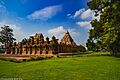
Kailasanathar Temple, Kanchi, one of the oldest temples in the city.
-
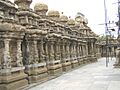
Inner court or the circumambulatory passage with 58 subshrines. Kailasanathar Temple, Kanchipuram.
-
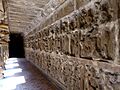
Sculptures showing Pallava legends in the Vaikuntha Perumal Temple, Kanchipuram.
-
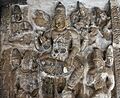
Sculpture of Maha Vishnu as the Supreme deity in Vaikuntha Perumal Temple, Kanchipuram.

.jpg)

.jpg)
.jpg)
See also
 In Spanish: Dinastía Pallava para niños
- List of Tamil monarchs
- Kadava dynasty
- Pallar
- Nolamba dynasty
