
Rusco Tower facts for kids
Quick facts for kids Rusco Tower |
|
|---|---|
 |
|
| Type | Tower house |
| Location | Near Gatehouse of Fleet, Dumfries and Galloway |
| Built | Circa 1500 |
| Built for | Mariota Carson and Robert Gordon |
|
Listed Building – Category A
|
|
| Designated | 1971 |
| Reference no. | LB3299 |
| Lua error in Module:Location_map at line 420: attempt to index field 'wikibase' (a nil value). | |
Rusco Tower, also known as Rusco Castle, is a historic tower house located near Gatehouse of Fleet in Dumfries and Galloway, Scotland. It was built around the year 1500 for Mariota Carson and her husband, Robert Gordon. The land was a gift from Mariota's father.
In the 1500s, the tower was used to hold some of the Gordon family's rivals. After Robert Gordon passed away, Mariota Carson remarried. Her oldest son, James Gordon, took control of the tower. He was worried his mother might give the tower to her new husband. James Gordon even had his mother held captive for a time. Later, a serious conflict involving James Gordon led to the death of Mariota's new husband, Thomas Maclellan, in Edinburgh.
The Gordon family sold the tower in the 1600s. People continued to live in Rusco Tower until the late 1800s or early 1900s. By the mid-1900s, the building was empty and falling apart. In 1971, it was recognized as an important historic building. Soon after, a Scottish businessman named Graham Carson bought and fixed up the tower. He lived there from 1979 to 2006. The tower is still owned by the Carson family and is used as a home today. A poem called "Rusco Castle, a Tale of the Olden Time" was written about the tower in 1841.
Contents
What's in a Name? Rusco Tower's History
The official name for this building, according to Historic Environment Scotland, is Rusco Tower. However, some people call it Rusco Castle. You might also see its name spelled as Rusko.
Long ago, the tower had different names. In 1515, when an important document was signed there, it was called "Ruschen." Records from 1575 show it as "Ruschew."
Exploring Rusco Tower: Design and Features
Rusco Tower is located about 5 kilometers (3 miles) north of Gatehouse of Fleet. It sits on a wooded hillside, looking down into the valley of the Water of Fleet. It is a rectangular tower house, which is a type of strong, tall home.
The tower has four floors, including its attic. It also has a wall walk inside its parapet, which is a protective wall at the top. Its design is quite similar to the nearby Cardoness Castle, just a bit smaller. It's possible the same builder constructed both.
Outside the Tower: What You See
The outside of the tower is shaped like a rectangle. It measures about 11.8 meters (39 feet) by 8.8 meters (29 feet). The tower stands about 15 meters (49 feet) tall.
You can see stone water spouts sticking out from the roof. On the east side, they are shaped like cannons! On the other sides, they are U-shaped. At the very top, there's a protective wall called a parapet. This wall has crenellated sections, which look like battlements. These are supported by special stone brackets called corbels. Inside the parapet, there's a small attic space called a garret. In the southeast corner, a small roofed area called a cap-house covers the stairway, which leads to the wall walk.
The windows are small and placed unevenly. They have slanted edges and, on the upper floors, decorative stone frames called cornices. The stone pieces above the windows, called lintels, stick out. This was unusual in Scotland and likely helped to keep rain away from the windows. On the west and east sides, the ground floor walls have gunloops. These are small openings shaped like upside-down keyholes, used for firing guns. They look similar to those at Cardoness Castle.
The main entrance is on the ground floor of the north wall. It has a wide, curved arch. This entrance used to lead into an extension built in the 1600s, which is now gone. The original entrance, which is simpler, is in the middle of the east side. Above it, you can see a worn stone plaque with two shields. The top shield, held up by two unicorns, shows the Royal Arms of Scotland. The bottom shield likely shows the coats of arms for the Gordon and Carson families, though only a letter 'G' can still be seen clearly.
On the north side of the building, you can still see the lower parts of the walls from the 17th-century extension. This part of the building was already in bad shape by the 1800s, and most of it has been taken down since then.
Inside the Tower: Rooms and Secrets
Rusco Tower is known for its clever design, especially how small rooms are built right into the thick walls. These walls can be up to 2.4 meters (7.9 feet) thick in some places!
Also built into the walls is a turnpike stair, which is a spiral staircase. This staircase goes all the way up through the tower. The ground floor has a vaulted ceiling, meaning it's curved like an arch. This floor is divided into several storage rooms and guard rooms. Some of these rooms have gun loops. One room even has a trap door that drops down into a dark, windowless dungeon!
Above the ground floor is a small, in-between level called an entresol. This level has a tunnel vaulted ceiling and one room with windows. It's thought that the ground floor was originally used for horses or cattle. The entresol might have been a sleeping area for servants.
The first floor is mostly taken up by the great hall. This large room is about 7.8 meters (25.6 feet) by 5 meters (16.4 feet). It has a beamed ceiling supported by stone brackets called corbels. The windows in the hall are arched. One of the stone seats in the west window hides a secret door. This door leads to a small room built into the wall. This secret room has its own window and a "laird's lug" (a "lord's ear"). This is a small listening hole that allowed someone in the secret room to hear what was happening in the great hall.
The second floor and the attic were originally large, open rooms. However, they have since been divided into smaller spaces.
Rusco Tower's Past: A Look at Its History
Building the Tower: Early Days
Rusco Tower was built between 1494 and 1504. It was constructed for Mariota Carson (also known as Acarsane) and her husband, Robert Gordon. The land, called Glenskyreburn estate, was a gift from Mariota's father, John Carson. After the tower was finished, Robert Gordon, who was the heir to the Lochinvar estate, started using the title "of Rusco."
Around 1501 or 1502, Robert Gordon was brought before the Lords of Council. He was accused of taking timber and slates from a house on Crown land to use for building Rusco Tower. He said the house was his, but he couldn't prove it. He was ordered to pay a large fine.
Turbulent Times in the 1500s
Robert Gordon had to leave Rusco soon after the tower was built. Around 1503, he and his brother Alexander were involved in the death of John Dunbar of Mochrum. While his brother left the country, Robert Gordon faced a punishment similar to being an outlaw. His belongings were taken away, and his estate was rented out by the Crown. In 1507, he was allowed to travel to France. By 1511, he received a pardon for his part in the event and could return to Scotland and reclaim his estate. By 1516, he had been made a knight.
Rusco Tower was used to hold several people captive in the 1500s. Robert Gordon once seized Janet Porter, a young woman who had recently married John McCulloch. Gordon tried to force her to sign over her family's land to him instead of her new husband. McCulloch, who wasn't powerful enough to get his wife back by force, went to court. Gordon didn't show up for the hearing, but the court ordered him to return Janet to her husband. It's not clear if the order was followed, but records show that the Gordon family did come to own Janet's land shortly after.
Gordon was also involved in legal disagreements with the Agnews of Lochnaw. In 1523, he tried to end a dispute by taking Andrew Agnew, the heir of Lochnaw and his own grandson, and holding him at Rusco. When Andrew's uncle demanded his return, Gordon claimed the boy was at a school in Dumfries. The records don't say how this situation ended.
Robert Gordon died in 1524. Within a year, his wife Mariota Carson married Thomas Maclellan of Bombie. Mariota owned Rusco Tower and its lands. Her oldest son, James Gordon of Lochinvar, was very worried she might leave the tower to her new husband's family. Because of this, he took control of Rusco, where his mother was still living. He even had her taken to the Borders and held captive. Her husband appealed to the courts. However, before the case was finished, a conflict involving James Gordon and his group led to Maclellan's death on the High Street in Edinburgh.
Later Years: From Home to Ruin and Back
The tower's later history was less dramatic. It became less important to the Gordon family once they owned Lochinvar. It was mostly used as a home for other family members. The tower was sold in the 1600s. Around this time, a two-story extension was added to its north side.
In 1841, a poem called "Rusco Castle, a Tale of the Olden Time" was published by Dugald Williamson of Tongland. The poem describes the tower:
But lo! a little ruined tower,
Erected by forgotten hands,
Though once the abode of pride and power,
That by the river's margin stands—
Of old the Lords of Lochinvar
Here dwelt in peace, but armed for war;
And Rusco Castle could declare
That valiant chief and lady fair
Had often wooed and wedded there.
Upon the eastern bank of Fleet,
Castramont smiles—a hamlet sweet
Just fronting Rusco Tower,
Of peace and war two emblems meet—
None fairer than the first we meet,
The other seems a dark retreat
Where savage passions lower.
Sources:
People lived in the tower until the late 1800s or early 1900s. But between the First and Second World Wars, it was left empty and started to fall into ruin.
In 1971, Rusco Tower was officially recognized as a Category A listed building, meaning it's a very important historic site. The next year, Graham Carson, a Scottish businessman, bought it. He hired an architect, W. Murray Jack, to restore it so people could live there again. The work was finished in 1979, and Graham Carson moved into the tower with his family.
Graham Carson had a great-grandfather born in Wigtownshire, which is close to Rusco. He tried to find out if his family was connected to the Carsons who first built the tower, but he couldn't find any proof. He lived in the tower until 2006. Then, his son, Ian, moved in. As of 2018, Ian Carson was still living at Rusco Tower.
Images for kids
-
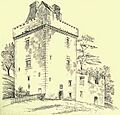 A view of the tower from the south east, published in 1889.
 -
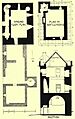 19th-century plans and sections of the tower, still showing the 17th-century extension
 -
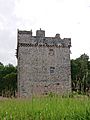 The tower's east elevation.


