
S/2015 (136472) 1 facts for kids

Makemake and its moon S/2015 (136472) 1, the fainter object pointed at by the arrow
|
|
| Discovery | |
|---|---|
| Discovered by |
|
| Discovery date | 27 April 2015 |
| Designations | |
| MK 2 (unofficial nickname) | |
| Orbital characteristics | |
| 22250±780 km | |
| Eccentricity | ≈0 |
| 18.023±0.017 days | |
| Inclination | 83.7° wrt Earth line of sight 63°–87° wrt ecliptic (prograde) |
| Satellite of | Makemake |
| Physical characteristics | |
|
Mean diameter
|
~175 km (4% albedo; best fit) 175–250 km (2–4% albedo) |
|
Mean radius
|
87.5 km |
| Albedo | 0.04 (best fit) 0.02–0.04 |
| 25.0 | |
| 7.89±0.04 | |
S/2015 (136472) 1 is a fascinating tiny moon far out in space. Scientists also give it the friendly nickname MK 2. This little moon travels around Makemake, which is a icy dwarf planet. Both worlds stay in the distant, freezing Kuiper belt beyond Neptune.
The moon is quite small, measuring about 175 km (109 mi) across. It travels along a wide path about 22,250 km (13,830 mi) away from its parent dwarf planet. It takes around 18 days for MK 2 to complete one trip around Makemake. Scientists spotted it in April 2015 using the famous Hubble Space Telescope. They made the big discovery using Hubble's sharp camera called the Wide Field Camera 3. The exciting news was officially shared with the world in April 2016.
Contents
Discovering the Hidden Moon
Finding this small moon was an impressive challenge for space scientists. Makemake shines brightly out in deep space, but its moon is very dim. In fact, MK 2 is about 1,300 times fainter than Makemake itself. That difference in brightness is known to astronomers as a shift in magnitude.
Because it shines with an apparent magnitude of 25 in visible light, our eyes could never see it directly. Even big ground telescopes could not easily spot it. MK 2 was often lost right inside the bright glare of the shiny dwarf planet. Astronomers finally used the sharp vision of the Hubble Space Telescope to capture this hidden world.
Physical Characteristics of the Dark Moon
A Moon Dark as Charcoal
One of the most surprising things about MK 2 is its unusually dark surface. Makemake itself is bright and reflective, like a giant ball of snow. MK 2 is completely the opposite. Scientists measure how much light an object reflects by finding its reflectivity or albedo. While Makemake reflects about 82% of sunlight, MK 2 reflects only 2% to 4%.
This tiny amount of light reflection means the moon is literally as dark as a lump of charcoal. Because it is so dark, it does not bounce back much visible light. This makes it look like a black speck drifting against the dark background of outer space.
The Mystery of the Missing Ice
Why would MK 2 be so dark when Makemake is so shiny? Astronomers think it has everything to do with gravity. Makemake is large enough to hold on to bright, volatile ices like frozen methane. These ices keep Makemake bright and white.
MK 2 is much smaller, so its gravity is very weak. When gentle heat from the faraway Sun touches MK 2, its bright surface ices turn directly into gas and escape into space. Without ice to reflect sunlight, all that remains is a layer of dark, rocky dust.
Solving an Infrared Space Puzzle
Before astronomers found this moon, space telescopes ran into a puzzling riddle. Instruments like the Spitzer and Herschel telescopes studied Makemake in far-infrared light. They measured its warmth, which is called thermal emission.
To their surprise, Makemake gave off much more heat than expected. A bright icy body should not release that much warmth. Scientists realized that some dark surface had to exist to absorb sunlight and radiate heat. When researchers discovered dark MK 2, the mystery was solved. The extra heat was coming directly from the dark surface of this secret moon.
Size and Mass
Scientists can calculate the size of MK 2 by looking at its brightness, its absolute brightness, and its albedo. If its surface reflects only 2% of light, it could be 250 km (160 mi) wide. If it reflects 4% of light, it is closer to 175 km (109 mi) across. Most astronomers think 175 km (109 mi) is the best fit.
MK 2 is also very light compared to its dwarf planet. If it has a similar density, it holds less than 0.2% of the whole system's mass. That means Makemake contains almost all the material in the pair.
How MK 2 Orbits Makemake
Path Around the Dwarf Planet
MK 2 travels in a neat, nearly circular orbit around Makemake. Its average distance, or semi-major axis, is about 22,250 km (13,830 mi). It takes roughly 18 days to finish a full loop.
Astronomers study whether an object moves in a forward or backward direction around its planet. They also check its angle in space, called orbital inclination, compared to the flat plane of our Solar System and our line of sight from Earth.
Cosmic Hide-and-Seek
From our view on Earth, MK 2's orbit is tilted edge-on. This means the moon seems to pass directly in front of or behind Makemake over and over. When one world blocks another, scientists call it an eclipse or an occultation.
Because of this edge-on view, the moon spent years slipping directly into Makemake's bright glare. That cosmic hide-and-seek game explains why stargazers did not find MK 2 sooner.
-
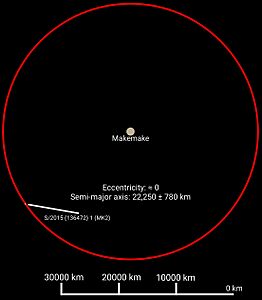
Polar view orbit diagram for S/2015 (136472) 1's orbit around Makemake.
-
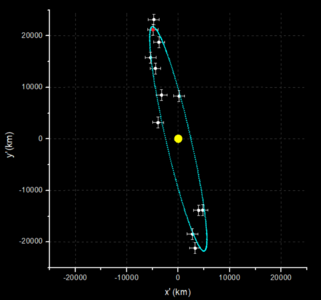
Diagram of S/2015 (136472) 1's orbit as seen from Earth. Measured positions of the moon are plotted as white points.
-
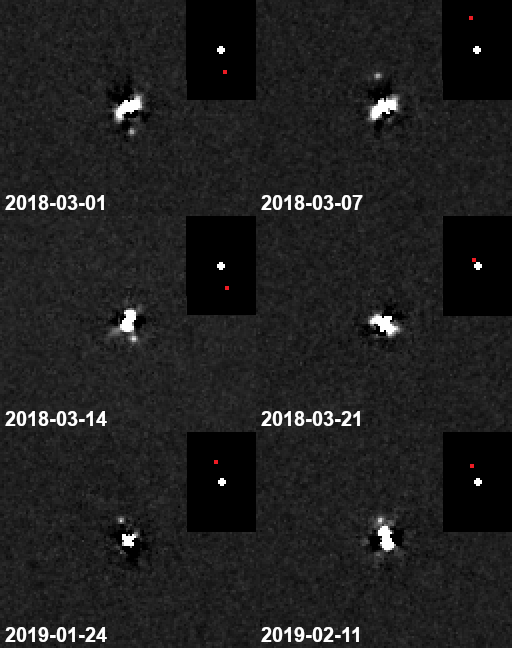
Animated time lapse of S/2015 (136472) 1 orbiting Makemake, as seen by Hubble during 2018–2019. Makemake appears smudged because its glare has been digitally removed to make the moon more visible.


How the Moon Got Its Name
Right now, this little moon has an official temporary label: S/2015 (136472) 1. Every part of this code has a meaning:
- "S/" stands for satellite, meaning a moon.
- "2015" is the year astronomers first saw it.
- "(136472)" is Makemake's official minor planet number.
- "1" means it was the first moon found for this body that year.
The discovery team nicknamed it MK 2 as a quick, simple shortcut. When an official name is chosen, it will follow special rules. Makemake is named after the creator god of Easter Island, so any permanent name will likely honor another exciting figure from that culture.
