
Shelling of Yeonpyeong facts for kids
Quick facts for kids Shelling of Yeonpyeong |
|||||||
|---|---|---|---|---|---|---|---|
| Part of the Korean War | |||||||
 Map of the shelling of Yeonpyeong |
|||||||
|
|||||||
| Belligerents | |||||||
 North Korea North Korea |
 South Korea South Korea |
||||||
| Casualties and losses | |||||||
| Unknown | 2 killed 16 wounded |
||||||
| 2 South Korean civilians killed and 3 wounded | |||||||
The shelling of Yeonpyeong was a serious event that happened on Yeonpyeong Island on November 23, 2010. It involved an exchange of artillery (large guns that fire shells) between the militaries of North Korea and South Korea.
The event began after South Korea held an artillery practice near the island. North Korea then fired about 170 shells at Yeonpyeong Island. This attack caused a lot of damage. Four South Koreans were killed, and 19 were injured. In response, South Korea fired shells back at North Korean gun positions.
North Korea stated they fired because they believed South Korean shells were landing in their part of the sea. Many countries did not approve of North Korea's actions. This incident made the "tension" (angry feelings) between North and South Korea much worse. The United Nations called it one of the most serious events since the end of the Korean War.
Contents
Military Exercises and Background
Each year, South Korea and the United States hold a large military practice called the Hoguk exercise. The 2010 Hoguk exercise involved 70,000 soldiers from all parts of the South Korean military. They used many vehicles, helicopters, warships, and aircraft.
North Korea's government felt these exercises were a way to prepare for an attack on them. However, South Korea and the US said the exercises were only for practice and defense.
The Attack and Response
On the morning of November 23, North Korea sent a message to South Korea. They asked if the Hoguk exercise was meant to be an attack. They also said they would not allow firing in what they considered their sea area.
South Korean forces were practicing firing in their own waters. These waters were near Baengnyeong Island and Yeonpyeong Island. A South Korean military official said their shells were fired south, away from North Korea. This firing was a regular monthly practice, not part of the Hoguk exercise.
At 2:34 PM Korean time, North Korea began firing shells at Yeonpyeong Island. The firing happened in two parts: from 2:34 PM to 2:55 PM, and again from 3:10 PM to 3:41 PM. Many shells hit homes and shops, causing a lot of destruction.
When South Korea saw this, they used their own large guns, called howitzers, to fire about 80 shells back at North Korea. The firing stopped around 4:42 PM. This was the first time North and South Korea had an artillery battle since the 1970s. It was seen as one of the most serious attacks by North Korea since the Korean War ended.
Because of the North Korean shelling, several fires started on Yeonpyeong Island. The South Korean military quickly moved civilians (people who are not soldiers) away from the island to keep them safe.
Impact and Damage
The attack sadly resulted in deaths and injuries. Two South Korean soldiers, Sergeant Seo Jeong-wu and Private First Class Moon Gwang-wuk, were killed. Six other military personnel were seriously hurt. Two civilians from the island, Kim Chi-baek (61) and Bae Bok-chul (60), also lost their lives.
Many parts of the island caught fire because of the attack. Most of the people living on Yeonpyeong Island had to leave after the shelling. Out of 1,780 residents, about 1,500 moved away. Many went to Incheon on the mainland. The city of Incheon sent fire engines and ambulances to help on the island.
Images for kids
-
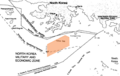
The South Korean 40 km by 20 km live-fire range in relation to the Northern Limit Line and the claimed North Korean 12 nautical mile territorial waters
-
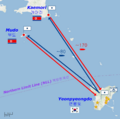
Map and graphic representation of the bombardment of Yeonpyeong
-
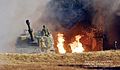
South Korean Marine Corps K9 self-propelled howitzer preparing counterattack right after the initial attack from North Korea
-
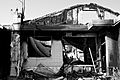
A building that was damaged by fire after the bombardment
-
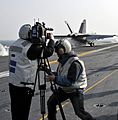
South Korean media on board the aircraft carrier George Washington observe a training mission, November 2010

.jpg)


See also
 In Spanish: Bombardeo de Yeonpyeong para niños
