
Smooth azalea facts for kids
Quick facts for kids Rhododendron arborescens |
|
|---|---|
 |
|
Scientific classification  |
|
| Kingdom: | Plantae |
| Clade: | Tracheophytes |
| Clade: | Angiosperms |
| Clade: | Eudicots |
| Clade: | Asterids |
| Order: | Ericales |
| Family: | Ericaceae |
| Genus: | Rhododendron |
| Species: |
R. arborescens
|
| Binomial name | |
| Rhododendron arborescens (Pursh) Torr.
|
|
| Script error: The function "autoWithCaption" does not exist. | |
Script error: No such module "Check for conflicting parameters".
The Rhododendron arborescens, also known as the smooth azalea or sweet azalea, is a beautiful flowering shrub. It gets its name "sweet azalea" from its lovely scent. This plant usually blooms in late spring and early summer. Its flowers can be white or pink, often with bright red stamens. In the fall, its shiny green leaves can turn a deep red or purple.
This plant naturally grows in the United States, often found near wet areas or streams. It likes acidic soil, which means the soil has a pH of 6.8 or less. It grows best in sandy soils that are more than 3,000 feet high. The plant can reach a height of 8 to 10 feet.
It's important to know that the flowers of this plant contain poisonous substances. Wild animals and humans should never eat any part of it. Eating this plant can cause problems like feeling sad, throwing up, diarrhea, and trouble breathing. In serious cases, it can even lead to a coma.
Contents
History of the Sweet Azalea
The discovery of R. arborescens is officially credited to two people: Frederick Traugott Pursh and John Bartram. They first saw this plant in John Bartram's garden in Philadelphia and also in Blue Mountain, Pennsylvania.
Some people also mentioned that André Michaux might have seen the plant earlier, in 1795, in North Carolina. However, no more plants were found in his collection, so Pursh and Bartram received the credit for its discovery.
The plant was first called Azalea arborescens by Pursh in 1814. But later, in 1824, John Torrey renamed it Rhododendron arborescens. He believed it belonged in the same group as other rhododendrons.
What the Plant Looks Like
Rhododendron arborescens is a shrub that can grow up to 18 feet tall. Its flowers grow in clusters at the end of the stems. These plants usually have yellowish-brown twigs.
The leaves are oval-shaped with smooth edges and rounded tips. The middle vein of the leaves often has tiny hairs. The leaves themselves are green and waxy, about 1.75 to 3 inches long. Plants found at higher altitudes often have smaller leaves and are shorter.
This plant usually produces 3 to 7 flowers after its leaves show a white or blue tint. The flowers have bright red stigmas that are easy to see, reaching all the way up to the petals. This plant is also deciduous, meaning it loses its leaves in the fall.
Where the Plant Grows
Sweet azaleas grow in the eastern part of the United States. You can find them in states like West Virginia, Pennsylvania, Tennessee, North Carolina, Georgia, and Alabama.
They often grow near streams in mountains or in moist forests. Rhododendron arborescens is known for blooming later than many other plants. Their blooming season can last from early April all the way to September.
How to Grow Sweet Azaleas
R. arborescens grows best in soil that is a little bit acidic, with a pH between 5.5 and 6. It doesn't like too much water, so good drainage is important for it to grow well. It can handle full sunlight but shouldn't be left in direct sun for too long.
When planting, it's helpful to place the roots slightly above the ground and then add soil around them. Adding organic materials like sawdust or pine bark can help the plant grow. Putting a few inches of pine bark or wood chips around the plant can help keep the soil moist and stop weeds from growing. However, older R. arborescens plants usually don't need fertilizer.
This plant has even won an award! It received the Royal Horticultural Society's Award of Garden Merit because it's such a great plant for gardens.
Safety: Why This Plant is Poisonous
R. arborescens contains special substances called andromedotoxins, specifically known as grayanotoxins. These are chemicals that can dissolve in water. Both the leaves and the flowers of this plant have these toxins.
Eating even a small amount, like 3 milliliters of nectar per kilogram of body weight, can be very harmful.
Symptoms of Poisoning
If someone eats the leaves or flowers of R. arborescens, they might start drooling and feel a burning sensation in their mouth. This can be followed by vomiting, diarrhea, feeling very weak in their muscles, and blurry vision.
More serious effects on the heart can include a slow heart rate (called bradycardia), low blood pressure (called hypotension), and problems with the heart's electrical signals. People might also have trouble breathing (Dyspnea) and feel very weak. In severe cases, someone could die within one to two days.
Possible Treatments
If someone has eaten this plant, it's important to get help right away. One way to try and treat it is to help the body get rid of the harmful substances. Sometimes, causing vomiting can help remove the compounds from the body.
Another treatment might involve replacing fluids in the body and getting help with breathing (respiratory support). Medicines like Quinidine can help with heart problems caused by the poisoning.
Images for kids
-
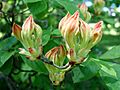
Immature flowers of Rhododendron arborescens
-

Structure of Grayanotoxin
-
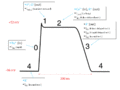
Cardiac Action Potential
-
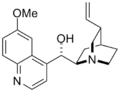
Structure of Quinidine


