
Texas horned lizard facts for kids
Quick facts for kids Texas horned lizard |
|
|---|---|
.jpg) |
|
| In New Mexico | |
| Conservation status | |
Scientific classification  |
|
| Kingdom: | Animalia |
| Phylum: | Chordata |
| Class: | Reptilia |
| Order: | Squamata |
| Suborder: | Iguania |
| Family: | Phrynosomatidae |
| Genus: | Phrynosoma |
| Species: |
P. cornutum
|
| Binomial name | |
| Phrynosoma cornutum (Harlan, 1825)
|
|
 |
|
| Script error: The function "autoWithCaption" does not exist. | |
| Synonyms | |
|
List
|
|

Script error: No such module "Check for conflicting parameters".
The Texas horned lizard (Phrynosoma cornutum) is a unique reptile found in parts of the United States and Mexico. It's one of about 21 types of "horned lizards" in North America. These lizards have spiky bodies and are sometimes called "horned toads" because of their round shape. Even though they look tough, they are usually very calm. Sadly, their numbers are decreasing in many areas, so people are working hard to protect them. In Texas, it's against the law to pick up or keep these special lizards.
What is a Texas Horned Lizard?
People often call the Texas horned lizard a "horned toad" or "horny frog." But don't let the name fool you! It's not a toad or a frog at all; it's a lizard. They get these nicknames because their bodies are round, and their snouts are blunt, making them look a bit like toads. The scientific name, Phrynosoma, actually means "toad-bodied." The word cornutum means "horned," which describes the real horns on their heads. These horns are actually part of their skull and contain bone.
Where Do Texas Horned Lizards Live?
The Texas horned lizard lives only in North America, mainly in the south-central United States and northeastern Mexico. You can find them in places like southeast Colorado, central and southern Kansas, central and western Oklahoma and Texas, southeast New Mexico, and a small part of southeast Arizona. In Mexico, they live in states like Chihuahua, Coahuila, Nuevo León, and Tamaulipas. They can live from sea level up to about 1,830 meters high. They like open areas like grasslands, deserts, and plateaus.
New Homes for Horned Lizards


Sometimes, Texas horned lizards are found in places far from their natural homes. In the past, many were kept as pets. When some escaped or were released, they started small groups in new areas. For example, there are stable populations in Florida, Georgia, and South Carolina that have been there for over 50 years. However, these groups usually don't spread much further.
What Does a Texas Horned Lizard Look Like?


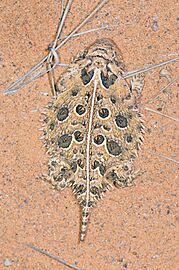
The Texas horned lizard is the biggest and most widespread of the roughly 21 horned lizard species. Females are usually larger than males. Females can be about 5 inches (12.7 cm) long, while males are around 3.7 inches (9.4 cm). They have special horns all over their bodies. The two largest horns are on their heads, with more on their eyebrows and jawline. They also have rows of spikes along their sides and on their backs.
Their color helps them blend in with their surroundings. They can be yellow or reddish-brown in deserts, or tannish-brown in grasslands. This camouflage helps them hide from predators. During mating season, their colors might become brighter. They also have dark lines from their eyes to their horn tips and a white line with black spots on each side of their body.
-
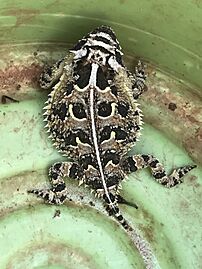
In Oklahoma
-
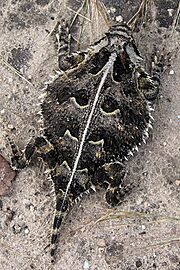
In Texas
-
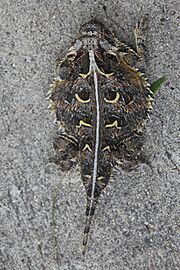
In Texas
-
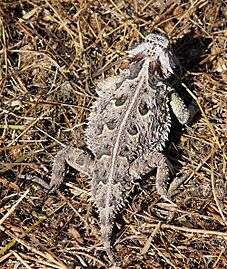
In Texas
-
In New Mexico

_(rotated).jpg)
.jpg)

.jpg)
Daily Life of a Horned Lizard


Even though they look fierce, Texas horned lizards are very gentle. They love to sunbathe! They need bright sunlight to make vitamin D, which keeps them healthy. That's why you often see them on roadsides or in other sunny, rocky spots. At night, they bury themselves in the sand to stay safe and warm.
Horned lizards usually move slowly, but they can run very fast if a predator is nearby. They will dart into thick grass or bushes to escape. They are also great at digging. They use their front legs to dig burrows where they lay their eggs. These lizards often live near harvester ant colonies because ants are a big part of their diet. They travel about 50 meters each day. For hibernation, they dig burrows about 140 mm deep, often facing south to catch the most sun.
How Horned Lizards Protect Themselves
Their natural colors help them hide, but if a predator gets too close, a horned lizard has other tricks. It will puff up its body, making itself look much fatter. This makes its scales stick out, making it hard for a predator to swallow. They can also use their sharp horns to poke attackers.
A Surprising Defense: Blood Squirting!

The Texas horned lizard has a truly amazing defense! It can squirt a stream of blood from the corners of its eyes, sometimes even from its mouth. This blood can shoot up to 5 feet (1.5 meters) away! They do this by holding blood in their head, which makes tiny blood vessels around their eyelids burst. This not only confuses predators but also the blood has a bad taste for animals like coyotes and domestic dogs. This special defense works very well against these types of predators. However, it doesn't seem to bother birds. When they do this, they can lose up to 6% of their body weight.
What Do Texas Horned Lizards Eat?


Texas horned lizards are picky eaters! About 70% of their diet is made up of harvester ants. They also eat other insects like termites, beetles, and grasshoppers. These lizards have a special ability to handle ant venom. Their blood has something that stops the ant venom from harming them. They also produce a lot of sticky mucus in their throat to trap and stop the ants they swallow. They are very efficient at catching and eating their prey.
Protecting the Texas Horned Lizard

In recent years, the number of Texas horned lizards has dropped in about 30% of their natural range. This decline is often blamed on the overuse of bug sprays (pesticides) and the spread of aggressive red imported fire ants. Both of these problems destroy harvester ant colonies, which are the main food source for the lizards.
Because of this, the Texas horned lizard is now a protected species. In Texas, it's against the law to catch, own, move, or sell them without a special permit. Even though they are listed as "least concern" globally by the IUCN, they are considered "threatened" in Texas. Their populations have disappeared from almost half of their original areas. This is due to cities growing, habitats being broken up, and people getting rid of ant populations. Also, fire ants push out the native ants that horned lizards eat. Even pets like domestic dogs and cats can be a threat. However, some studies suggest that small towns with good habitats and food might offer a safe place for these lizards.
In 2014, a group called the Center for Biological Diversity asked the Oklahoma Department of Wildlife Conservation to add the Texas horned lizard to its endangered species list because of the big drop in their numbers there. They also mentioned that reptiles, in general, are disappearing much faster than before, mostly because of human activities.
Helping Horned Lizards Grow
Zoos are working hard to help the Texas horned lizard. The Fort Worth Zoo has started a program to breed them and release the babies into the wild. They hope that by releasing many young lizards, enough will survive to help the wild population grow. Other zoos, like the Dallas Zoo and Houston Zoo, are also working to raise these lizards. The San Antonio Zoo is even working with landowners to release zoo-hatched lizards back into areas where they used to live.
Scientists Study Horned Lizards
Scientists at Texas Christian University, the nearby Fort Worth Zoo, and Dallas Zoo are studying horned lizards. They collect information and do fieldwork to learn more about these animals. Since 2010, the Dallas Zoo has been doing a "mark-and-recapture" study. They catch lizards, tag them, collect data, and then release them. This helps them understand how long lizards live, how many live in an area, and what kind of environment is best for this threatened species. Money from special horned lizard "Keep Texas Wild" license plates helps fund this important research.
Horned Lizards in Culture and History

The Texas horned lizard is a very important symbol in Texas. It is the official state reptile! It's also the mascot for Texas Christian University, where it's known as the "horned frog." You can even see it on the university's official seal.
A famous story from 1928 tells about "Ol' Rip the Horned Toad." People believed he survived being sealed in a time capsule for 31 years! Ol' Rip became a national celebrity, even meeting President Calvin Coolidge. This story made horned toads very popular as pets, which unfortunately led to a big drop in their numbers in the wild. Ol' Rip's story even inspired the cartoon character Michigan J. Frog in 1955.
Horned Lizards in Native American Art
For some Native American people, horned lizards are considered sacred animals. You can often see them as a design in Native American art from the Southwestern United States and Mexico.
See Also
 In Spanish: Lagarto cornudo para niños
