
Torii facts for kids

A Torii (pronounced "toh-ree-ee") is a special type of gate found in Japan. These traditional Japanese gates are most often seen at the entrance of or inside a Shinto shrine. A torii acts like a symbolic doorway, marking the change from the everyday world to a sacred, holy space. It's a place where kami (Japanese spirits or deities) are welcomed and believed to pass through.
Seeing a torii gate is usually the easiest way to spot a Shinto shrine. On Japanese road maps and even on Google Maps, a small torii icon represents these shrines.
The first torii gates appeared in Japan a very long time ago, at least by the mid-Heian period. They were mentioned in a text written in the year 922. The oldest stone torii still standing was built in the 12th century. It belongs to a Hachiman shrine in Yamagata Prefecture. The oldest wooden torii that still exists is a ryōbu torii at Kubō Hachiman Shrine in Yamanashi Prefecture, built in 1535.
Torii gates were traditionally made from wood or stone. Today, you can also find them made from strong materials like reinforced concrete or stainless steel. They are usually either left unpainted or painted a bright red-orange color called vermilion, often with a black top beam. Shrines of Inari, the kami of good fortune and business, often have many torii. This is because people who have been successful in business sometimes donate a torii as a thank you. Fushimi Inari-taisha in Kyoto is famous for having thousands of these donated torii, each with the donor's name on it.
Contents
What Torii Gates Are Used For
The main job of a torii is to mark the entrance to a sacred area. Because of this, the path leading to a Shinto shrine, called a sandō, almost always has one or more torii gates. This helps people tell the difference between a Shinto shrine and a Buddhist temple. If a path has several torii, the one furthest out is called the ichi no torii (first torii). The ones closer to the shrine are usually called the ni no torii (second torii) and san no torii (third torii). These gates show that you are getting closer to the most sacred part of the shrine. You can also find torii in front of the tombs of Japanese Emperors, showing the strong connection between Shinto shrines and the Imperial family.

While torii are mostly linked to Shinto shrines today, they were also used in Buddhist settings in the past. For example, Kūkai, who started Shingon Buddhism, used torii to mark sacred spaces for special ceremonies. Osaka's Shitennō-ji, one of the oldest Buddhist temples in the world, founded in 593, has a stone torii at one of its entrances. Many Buddhist temples also have small Shinto shrines dedicated to their local guardian spirits, and these shrines will have a torii. The goddess Benzaiten, who combines ideas from both Shinto and Buddhism, is sometimes shown with a torii on her head.
Sometimes, the torii is used as a symbol of Japan in non-religious ways. For instance, it is a symbol for some US military groups stationed in Japan. It is also used as an entrance feature in some Japanese communities around the world, like Liberdade in São Paulo, Brazil.
Where Torii Gates Came From
Experts have different ideas about where the torii gate style came from. Some believe that the Japanese torii might have been inspired by the torana, which are ceremonial gateways found in ancient Buddhist architecture in India. These torana gates also mark the entrance to sacred places. People noticed similarities in how they look and their names, leading to this idea.
Other theories suggest that torii might be related to the pailou gates in China or the hongsalmun gates in Korea. While some of these gates look a bit like torii, they also have many different styles.
Another interesting idea is that the word "torii" literally means "bird perch." This theory suggests that the gates might have originally been places for birds to rest. In many Asian cultures, birds are seen as having special or spiritual powers. For example, in Korea, there are poles called sotdae with wooden birds on top. These poles are often found at village entrances and are believed to protect against bad spirits and bring good luck. Even though these "bird perches" don't look exactly like modern torii, they show how birds were important in spiritual beliefs.
In ancient Japan, birds were also sometimes connected to important events or spirits. For example, old Japanese stories mention that Yamato Takeru, a legendary prince, turned into a white bird after he died and chose his own burial place. This led to his tomb being called the "white bird grave." This connection between birds and spiritual ideas might help explain the name "bird perch" for the torii, even if birds are not visible on the gates today.

Finally, it's also possible that the torii is a unique Japanese invention. One idea is that the first torii developed step-by-step:
- First, four posts might have been placed at the corners of a sacred area, connected by a rope to show what was holy and what was not.
- Then, two taller posts were put at the main entrance, allowing a priest to enter.
- A rope was tied between these two posts to mark the boundary. This simple form is still seen today in a type of torii called the shime-torii. You can see an example in front of Ōmiwa Shrine's main hall in Nara.
- Later, the rope was replaced by a solid beam, called a lintel.
- To make the gate stronger, another beam was added to connect the pillars, creating what is now called a shinmei torii. This basic style has two vertical pillars, a top lintel, and a tie-beam.
Parts of a Torii Gate

Torii gates can be unpainted or painted bright vermilion (red-orange) and black. The black color is usually only on the top beam and the base of the pillars. Very rarely, you might see torii in other colors, like the white and red one at Kamakura-gū in Kamakura.
Here are some of the main parts of a torii:
- The kasagi is the main horizontal beam at the very top.
- Sometimes, a second, smaller horizontal beam called a shimaki is placed just below the kasagi.
- The kasagi and shimaki can sometimes curve slightly upwards, which is called sorimashi.
- The nuki is the tie-beam that connects the two vertical pillars. It often sticks out a bit from the sides.
- Small wedges called kusabi are often used to hold the nuki in place. These wedges can also be decorative.
- In the middle of the nuki, there might be a small support called a gakuzuka. This is sometimes covered by a tablet that shows the name of the shrine.
- The vertical pillars, called hashira, often rest on a white stone ring called a kamebara (turtle belly) or daiishi (base stone). Sometimes, a decorative black sleeve called a nemaki is used instead.
- At the very top of the pillars, there might be a decorative ring called a daiwa.
Torii gates are mostly symbolic, so they usually don't have doors or fences. However, there are a few exceptions, like the triple-arched miwa torii at Ōmiwa Shrine.
Different Styles of Torii Gates
Torii gates come in many different styles, but they can generally be grouped into two main families: the Shinmei family and the Myōjin family. Gates in the Shinmei family have straight top beams, while those in the Myōjin family have curved top beams.
The simplest type of torii is the shime torii. It's just two posts with a sacred rope, called a shimenawa, tied between them. This is thought to be one of the oldest torii styles.
Shinmei Family Torii Gates
Torii gates in the Shinmei family are known for their straight upper beams.
-

Shime torii – just two posts and a shimenawa
-

Shinmei torii
-

Ise torii – a shinmei torii with a kasagi pentagonal in section, a shimaki and kusabi
-

Mihashira torii – a triple shinmei torii


Shinmei Torii: The Basic Style
The shinmei torii is the most basic style in this family. It has a top beam (kasagi) and two pillars (hashira) connected by a tie-beam (nuki). In its simplest form, all parts are rounded, and the pillars stand straight up. This style is believed to be the oldest type of torii.
Ise Torii: Special to Ise Shrine
The Ise torii is a special style found only at the Inner and Outer Shrines of Ise Shrine in Mie Prefecture. It looks very much like a shinmei torii, but its pillars lean slightly inwards, and the nuki is held in place by wedges. The top beam (kasagi) has a unique five-sided shape. Some Ise torii also have a second, rectangular beam (shimaki) below the main top beam.
Mihashira Torii: The Three-Pillar Gate
The mihashira torii (meaning "three-pillar torii") is a very unique type of gate. It looks like three individual shinmei torii joined together to form a triangle. Some people believe that early Japanese Christians might have built these gates to represent the Holy Trinity.
Myōjin Family Torii Gates
The Myōjin family of torii gates is recognized by its curved upper beams.
-

Myōjin torii – kasagi and shimaki are curved upwards.
-

Daiwa or Inari torii – A myōjin torii with rings at the top of the pillars
-

Ryōbu torii – a daiwa torii with pillars supported on both sides


Myōjin Torii: The Most Common Style
The myōjin torii is the most common style of torii gate you will see. It has curved upper beams (kasagi and shimaki) that gently arch upwards. Wedges are usually present to hold the nuki in place. Myōjin torii can be made from wood, stone, concrete, or other materials, and they are often painted vermilion or left unpainted.
Daiwa or Inari Torii: With Rings on Top
The daiwa torii (also called Inari torii) is a myōjin torii that has two decorative rings, called daiwa, at the very top of its pillars. This style is often seen at Inari shrines, which is why it's also known as Inari torii. However, not all torii at famous Inari shrines like Fushimi Inari-taisha are of this specific style. This style first appeared during the late Heian period.
Ryōbu Torii: The Four-Legged Gate
The ryōbu torii (also called "four-legged torii") is a daiwa torii where the main pillars are strengthened on both sides by smaller, square posts. The famous torii that appears to float in the water at Itsukushima Shrine is a ryōbu torii. This shrine was once also a Buddhist temple, which shows the historical connection between these gates and both Shinto and Buddhist traditions.
Images for kids
-
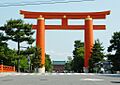
Torii or traditional Japanese gate. Heian-jingū, Sakyō-ku, Kyoto.
-

Beachside torii on the island of Naoshima
-
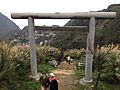
A shinmei torii in the Ōgon Shrine
-
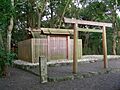
Ise torii, first type. Note the presence of kasagi.
-
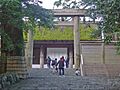
Ise torii, second type. Note the shimaki.
-
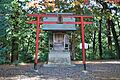
Hachiman torii
-
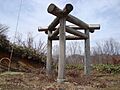
Mihashira torii
-

A shiroki torii
-
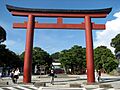
Myōjin torii
-
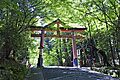
Sannō torii
-
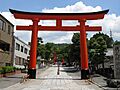
Daiwa torii. Note the daiwa rings at the top of the pillars.
-
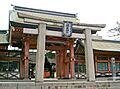
The Sumiyoshi torii has pillars with a square cross-section.
-
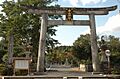
Nakayama torii
-
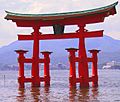
Ryōbu torii
-
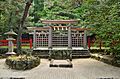
Miwa Torii
-
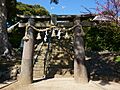
The hizen torii (肥前鳥居) has a rounded kasagi and thick flared pillars.
-
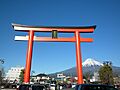
Fujisan Hongū Sengen Taisha
-
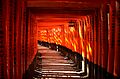
Senbon torii at Fushimi Inari-taisha
-
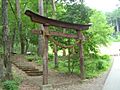
Torii in the Hida Minzoku Mura Folk Village
-
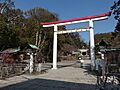
White and red torii at Kamakura-gū
-
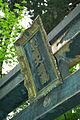
A tablet on a torii at Nikkō Tōshō-gū covers the gakuzuka.
-
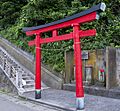
The typical five-sided shape of a torii's kasagi. Note the black nemaki.
-
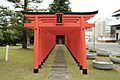
A row of torii
-
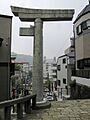
One-legged torii, Sannō Shrine, Nagasaki, Japan. The other half was toppled in the explosion of the nuclear bomb.
-
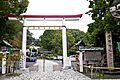
An unusual white and red Nakayama torii
-
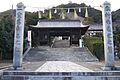
A shime torii
-
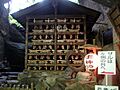
Rows of tiny votive torii donated by the faithful.
-
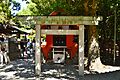
An unusual kaku-torii (角鳥居, lit. square torii) at Sumiyoshi Taisha: the nuki does not protrude and all members are square in section.
-
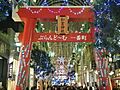
A temporary Torii for new year celebration in a shopping street decorated with Christmas lights
-
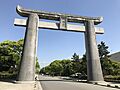
An example of a Hizen style gate
-
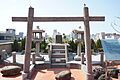
A torii in Hayashi Department Store, Tainan, Taiwan. The kasagi part was broken after World War II


.jpg)
_03.JPG)


.jpg)


See also
- Dvarapala is a door or gate guardian often portrayed as a warrior or fearsome giant, usually armed with a weapon.
- Hongsalmun, in Korean architecture with both religious and other usage
- Iljumun, portal in Korean temple architecture
- Mon, generic Japanese term for gate
- Paifang, in Chinese temple architecture
- Tam quan, in Vietnamese temple architecture
- Torana, a Hindu-Buddhist ceremonial arched gateway
