
University College London facts for kids
 |
|
|
Former names
|
London University (1826–1836) University College, London (1836–1907) University of London, University College (1907–1976) University College London (1977–2005; remains legal name) |
|---|---|
| Motto | Latin: Cuncti adsint meritaeque expectent praemia palmae |
|
Motto in English
|
Let all come who by merit deserve the most reward |
| Type | Public research university |
| Established | 11 February 1826 (University status 2023) |
|
Academic affiliations
|
|
| Endowment | £175.0 million (2025) |
| Budget | £2.163 billion (2024/25) |
| Chair | Victor L. L. Chu |
| Visitor | Sir Geoffrey Vos (as Master of the Rolls ex officio) |
| Chancellor | Anne, Princess Royal (as Chancellor of the University of London) |
| President and Provost | Michael Spence |
|
Academic staff
|
10,350 (2023/24) |
|
Administrative staff
|
6,655 (2023/24) |
| Students | 51,315 (2024/25) 46,135 FTE (2024/25) |
| Undergraduates | 25,705 (2024/25) |
| Postgraduates | 25,610 (2024/25) |
|
Other students
|
895 (studying wholly overseas; 2021/22) |
| Location |
London, England
51°31′29″N 00°08′01″W / 51.52472°N 0.13361°W |
| Campus | Urban |
| Colours | Purples and white |
University College London, known as UCL, is a large public research university in London, England. It is part of the University of London and is one of the biggest universities in the United Kingdom. UCL has many students, especially those studying for advanced degrees.
UCL started in 1826 as London University. Its founders had new ideas about education. It was the first university in London and the first in England to welcome students of all religions. UCL was also one of the first places in the UK to admit women alongside men in 1878. Although it began as a college, UCL officially became a university in 2023. Over the years, it grew by joining with other important schools and institutes.
UCL's main campus is in the Bloomsbury area of central London. It also has a newer campus, UCL East, in Stratford, East London. The university is divided into 11 main learning areas called faculties, which contain over 100 departments and research centers. UCL also has several interesting museums, like the Petrie Museum of Egyptian Archaeology and the Grant Museum of Zoology and Comparative Anatomy. UCL contributes a lot to the UK economy, especially through its research and knowledge.
UCL is a member of many important academic groups, such as the Russell Group. It is known as one of the top research universities in southeast England. UCL also has its own publishing house, UCL Press, and companies that help turn new ideas into useful products.
Many famous people have studied or worked at UCL. These include the founder of the Republic of Mauritius and the first prime minister of Japan. One of the co-discoverers of DNA's structure also studied here. UCL academics have made many important discoveries, like finding five naturally occurring noble gases and inventing the vacuum tube. As of 2025, 33 Nobel Prize winners and three Fields Medal winners have been connected to UCL.
Contents
UCL's Story: How It Began
Starting as London University (1826-1836)

UCL was founded on February 11, 1826. It offered a new kind of education compared to older universities like Oxford and Cambridge. People bought shares to help start London University. This meant it was a new kind of institution, but it did not yet have the power to award its own degrees. Leonard Horner, a scientist, was its first leader.

The philosopher Jeremy Bentham is often called the "spiritual father" of UCL. His ideas about education and society greatly influenced the university's founders. These ideas included welcoming students from all backgrounds.
In its early years, London University started many new courses. It created the first professor role for political economy in 1828. In 1829, it appointed England's first professor of English. The university also founded a school, which later became University College School. In 1834, University College Hospital opened to help teach medical students.
Becoming University College, London (1836-1900)

After trying for many years to become a full university, London University accepted a new plan. In 1836, it became University College, London through a special royal charter. On the same day, the University of London was created. This new university would award degrees to students from colleges like UCL. UCL and King's College London were the first two colleges to join.
UCL continued to grow and add new subjects. The Slade School of Fine Art was founded as part of UCL in 1871. This school became famous for teaching art.
In 1878, UCL made a big step forward by admitting women to its Arts, Law, and Science faculties. This made it one of the first colleges in the UK to welcome women alongside men. This was an important moment for equal opportunities in education.
UCL Joins the University of London (1900-1976)
| University College London (Transfer) Act 1905 | |
|---|---|
| Act of Parliament | |
|
|
| Long title | An Act for transferring University College London to the University of London and for other matters connected therewith and for amending the University of London Act 1898. |
| Citation | 5 Edw. 7. c. xci |
| Dates | |
| Royal assent | 11 July 1905 |
| Other legislation | |
| Amends |
|
| Text of statute as originally enacted | |
In 1907, UCL officially merged into the University of London. It became known as University of London, University College. This gave UCL a stronger voice in how the larger university was run. The leader of UCL also changed their title to Provost.

In the early 1900s, UCL had a research lab that studied human traits and heredity. Later, UCL recognized that some of the ideas from this time were harmful and wrong. The university apologized in 2021 for its past involvement in promoting these ideas.
During the Second World War, UCL suffered a lot of damage from bombs. Many buildings, including the main hall and library, were destroyed. Departments had to move to different places across the country. It took until 1954 for the main building to be fully repaired.
UCL played an important part in the early development of the internet. In 1973, a research group at UCL helped connect early computer networks. This was a big step in creating the global internet we use today. For a long time, some social spaces at UCL were only for men. In 1969, students and staff worked to change this, making sure everyone could use these spaces.
UCL Becomes Independent Again (1976-Present)


In 1976, UCL regained its legal independence. It became formally known as University College London. However, it still did not have the power to award its own degrees. This changed in 1993, when UCL and other colleges could give out University of London degrees themselves. This made UCL feel more like a university in its own right.
UCL continued to grow by joining with other institutions. These included the UCL Institute of Archaeology in 1986 and several medical schools in the late 1980s and 1990s. There were talks about UCL joining with another university, Imperial College London, in 2002. However, many staff and students at UCL disagreed with the idea, and so the plan was stopped.

In 2005, UCL was finally granted the power to award its own degrees. All students who started from 2007/08 received UCL degrees. Around this time, the university also started using "UCL" as its main name in all communications.
UCL has taken important steps to ensure a safe and respectful environment for all its students. For example, it changed its rules to prevent staff from having certain relationships with students. It also made sure that any concerns raised by students are handled openly and fairly. More recently, UCL discovered that some events related to past harmful ideas had taken place on campus. The university quickly investigated, renamed buildings associated with these ideas, and again apologized for its historical connections to them. This showed its commitment to learning from the past. UCL has also faced discussions about its funding sources, especially regarding donations from certain trusts. The university works to ensure its partnerships align with its values.
UCL continued to expand, opening a new campus called UCL East near the Olympic Park in London. This campus offers new teaching and research spaces. In 2023, UCL officially gained full university status. This was a big step in its long history.
Exploring UCL's Campuses
The Main Campus in Bloomsbury
UCL's main campus is in the Bloomsbury area of Central London. Many departments are located around Gower Street. Several health institutes are also near hospitals in central London.

Important historic buildings in Bloomsbury include the UCL Main Building. This building features the original Wilkins building, known for its classical design. The Cruciform Building, with its unique shape, is also nearby. Many of UCL's buildings are considered important historical sites. Sometimes, students express their views on important world events. In 2024, there were student protests on campus, and UCL worked through legal channels to manage the situation and ensure the campus could continue its normal activities.
- UCL buildings in Bloomsbury
-
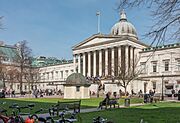
Wilkins Building and Main Quad
-
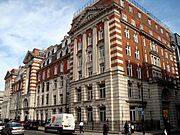
The Rockefeller Building on University Street, one of UCL's largest premises
-
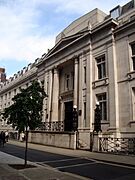
The Kathleen Lonsdale Building on Gower Place, home of UCL's department of earth sciences
-
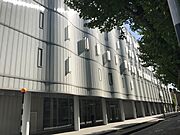
The Sainsbury Wellcome Centre for Neural Circuits and Behaviour building
.jpg)


UCL East: A New Campus

UCL has a second campus called UCL East. It is located at the Queen Elizabeth Olympic Park in Stratford, East London. The first buildings at UCL East opened in 2022 and 2023. These buildings offer teaching, research spaces, and student accommodation. More buildings are planned for the future. UCL also has a campus within Here East, which was once the Olympic park media center.
Where Students Live: UCL Accommodation
.jpg)
UCL owns 26 student halls, providing about 7,000 beds. The university guarantees a place for most first-year undergraduate students who apply on time. It also guarantees accommodation for some international postgraduate students. Students under 18 or those who have been in care also have guaranteed places.
One of UCL's student buildings, New Hall, received some criticism for its design when it opened in 2013. People felt its design wasn't the best for student living, highlighting the importance of good architecture. The UCL East campus also includes new student rooms.
UCL's Green Efforts: Protecting Our Planet
UCL is committed to being environmentally friendly. Its new Student Centre, opened in 2019, was designed to be very sustainable. It received a top environmental certification, placing it among the best buildings in the UK for sustainability.
In 2019, UCL launched a plan for a sustainable future. The Positive Climate initiative aims to reduce energy use and use only renewable energy by 2024. It also plans for all UCL buildings to be carbon neutral by 2024. The goal is to achieve net zero carbon emissions for UCL by 2030.
Another initiative, The Loop, promotes using resources wisely. UCL wants to reduce waste and increase recycling. The Wild Bloomsbury initiative aims to create more green spaces on campus to help nature thrive. UCL is recognized globally for its sustainability efforts.
How UCL is Run
Leaders and Decision-Makers
UCL has a clear structure for making decisions. The main groups are the council and the academic board. These groups help guide the university. There is also a University Management Committee that handles daily operations.
The most senior leader at UCL is the President and Provost. This person is in charge of academic and administrative matters. Michael Spence has been the President and Provost since January 2021.
Learning Areas: Faculties and Departments


UCL organizes its teaching and research into eleven main faculties. Each faculty has many schools, departments, and institutes. These cover a wide range of subjects, from arts and humanities to engineering and medical sciences.
| Faculty | Staff | Students | ||
|---|---|---|---|---|
| Undergraduates | Postgraduates | |||
| Taught | Research | |||
| Arts and Humanities | 620 | 2,684 | 943 | 226 |
| Bartlett (Built Environment) | 1,272 | 925 | 2,836 | 411 |
| Brain Sciences | 1,725 | 929 | 1,961 | 1,034 |
| Engineering Sciences | 667 | 4,373 | 2,791 | 1,122 |
| IOE (Education and Society) | 1,318 | 1,515 | 3,988 | 684 |
| Laws | 175 | 844 | 450 | 49 |
| Life Sciences | 964 | 2,632 | 1,084 | 592 |
| Mathematical and Physical Sciences | 1,135 | 3,927 | 929 | 680 |
| Medical Sciences | 1,321 | 2,356 | 1,287 | 430 |
| Population Health Sciences | 1,578 | 247 | 1,365 | 447 |
| Social and Historical Sciences | 1,101 | 4,130 | 2,054 | 488 |
How UCL is Funded
In the financial year ending July 31, 2024, UCL had a total income of over £2 billion. A large part of this came from research grants and student tuition fees. UCL also receives funding from government bodies and donations.
A report in 2022 showed that UCL helps the UK economy by about £10 billion each year. This is mainly through its research and spending. UCL also supports new businesses started by its graduates.
The Academic Year
The UCL academic year is divided into three terms. These are First Term (September to December), Second Term (January to March), and Third Term (April to June). There are also short breaks called reading weeks.
UCL's Look: Logo and Colours

UCL uses a special logo for its identity. The logo shows a stylized picture of the Wilkins Building's entrance and the letters "UCL". The design has changed a few times over the years. The current logo, introduced in 2026, uses dark and bright purple colors.
UCL's motto is in Latin: "Cuncti adsint meritaeque expectent praemia palmae". This means "Let all come who by merit deserve the most reward". This motto reflects UCL's focus on achievement and fairness. While UCL has an official logo, some student groups use a different badge. This badge isn't officially recognized in the world of heraldry (the study of coats of arms), but it's still used by many sports teams and clubs. UCL's traditional colors are purple and blue.
Working with Others: Partnerships

UCL is a member of the University of London. It was one of the first colleges to join this larger university in 1836. UCL is also a founding member of the Russell Group, which includes 24 leading research universities in Britain. It is considered part of the "golden triangle" of top research universities in southern England.
UCL works with many other universities and organizations around the world. These partnerships help with research and learning. For example, UCL is part of UCLPartners, a large health science center. It also works with the Francis Crick Institute, a major biomedical research center.

UCL also offers joint degrees with other universities. It sponsors the UCL Academy, a secondary school in London. This school opened in 2012 and was the first in the UK to have a university as its main sponsor.
What Students Learn and Discover
Amazing Discoveries: UCL's Research
_2014.jpg)
UCL is a very active research university. In 2023/24, it received over £538 million for research projects. This funding comes from research councils, charities, and other sources. UCL's research is highly rated. In a recent national assessment, 58% of its research was considered "world leading." This means it is among the best in the world.
Special Research Centers
UCL has many research centers that focus on specific topics. The London Centre for Nanotechnology studies tiny materials at the atomic level. UCL also has research centers that study important historical topics, like the history of slavery and its lasting effects. This helps us understand the past better. The Sainsbury Wellcome Centre for Neural Circuits and Behaviour studies how the brain works.
Sharing Knowledge and Ideas
UCL is good at turning new ideas into useful products and services. It has a company called UCL Business that helps researchers get patents and start new companies. This helps bring scientific discoveries to the public.
UCL also has its own publishing house, UCL Press. It was the first fully open access university press in the UK. This means many of its books and articles can be downloaded for free by anyone. As of December 2024, UCL Press had over 13 million downloads of its open access books.
UCL Libraries: A World of Books

UCL has 18 libraries across its campuses. Together, they hold over 2 million books. The largest is the UCL Main Library, which has collections on arts, humanities, and law. The UCL Science Library focuses on subjects like engineering and life sciences.

Other specialized libraries include the UCL Bartlett Library for architecture and the Newsam Library for education. Students can also use the large Senate House Library and the British Library, which are nearby.
Rare Books and Special Collections
UCL's Special Collections holds many historical and important works. It has over 150,000 rare books, some printed before 1500. It also has over 600 collections of old documents and manuscripts. These include first editions of famous books like Isaac Newton's Principia and Charles Darwin's On the Origin of Species.
UCL Museums: Treasures to Explore

UCL has several museums that are open to the public. They cover many different fields:
- Petrie Museum of Egyptian Archaeology: This museum has about 80,000 items from ancient Egypt. It shows the history of the Nile valley from prehistoric times to the Islamic period.
- UCL Art Museum: This collection includes works by many artists, especially women artists from the 1890s onwards.
- Grant Museum of Zoology and Comparative Anatomy: Started in 1827, this museum has about 68,000 animal specimens. It includes rare items like dodo bones and a quagga skeleton.
How UCL Ranks Among Universities
| National rankings | |
|---|---|
| Complete (2021) | 13 |
| Guardian (2021) | 10 |
| Times / Sunday Times (2021) | 9 |
| Global rankings | |
| ARWU (2020) | 14 |
| QS (2021) |
9 |
| THE (2021) | 22 |

UCL is consistently ranked as one of the top universities in the UK and worldwide. These rankings look at things like teaching quality, student experience, and research. UCL was named "University of the Year" in the Times/Sunday Times Good University Guide for 2024.
In subject-specific rankings, UCL is often in the top ten for many areas. For example, it has been ranked first for subjects like American studies, linguistics, and architecture. Graduates from UCL also tend to earn more five years after finishing their studies.
Globally, UCL is also highly regarded. It has been in the top 25 of major world rankings for many years. In the 2025 QS World University Rankings, UCL was ranked 9th in the world.
Joining UCL: How to Apply
|

In the 2024/25 academic year, UCL had over 46,000 students. This included many undergraduate and postgraduate students. UCL is known for having high entry standards. Students applying for law or medicine courses often need to take special tests. Some courses also require an interview.
Many international students choose to study at UCL. Since 2015, most applicants to UCL have been from outside the UK. Within the UK, many UCL students come from London and nearby regions.
Making UCL Accessible to Everyone
| Domicile and Ethnicity | Total | ||
|---|---|---|---|
| British White | 23% |
|
|
| British Ethnic Minorities | 25% |
|
|
| International EU | 5% |
|
|
| International Non-EU | 47% |
|
|
| Undergraduate Widening Participation Indicators | |||
| Female | 58% |
|
|
| Independent School | 16% |
|
|
| Low Participation Areas | 5% |
|
|
UCL has programs to help students from all backgrounds join the university. One program is called Access UCL. It offers lower entry requirements for eligible students. This includes students from disadvantaged areas or those who have been in care.
UCL also runs week-long Summer Schools for talented students from less privileged backgrounds. These programs help students explore London and learn more about university life. In 2023, UCL started a special foundation year for disadvantaged students interested in engineering. This helps them meet the entry requirements for degrees.
Life as a UCL Student
Students' Union: Your Voice and Activities

The Students' Union UCL was founded in 1893. It is one of the oldest student unions in England. The Union represents students' interests and offers many services. It is run by students who are elected by their peers.
The Union supports over 250 clubs and societies. These include sports clubs, media groups like Pi Magazine, and the Debating Society. Famous people like Christopher Nolan were once members of the Film Society.
Faith
UCL was founded to be a place where people of all faiths could study together. It has prayer rooms and silent meditation spaces for students. There are also student societies for most major religions.
Sport
The Students' Union runs over 70 sports clubs. These include cricket, rowing, running, and rugby. UCL teams compete against other universities in various sports.
UCL has good sports facilities. There is a fitness center on the main campus. It also has a large athletics ground in Shenley, Hertfordshire.
Mascot

UCL's mascot was Phineas MacLino, a wooden statue of a Scottish Highlander. It was first taken from a shop in 1900. Phineas became a symbol of student fun and rivalry. In 2019, the Students' Union decided to remove the mascot from its bar. This was due to its connections to historical issues.
Rivalry with King's College London

UCL has a long-standing, friendly rivalry with King's College London. Students from King's sometimes called UCL students "Godless Scum of Gower Street." This was because UCL welcomed students of all religions. UCL students, in turn, had their own nicknames for King's.
This rivalry often led to playful "rags" or pranks between the two universities. In 1922, King's students took Phineas, UCL's mascot. This led to a big student battle to get him back. Another time, King's mascot, Reggie the Lion, was captured by UCL students. These events were part of a fun, competitive spirit between the two schools.
Student Campaigns
UCL students have often been active in important causes. In 1956, they marched against Soviet actions in Hungary. In the 1960s, students campaigned for nuclear disarmament and against apartheid.
In 2010, students and staff protested to ensure all UCL staff were paid a fair living wage. Students also protested against plans to increase university fees. In 2016 and 2017, students organized "rent strikes" to protest high accommodation costs. These actions led to UCL providing rent cuts and bursaries for students.
In 2018, students started a climate action society. This group pushed the university to stop investing in fossil fuels. In 2024, students set up a protest camp on campus to express their views on world events. This followed similar protests at other universities.
UCL's Student Community
UCL student body 2021/22 UK undergrad (23.5%) Int undergrad (27.3%) UK taught postgrad (17.4%) Int taught postgrad (18.7%) UK research postgrad (7.5%) Int research postgrad (5.6%)
| Domicile and ethnicity | ||
|---|---|---|
| British – white | 25.6% |
|
| British – Asian | 12.8% |
|
| British – Black | 3.1% |
|
| British – mixed heritage | 3.7% |
|
| British – other/unknown | 3.2% |
|
| International – European Union | 9.4% |
|
| International – China | 23.0% |
|
| International – rest of Asia | 10.7% |
|
| International – rest of the world | 8.4% |
|
| Gender | ||
| Female | 60.8% |
|
| Male | 39.1% |
|
| Other | 0.1% |
|
| Age | ||
| 30 and over | 12.1% |
|
| 25–29 | 13.8% |
|
| 21–24 | 34.8% |
|
| 20 and under | 39.3% |
|
In the 2021/22 academic year, UCL had 46,830 students. It had the second-largest number of students in the UK. UCL also had the most international students of any UK university since 2014/15. Most students at UCL study full-time. The student body is diverse, with students from many different countries and backgrounds.
Diversity
UCL is committed to promoting equality and diversity. It has received awards like the institutional silver Athena SWAN award. This award recognizes efforts to support women in science and other fields. UCL also holds a bronze Race Equality Charter award. This shows its commitment to racial equality.
UCL was previously part of a scheme promoting LGBT+ equality. It decided not to rejoin this scheme in 2021. This decision caused some discussion among staff and students.
Notable People
Many influential people have been part of UCL. Francis Crick, who helped discover the structure of DNA, was an alumnus. Joseph Lister, a pioneer in using antiseptics in surgery, also studied here. Charles K. Kao, known as the "Godfather of broadband", is another famous alumnus.
Notable staff members include Otto Hahn, who pioneered nuclear chemistry. Peter Higgs, who proposed the Higgs mechanism, also worked at UCL. Sir William Ramsay discovered all the naturally occurring noble gases while at UCL.
As of 2025, 33 Nobel Prize winners and three Fields Medal recipients have been connected to UCL. These include both former students and academic staff.


.jpg)


In earlier times, many well-known people attended lectures at UCL. These included Mahatma Gandhi and John Stuart Mill. Later, Jomo Kenyatta, the "Founding Father" of Kenya, also took courses at UCL.
See also
 In Spanish: University College de Londres para niños
- List of universities in the UK
