
Willson Group facts for kids
| Years active | 1860–1906 |
|---|---|
| Country | England |
| Major figures | John Joseph Willson Emilie Dorothy Hilliard Willson Michael Anthony Hilliard Willson Margaret Willson Emilie Dorothy Willson Mary A. Hilliard Willson |
| Influences | English art |
| Influenced | Instrumental to the foundation of Leeds Art Gallery |
The Willson Group was a family of artists from England who were active from around 1860 to 1906. They were Quakers, a Christian group known for their simple lifestyle. This family included about seven painters who created landscapes, portraits, and funny drawings called caricatures. Key members were John Joseph Willson, his sister Hannah Willson, his wife Emilie Dorothy Hilliard, and their four children: Michael Anthony Hilliard Willson, the twins Margaret Willson and E. Dorothy Willson, and Mary Hilliard Willson.
John Joseph, often called J.J. Willson, was a main leader in his family's business, Willson, Walker & Co. This company owned a large tannery (a place where animal hides are turned into leather) in Sheepscar. J.J. Willson was very important in helping to create the Leeds Art Gallery. He worked with other artists like John Atkinson Grimshaw on a special committee. He also became a vice president of the Yorkshire Union of Artists.
J.J., Margaret, and Dorothy showed their art at the famous Royal Academy Summer Exhibition. Margaret's work was shown there five times! Michael and Mary received special requests (commissions) to create art. This included caricatures of important people in Leeds, like Sir James Kitson and John Barran MP. They also painted oil portraits of Isaac and Ann Rickett and George Corson. The children and J.J.'s sister never married.
Contents
The Willson Family and Their Art Business
Family Home and History
The Willson family owned a house called High Wray House in Claife, near Ambleside. This house, built in 1728, is now a listed building (meaning it's protected for its history). The family owned a lot of land in the Hawkshead, Coniston, and Langdale valleys. They added an upper floor to the house in the 1800s. In the early 1840s, the family even paid for a schoolhouse on their property. This school building later became the High Wray Village Hall.
Willson, Walker & Co. Business

The Willson Group artists were able to focus on their art because their family business, Willson, Walker & Co., provided money. This business was very successful thanks to John Willson Senior. He was a JP (a local judge) and lived in Barwick-in-Elmet and Roundhay, Leeds. His wife was Margaret. John Senior was even the mayor of Leeds from 1853 to 1854.
John Senior started the family's tannery business in 1823. It moved to Sheepscar Street in 1847. The company made Spanish leather and leather glue. They also created leather items, like a leather dressing case that might have been made for the Great Exhibition of 1851. By 1893, it was the biggest tannery in England! The business closed in 1901. However, the money from J.J. Willson's leadership in this company likely allowed his family to dedicate themselves to art until around 1900. Another company bought the factory in 1904 and still makes leather goods there today.
Where the Artists Lived and Worked
.JPG)
All the artists in the Willson Group worked from their home. The group included J.J. Willson, his wife, their son, three daughters, and J.J.'s unmarried sister Hannah. They all lived together in different places around Leeds.
From about 1863 to 1871, they lived in Newton Grove, Headingley. From at least 1888 to 1891, they lived with several servants at 2 Moorland Terrace in the Lawnswood area. From about 1897 to 1902, the family lived in a house called Ballamona in Headingley. They rented this house from architect George Corson. By 1906, the four children, still unmarried, were living at 5 Moorland Road, Leeds, with their aunt Hannah Willson.
Hannah Willson
Hannah Willson (born around 1829 in Leeds – died July 7, 1918, in Leeds) was an artist who had her own money from investments. She was J.J.'s unmarried sister and the aunt of Michael, Margaret, Emilie, and Mary Willson. Hannah lived in High Wray, Claife, until before 1890, when she moved to Leeds to live with her brother's family. She passed away at age 89.
Hannah's Art Exhibitions
- Small Cottage at Bewdley (1890): This was described as "an excellent little picture" shown at the Leeds Fine Arts Club.
John Joseph Willson
John Joseph Willson (born around 1837 in Leeds – died November 15, 1903, in High Wray), known as J.J., was the only son of John Willson Senior. Like his father, he was a Quaker. He took over his father's leather business and became its main leader. He was also a talented amateur artist, especially good at painting with watercolors. He focused on sports and landscapes.
Artists Edwin Moore and Richard Waller gave him some lessons, but he mostly taught himself. He showed his art at the Royal Academy of Arts and the Walker Art Gallery. In 1896, he became a vice-president of the Yorkshire Union of Artists. He also helped judge art prizes at the Leeds School of Art and donated prizes for art to other groups. J.J. was a long-time member of the Leeds Philosophical Society and a governor of Yorkshire College. Even when he was ill, he continued to paint.
Sadly, the family business failed, and J.J. became sick. He died at his sister's house in High Wray, Ambleside, at age 67.
Helping to Create Leeds Art Gallery

John Joseph was the person who first thought of having modern art exhibitions in Leeds. He was one of the founding members and, for 27 years, the president of the Leeds Fine Art Society (LFAS). He also served as honorary secretary of the Yorkshire Fine Art Exhibition (YFAE). After he died, the Yorkshire Post and Leeds Intelligencer newspaper praised his work with the LFAS:
"As president of the Leeds Fine Arts Club, John Joseph Willson's artistic and social qualities were seen to the fullest advantage. ... he was, by the example of his work and by his cheery enthusiasm, the life and soul of the little body."
In 1876, the LFAS formed a special committee, including J.J. Willson, to raise money and build a permanent public art gallery. Even though the committee members changed, and the Leeds Town Hall eventually took over the building and funding, it was this original committee that started the idea. They raised a lot of the early money through donations. Several original members, including J.J. Willson, stayed involved until the very end. The committee first met at the Mechanics' Institute. Important members included the Marquis of Ripon and architect William Henry Thorp, who would design the Municipal Art Gallery in 1886–1888.
.JPG)
By 1879, the committee was meeting at the Mayor's rooms in Leeds Town Hall. The committee, which always included Town Hall representatives, grew to include more town councillors, J.J. Willson, and other artists. They estimated the gallery would cost £10,000 and had already raised £2,000. By 1888, the Leeds Town Hall had taken charge, raising the rest of the money and taking credit for the idea. The gallery opened in 1888.
Meanwhile, from 1880, the YFAE held art exhibitions in the Athenaeum Building in Leeds. J.J. showed his work at the first Spring Exhibition in 1880, alongside famous artists like Thomas Sidney Cooper and John Atkinson Grimshaw. J.J. used his position to promote the idea of a new "good gallery" for Leeds. He believed Leeds needed a proper place to display art and help local artists sell their work.
J.J.'s Amateur Acting
John Joseph also enjoyed amateur dramatics (acting in plays for fun, not as a job). For example, in 1889, he performed in plays to support a charity. Reviewers said he gave "a capital rendering" of his parts, acting "with care and discretion." He was also praised for being "capital as Marmaduke Vavasour" in another charity performance in 1890.
J.J.'s Art Exhibitions
- Autumn tints in Lundoleu, Norway (1880): Shown at the Yorkshire Art Exhibition.
- Anxious Moments (1880): Described as showing "a stormy effect."
- The Breezy Expanse of Adel Moor (1885): Called "most important and gratifying."
- A Study of Gossamer (1890): Exhibited as president of Leeds Fine Arts Club. This painting, made years ago in Scotland, showed a "misty morn, with fairy wreaths bedecked."
- Home in the Gloaming (1899): Described as "one of the strongest drawings Mr J.J. Willson has ever shown."
- The Last Gleam, 1191 (1900): A watercolor shown at the Royal Academy Summer Exhibition.
J.J.'s Artworks
- Set of pen and ink sketches of the Society of Friends annual meeting at Devonshire House, London (1860): These were bound into a small booklet.
- The Pot Hawker (1878): A watercolor painting.
- Peasant woman seated at the edge of the forest, (undated): Another watercolor.
J.J.'s obituary in 1903 mentioned that one of his works was bought by the Leeds Municipal Art Gallery. As of 2019, the gallery listed his watercolor Arundel Castle from the Meadows, but it couldn't be found.
-
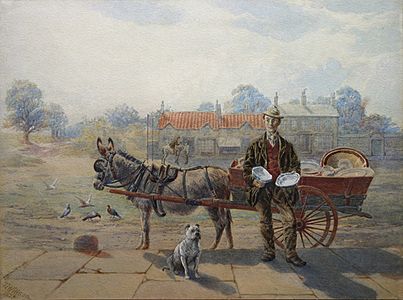
The Pot Hawker, 1878
-
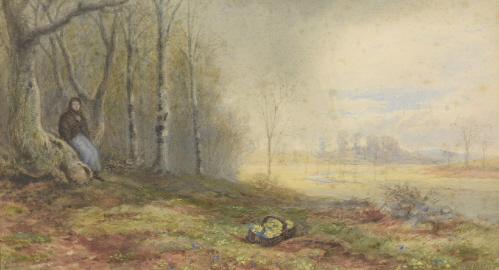
Peasant seated at the edge of the forest, undated
-
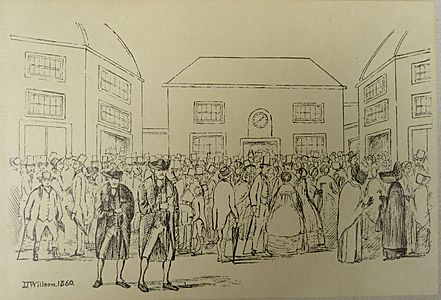
The Meeting House yard, Devonshire House, 1860
-
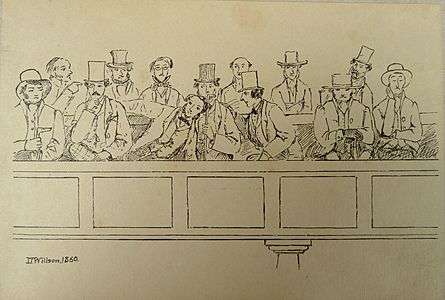
The Men's Side, 1860
-
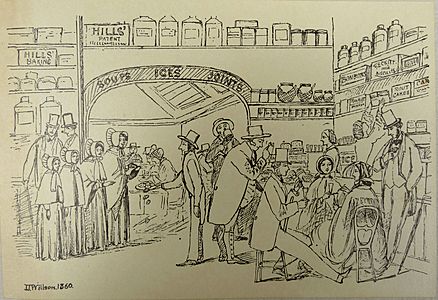
Hills the confectioner's, 1860
-
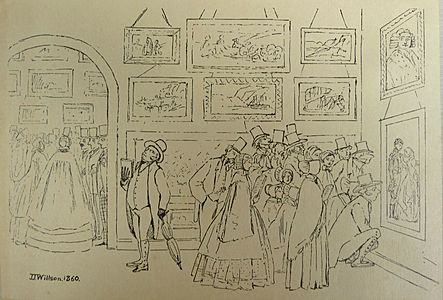
Royal Academy, 1860


Emilie Dorothy Hilliard Willson
Emilie Dorothy Hilliard Willson (born around 1838 in New York – died January 18, 1899, in Leeds) was the daughter of architect John Hilliard. She was the American-born wife of John Joseph Willson. They married in Scarborough in 1861. Emilie was also an artist who exhibited her work. She died at age 60 from illnesses like influenza and heart failure.
Michael Anthony Hilliard Willson
Michael Anthony Hilliard Willson (born April 13, 1863, in Kirkstall – died December 27, 1943, in Ulverston) was a landscape artist and the oldest son of John Joseph Willson. Michael studied at the Leeds College of Art around 1900. He also had his own collection of artworks, some of which were sold at Sotheby's in 1918. Michael passed away at age 79.
Michael's Art Exhibitions
- Our Public Servants (1890): Described as "very clever character sketches" shown at the Leeds Fine Arts Club. These were later published.
- Blue Bow (1899): Shown at the Leeds Public Gallery.
- Mirror frame and panel (1901): Exhibited at the Arts and Crafts exhibition at Leeds City Art Gallery.
Michael's Artworks
- Ruins with Man and Dog (1884): A pencil drawing.
- Our Public Servants (1891): A set of twelve caricatures signed "Bob." These were watercolor portraits published as prints, showing important men from Leeds. The original watercolors are kept in the Leeds Museums and Galleries archives.
- Portrait of George Corson (1901): An oil painting of Leeds architect George Corson. This portrait was commissioned by the Leeds and Yorkshire Architectural Society.
- Isaac Reckitt and Ann Reckitt (1906): A pair of oil portraits.
-
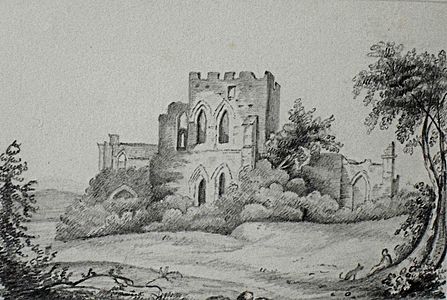
Ruins with man and dog, 1884
-
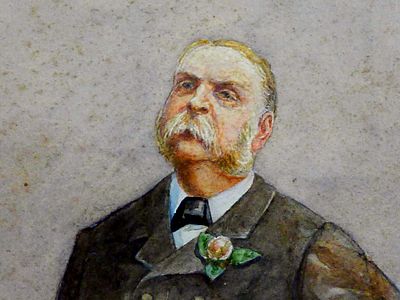
James Kitson, 1891
-
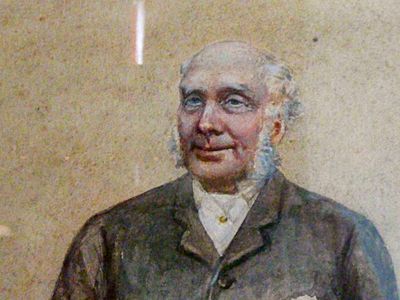
John Barran, 1891
-
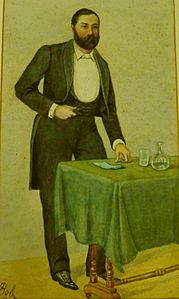
Arthur Lawson, 1891
-
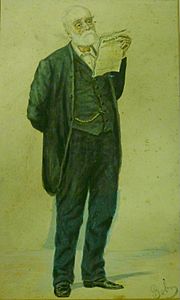
George Tatham, 1891
-
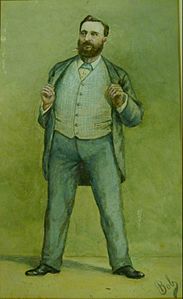
John Shackleton Mathers, 1891
-
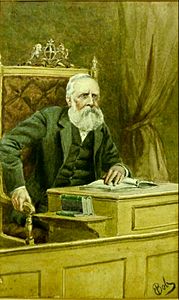
William Bruce, 1891
-
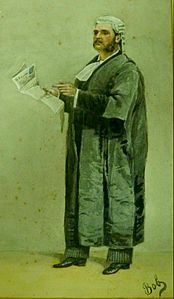
George Morrison, 1891
-
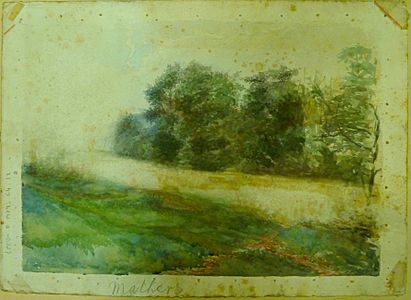
Landscape on reverse of the J.S. Mathers painting
-
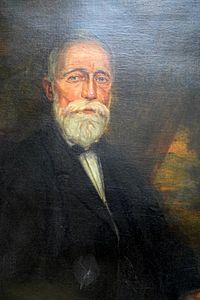
George Corson, 1901
-
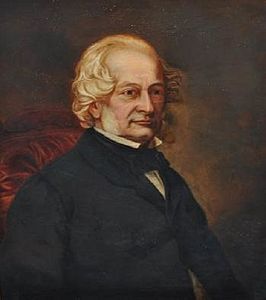
Isaac Reckitt, 1906
-
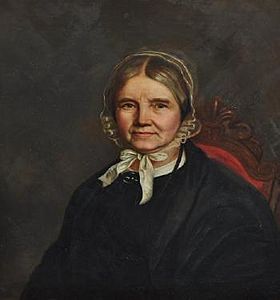
Ann Reckitt, 1906
.jpg)
.JPG)
.JPG)
.jpg)
.jpg)
.jpg)
.jpg)
.jpg)
.JPG)
.JPG)


Margaret Willson
Margaret Willson (born August 16, 1867, in Kirkstall – died March 8, 1932, in Ulverston) was the twin sister of Emilie Dorothy Willson. Margaret was John Joseph Willson's daughter. She was a decorative designer and painter who worked in Leeds. Between 1888 and 1906, Margaret showed her art at the Royal Academy of Arts. She died at age 63.
Margaret's Exhibitions
- Hydrangeas (1888): An oil painting shown at the Royal Academy Summer Exhibition.
- Study of White Orchids (1889): Another oil painting at the Royal Academy.
- Cragg Hall and Fewston Reservoir, near Blubberhouses, Yorkshire (1897): A watercolour at the Royal Academy.
- Portrait of a Lady (1902): A watercolor at the Royal Academy.
- A relic of the Past (1906): A watercolor at the Royal Academy.
- Painted silk fan with pearl mount (1906): Shown at the Arts and Crafts Exhibition Society's show.
- A Socialist (1890): Described as a "cleverly executed study" of a man.
- Two watercolour portraits, including one of William Harvey (1905): Shown at the Leeds Exhibition.
Emilie Dorothy Willson
Margaret's twin, Emilie Dorothy Willson (born August 16, 1867, in Kirkstall – died October 10, 1918, in York), was an artist who exhibited at the Royal Academy of Arts and the Walker Art Gallery in Liverpool. She likely used "Dorothy" to avoid confusion with her mother. She died at age 51 from double pneumonia.
Dorothy's Exhibitions
- A Study of Clematis (1890): Described as a "charming picture" at the Leeds Fine Arts Club.
- A Dewy Morning (1900): A watercolor shown at the Royal Academy Summer Exhibition.
Mary Hilliard Willson
Mary Hilliard Willson (born March 22, 1871, in Leeds – died May 30, 1928, in Hill of Oaks) was the youngest member of the Willson Group and John Joseph Willson's daughter. She attended the Leeds College of Art in 1900. In 1901, she won a National Queen's Prize for art, placing fifth in the United Kingdom. She was described as a "designer and art applied worker" in 1911. Mary painted landscapes and oil portraits. She died at age 54.
Mary's Exhibitions
Mary showed her art at various places from at least 1882, including the Yorkshire Union of Artists exhibitions.
- Drawing (1882): Won third prize at the Stockton Fine Art and Industrial Exhibition.
- Lane near Meanwood (1885): Described as "richly coloured" and "effective."
- Kirkstall Abbey (1885): A "dainty watercolour."
- Mirror frame (1900): Shown at Leeds City Art Gallery in the Arts and Crafts department.
