
Zhang Guohua facts for kids
Quick facts for kids
Zhang Guohua
|
|
|---|---|
|
张国华
|
|

Zhang Guohua in 1955
|
|
| Communist Party Secretary of the Tibet Autonomous Region | |
| In office 24 January 1950 – February 1952 |
|
| Preceded by | None (Post Created) |
| Succeeded by | Zhang Jingwu |
| In office 1965–1967 |
|
| Preceded by | Zhang Jingwu |
| Succeeded by | Zeng Yongya |
| Governor of Sichuan | |
| In office 1968–1972 |
|
| Preceded by | Li Dazhang |
| Succeeded by | Liu Xingyuan |
| Commander of Chengdu Military Region | |
| In office 1952–1965 |
|
| Personal details | |
| Born | October 22, 1914 Yongxin County, Jiangxi, Republic of China |
| Died | February 21, 1972 (aged 57) Chengdu, Sichuan, China |
| Political party | Communist Party of China |
| Military service | |
| Allegiance |  People's Republic of China People's Republic of China |
| Branch/service |  People's Liberation Army Ground Force People's Liberation Army Ground Force |
| Years of service | 1931–1972 |
| Rank |  Lieutenant General Lieutenant General |
| Commands | Field commander during Sino-Indian War |
| Battles/wars | Long March, 2nd Sino-Japanese War, Chinese Civil War, Invasion of Tibet, Sino-Indian War |
Zhang Guohua (simplified Chinese: 张国华; traditional Chinese: 張國華; pinyin: Zhāng Guóhuá; Wade–Giles: Chang Kuo-hua; October 22, 1914 – February 21, 1972) was an important Chinese military leader and politician. He was a lieutenant general in the People's Liberation Army (PLA). He played a big role in events like the Chinese invasion of Tibet and the war with India. He also served as a top leader for the Communist Party of China in the Tibet area.
Contents
Early Life and Joining the Party
Zhang Guohua was born in Yongxin County, a place in Jiangxi province, in 1914. When he was 17 years old, in 1931, he joined the Communist Party of China. This was a very important step in his life and career.
Military Career and Leadership

Leading the Tibet Campaign

In 1950, Zhang Guohua was a commander in the People's Liberation Army. He led the main forces during the Qamdo campaign against Tibetan troops. He was chosen for this role because he understood Tibetan culture. Mao Zedong, China's leader, wanted the army to respect local religions and customs. Zhang Guohua supported the Dalai Lama, who is the spiritual leader of Tibetan Buddhism. After their victory, he chose not to march his troops into the city.
Zhang Guohua became the Secretary of the Communist Party Committee in Tibet from 1950 to 1952. Later, he also led the Tibet Work Committee. This group was in charge of talking about the Seventeen Point Agreement for the Peaceful Liberation of Tibet. This agreement was about how Tibet would become part of China. Zhang Guohua returned to his role as secretary from 1965 to 1967.
Role in the Sino-Indian War
In 1962, Zhang Guohua attended a meeting of military leaders. They discussed the situation with India. India had occupied some land that China also claimed. The leaders felt that peaceful talks were not working.
On October 18, 1962, Zhang Guohua was at a big meeting where the decision was made to go to war with India. This war was called the Sino-Indian War. Zhang Guohua was the main field commander for the People's Liberation Army during this conflict. He helped reassure Mao Zedong about the plan for the war.
During the Cultural Revolution
In February 1967, the Cultural Revolution began in China. During this time, groups called Red Guards tried to remove Zhang Guohua from his position as governor in Lhasa, Tibet. He used military vehicles to stop them. After this, he moved to Sichuan province. He then served as the governor of Sichuan from 1968 until 1972.
Zhang Guohua passed away on February 21, 1972.
Images for kids
-
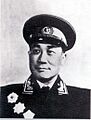
Zhang Guohua in 1955
